
Should you try to beat the market?
Or is there an easier way to make money when investing?
These questions are at the heart of the debate between passive investing and active investing.
This article explores why, for retail clients, passive investing might just be the easier way to grow your wealth when investing, especially when one considers costs, consistency, historical performance, time commitment, risk, and diversification.
What’s the Difference between Passive Investing and Active Investing?
Active investing means trying to "beat the market" via trading investments that you think will outperform the market.
With active trading you either invest your time in learning all about investing to make trades or you pay an advisor to do it on your behalf. The goal is to get higher returns than the overall market.
Passive investing takes a simpler road. You don't try to beat the market - you join it! You invest in a diversified portfolio of assets to track the performance of a market index or a specific asset class (like stocks and shares). The idea is that when the market goes up, your funds go up too.
The Case for Passive Investing
1. Lower Costs
One of the most compelling arguments in favor of passive investing is the significantly lower costs associated with it.
With passive investing, there’s no active management required which means that they come with substantially lower fees and expenses compared to actively managed funds.
Conversely, active investing typically comes with higher fees. Active investors constantly buy and sell assets, trying to "beat the market," which leads to higher transaction costs and higher management fees as you’re paying for the manager’s expertise.
This is backed up by the data. Morningstar’s research has found that only 13% of active funds have an annual fee of less than 0.5%, compared to 90% of passive funds1.
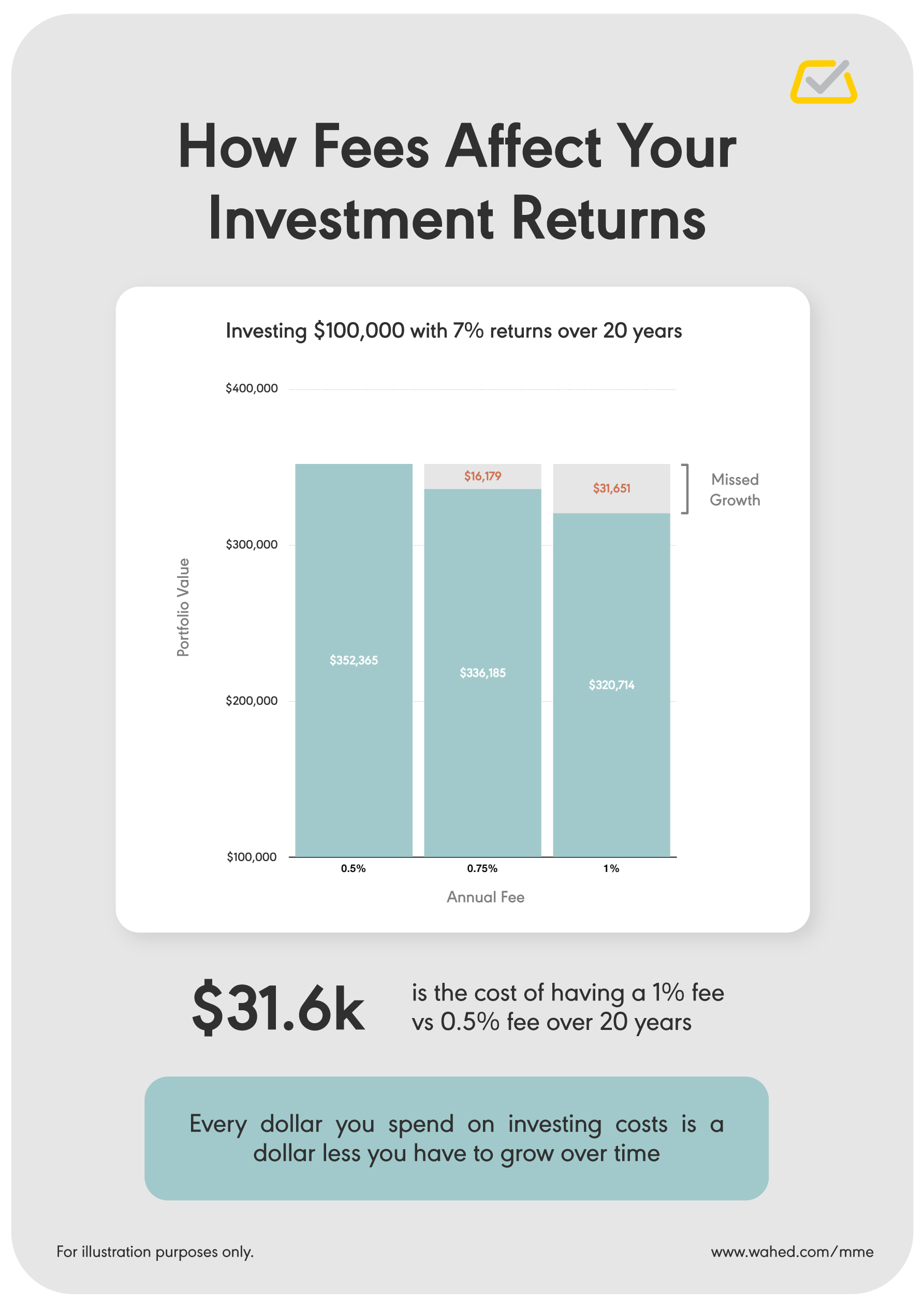
Every dollar you spend on investing costs is a dollar less you have to grow over time. Over the long term, even seemingly small fees can substantially erode returns due to the power of compound returns.
To see this visualised, we’ve created the below infographic to show the impact of fees on your investment. As you can see, high fees can be costly to your investment returns!
2. Consistency in Performance
Passive investments aim to mimic the performance of a given market index or asset class. This approach offers a level of predictability that is often absent in active investing, where fund managers attempt to outperform the market through stock selection, timing, and other strategies.
With that said, it’s important to bear in mind that past performance is no guarantee of future results. This point is just here to illustrate that with passive investing, there is a track record that has been evidenced over time.
Historically, many actively managed funds have struggled to consistently beat their benchmarks. In fact, numerous studies have shown that a significant majority of active funds underperform their respective market indices over extended periods.
For example, the SPIVA scorecard is a widely cited report that tracks the performance of actively managed funds against their benchmark S&P indexes. In their mid-year 2023 scorecard, they found that over last the 15 years, 92% of large-cap equity funds in the US underperformed against the S&P 500.
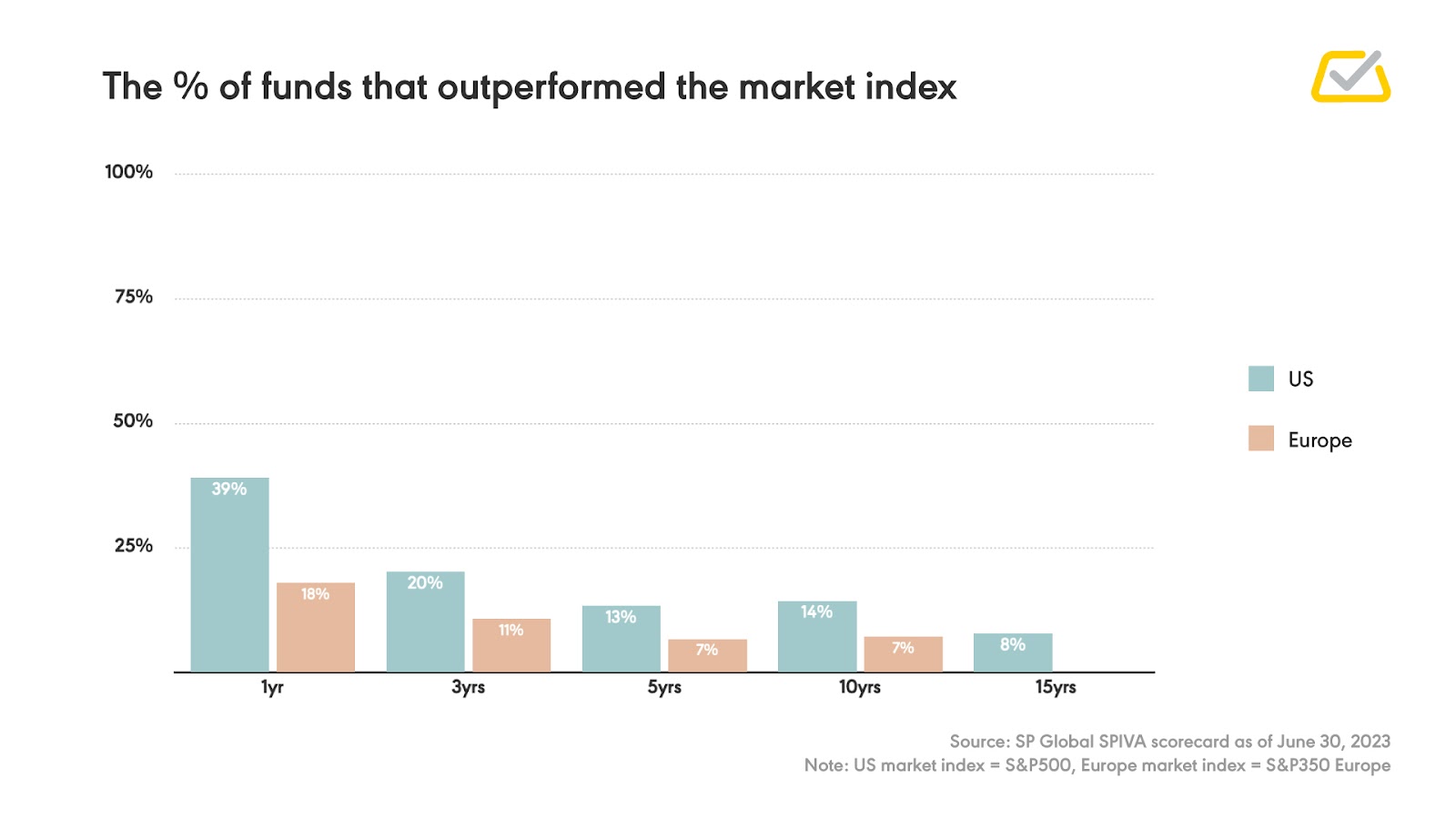
The SPIVA scorecard provides compelling evidence that even professional fund managers have difficulties consistently picking stocks that outperform broad market indexes over the long run. As you can see from the chart, the success rate falls over time.
Passive investors, on the other hand, can reasonably expect to achieve results that closely mirror the overall market's performance. By avoiding the difficulties of stock-picking, passive indexed approaches offer a reliable path to grow wealth over long time periods based on historical data.
3. Historical Performance
Passive investment strategies, such as those tracking major market indices like the S&P 500 or the FTSE Shariah USA Index, have consistently shown competitive performance over the long term. These indices reflect the overall growth and health of the economy and typically appreciate in value over time.
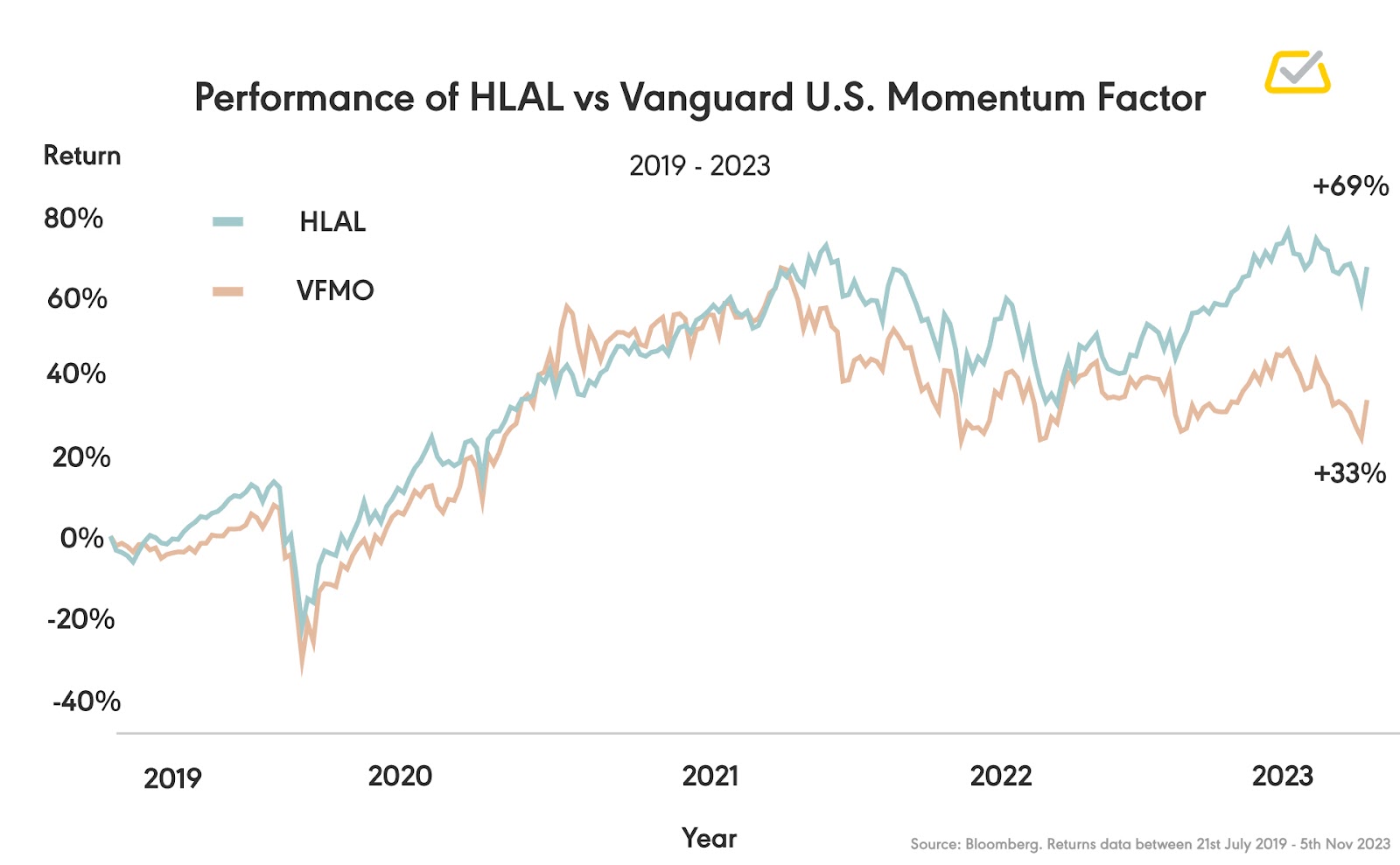
For instance, HLAL which is a passive ETF that tracks the FTSE Shariah USA Index, and represents a diversified basket of over 200 shariah-compliant large-cap U.S. stocks, has shown remarkable growth since its inception in 2019.
As we mentioned before, passive indexes often outperform active strategies. Let’s compare HLAL to VFMO. VFMO which stands for Vanguard U.S. Momentum Factor ETF is an active ETF by Vanguard, one of the world's largest investment companies with $7.7 trillion in global assets under management. VFMO invests in US stocks with strong recent performance and aims to beat the market.
As you can see from the below chart, HLAL has outperformed VFMO since inception returning over double the returns (+69% vs +33%). To bring this point home, if you invested $100k with both ETFs during this period, with HLAL, your $100k would have grown to $169k whereas with VFMO, it would have grown to $133k. This is a great example of how a passive ETF like HLAL can outperform active ETFs.
While there are periods of market volatility and downturns, history has demonstrated that over extended timeframes, these indices tend to recover and trend upward. Passive investors benefit from this historical performance without trying to outguess the market's short-term movements.
4. Reduced Stress and Time Commitment
Active investing can be a demanding and stressful endeavor. It requires continuous monitoring of the markets, in-depth research, and rapid decision-making. The pressure to make profitable trades can lead to emotional stress and anxiety.
Given that investing is a long-term pursuit, it can take years before an active investor has enough data to conclusively determine whether their active trading strategy has paid off. Not only do you invest a lot of up-front time researching opportunities and constructing your portfolio, you have to dedicate considerable time each year to review your portfolio and look at new opportunities.
In contrast, passive investors adopt a more relaxed approach. They commit to a long-term perspective, which often requires minimal intervention and oversight. This hands-off approach can be particularly appealing to individuals who have busy lives, careers, or other commitments, as it allows them to build wealth without constantly being tied to maintaining their investment portfolio.
5. Risk Reduction through Diversification
Diversification is a core principle of passive investing. By holding a broad range of assets within a passive portfolio, investors can significantly reduce their exposure to individual company risk.
This strategy guards against the possibility of a single investment or asset performing poorly and dragging down the entire portfolio.
Compare our passive fund range
Key Considerations
While passive investing has many advantages, it's not without its considerations and potential drawbacks:
- Market Risk: Passive investors are exposed to market fluctuations, and they must be prepared for the occasional bear market or downturn. A long-term perspective is crucial to weather such storms.
- Lack of Flexibility: Passive investors have limited control over their investments because they are committed to mirroring a specific index. They can't make quick adjustments to capitalize on emerging trends or opportunities.
However, passive investing advocates would argue that this is the point of passive investing anyhow. The idea is to pick a long-term strategy and stick with it instead of trying to catch the next big thing. - Limits your growth as an investor: When you are actively engaged in researching companies, evaluating financials, tracking markets, and deciding when to buy and sell stocks yourself, you build critical knowledge about investing.
However, the rationale behind passive investing is often either 1) recognizing you don’t have the time or interest to effectively learn how to research and analyze stocks in-depth or 2) acknowledging that developing stock-picking skills that reliably beat the market is very difficult, even for professionals.
How Can You Start Investing Passively?
As we’ve seen, passive investing is a low-effort and low-cost way to grow your wealth.
Of course, for Muslim passive investors, you want to ensure that you only invest in shariah-compliant investments. That’s where we come in.
Wahed allows Muslims to invest their money in a diversified, low-cost and most importantly shariah-compliant way. We do this by investing your money into different investments that are matched to you, and that you feel comfortable with. Just choose your desired risk level and we’ll handle the rest.
Wahed has already helped 300,000 Muslims across the world to grow their wealth in a way that is in line with their faith and values.
Start investing passively
[1] https://www.morningstar.co.uk/uk/news/215822/a-closer-look-at-uk-fund-costs.aspx
*The term 'Halal' denotes that it is permitted and follows Islamic law