





Key Takeaways:
If you're a Muslim professional in the U.S., you've probably wondered whether contributing to an IRA conflicts with your faith. The question is more common than you might think - and the answer is more nuanced than a simple yes or no.
The short version: an IRA itself is not haram. What matters is what you put inside it.
This guide breaks down how Individual Retirement Accounts work, what Islamic finance principles say about them, and how U.S. Muslims can use IRAs to build real, long-term retirement wealth - without compromising on Shariah compliance.
What Is an IRA?
IRAs are not employer-tied. You open one yourself through a financial institution, and you control what you invest in. That flexibility is precisely what makes them relevant for halal investing.
Key IRA basics:
- 2026 contribution limit¹: $7,500 per year ($8,600 if you're 50 or older, including a $1,100 catch-up contribution)
- Investment options: Stocks, ETFs, bonds, mutual funds — and critically, you choose which ones
- Purpose: Long-term, tax-sheltered wealth accumulation for retirement
The tax advantages are significant. Depending on the IRA type, your money grows either tax-deferred or completely tax-free, meaning compound growth is not eroded year-on-year by capital gains or dividend taxes.
Types of IRAs
Traditional IRA
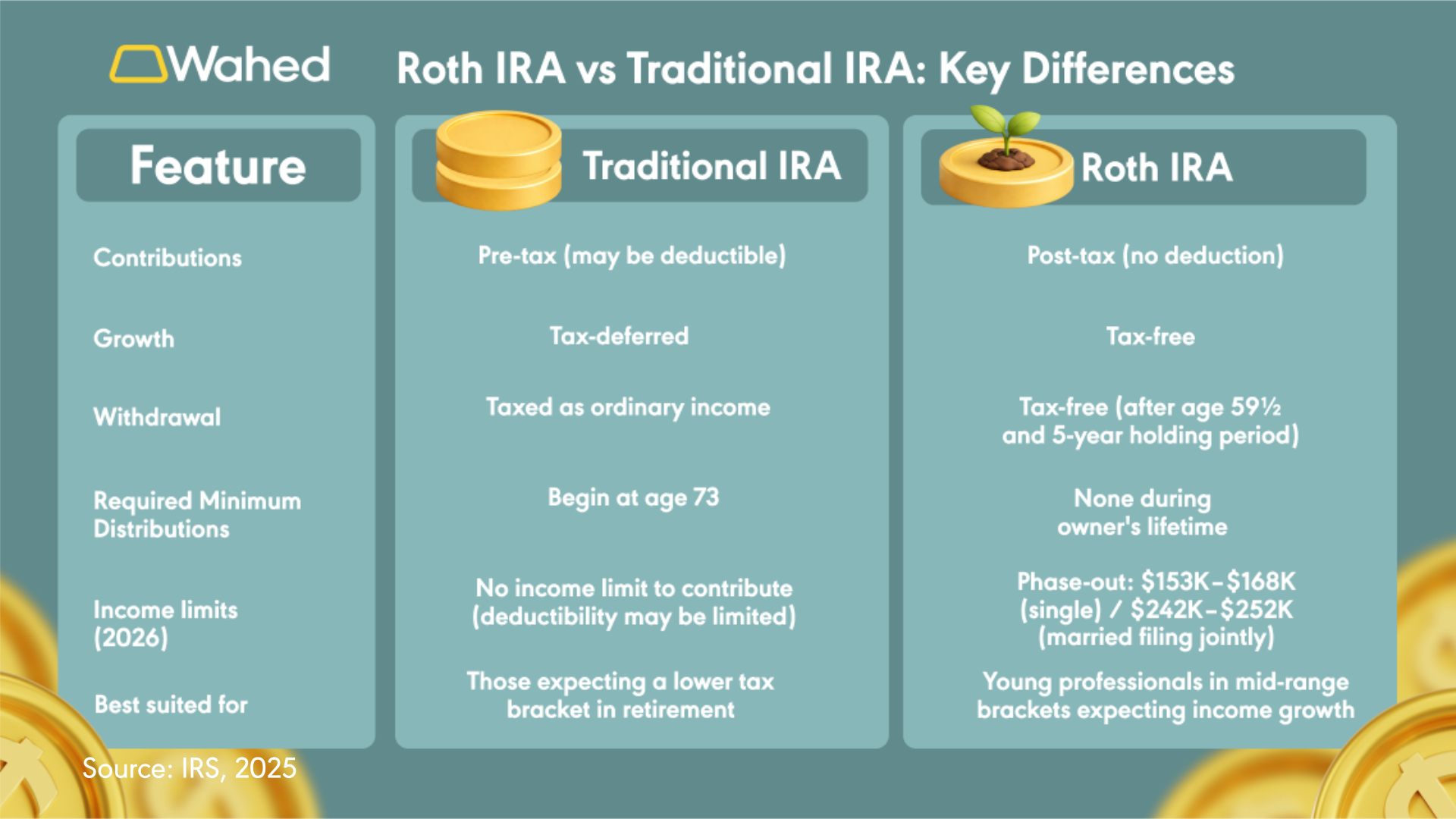
With a Traditional IRA, your contributions may be tax-deductible in the year you make them — reducing your taxable income today. The trade-off: you pay income tax when you withdraw the money in retirement.
- Contributions: Pre-tax (deductibility depends on income and whether you have a workplace retirement plan)
- Growth: Tax-deferred
- Withdrawals: Taxed as ordinary income
- Required Minimum Distributions (RMDs): Begin at age 73
This structure suits someone who expects to be in a lower tax bracket in retirement than they are today.
Roth IRA
A Roth IRA flips the model. You contribute money that has already been taxed, and in exchange, your withdrawals in retirement are completely tax-free - including all the growth.
- Contributions: Post-tax
- Growth: Tax-free
- Withdrawals: Tax-free (after age 59½ and 5-year holding period)
- RMDs: None during the owner's lifetime
- Income limits apply: In 2026, the phase-out range is $153,000–$168,000¹ for single filers and $242,000–$252,000 for married filing jointly¹
For most young Muslim professionals - those currently in mid-range tax brackets who expect income to grow - the Roth IRA is often the more advantageous long-term vehicle, since decades of halal equity growth comes out entirely tax-free.
Is an IRA Halal in Islam?
The account structure itself is neutral from a Shariah perspective. An IRA is simply a legal wrapper - a container that holds investments. The U.S. government does not dictate what you invest in. You do.
What determines whether your IRA is halal or haram is the nature of the underlying investments held within it.
This is a well-established principle in Islamic finance. The permissibility of a financial instrument is assessed based on:
- Avoidance of Riba (interest): Any investment that generates returns through interest - such as conventional bonds, savings certificates, or interest-bearing money market funds - is prohibited.
- Avoidance of haram industries: Investments in businesses whose primary activity is impermissible under Shariah - alcohol, tobacco, weapons, adult entertainment, conventional banking, gambling - are not permitted.
- Business activity screening: Even in permissible industries, companies with excessive debt ratios or revenue from haram sources may fail Shariah screening.
The good news: none of these restrictions are unique to IRAs. They apply to any investment account. And because IRAs give you full control over what you invest in, they are entirely compatible with halal investing - when managed correctly.
When an IRA Becomes Haram
Understanding where the line is helps you invest with confidence. An IRA becomes problematic under Shariah when it holds:
Interest-bearing bonds: Government bonds, corporate bonds, and bond funds generate returns through interest payments (coupon payments). These are the most common Riba-generating instruments in retirement portfolios and should be avoided entirely. The widespread advice to "add bonds as you age" is one that Muslim investors need to approach differently.
Conventional banking stocks: Banks that operate on interest-based models - which includes most major U.S. banks, are not Shariah-compliant.
Gambling and alcohol companies: Any company whose core business involves gambling (MGM, DraftKings), alcohol production or distribution, tobacco, or adult entertainment falls outside permissible investment.
Conventional insurance companies: Traditional insurance structures involve elements of gharar (excessive uncertainty) and riba, making most insurance company stocks non-compliant.
Shariah Screening: How It Works
Shariah screening is the process by which Islamic finance scholars and institutions assess whether a stock or fund meets Islamic finance standards. It mainly operates on two levels:
- Sector screening: Eliminates companies in prohibited industries outright
- Financial ratio screening: Evaluates debt-to-asset ratios, interest income as a percentage of total revenue, and receivables ratios - ensuring the company's financial structure doesn't rely heavily on interest-based mechanisms
Reputable halal investment platforms apply these screens systematically, removing the burden of manual research from individual investors.
%20Explore%20Wahed%27s%20Halal%20Portfolios%20.webp)
How Muslims Can Invest in an IRA
1. Shariah-Compliant ETFs
A Shariah-compliant ETF (Exchange-Traded Fund) is a diversified basket of stocks that has been pre-screened to exclude non-halal companies. These trade on public exchanges just like conventional ETFs, and they provide broad market exposure without requiring you to vet individual stocks.
Examples include halal equity funds that track global or U.S. equity markets after filtering for Shariah compliance. They offer the simplicity of passive investing while maintaining faith alignment.
The key advantage: instant diversification with ongoing compliance monitoring, typically overseen by a Shariah advisory board that reviews the fund's holdings regularly.
%20Learn%20more%20about%20Wahed%E2%80%99s%20Halal%20ETFs.webp)
2. Individual Halal Stocks
If you prefer more direct control, you can build a portfolio of individually selected Shariah-compliant stocks inside your IRA. This means identifying companies that pass both sector and financial ratio screens - typically technology, healthcare, consumer goods, and industrial companies with low debt and negligible interest income.
This approach requires more research and active management, but some investors prefer the transparency of knowing exactly what they own.
Platforms exist that provide pre-built Shariah stock screeners, simplifying the selection process considerably.
3. Halal Managed Portfolios
A halal managed portfolio - sometimes called a robo-halal portfolio is a professionally constructed and managed investment portfolio that is screened for Shariah compliance from the ground up. You specify your investment objective, risk tolerance and retirement horizon, and a Shariah-compliant allocation is constructed and rebalanced on your behalf.
This is the most hands-off approach, and for busy professionals - engineers, doctors, consultants - it removes the ongoing compliance burden entirely.
The diversification benefit across these approaches is real: holding a mix of Shariah-compliant equity across sectors reduces concentration risk while staying within Islamic finance principles.
Halal Retirement Investing: What the Numbers Look Like
Consider a Muslim professional who opens a Roth IRA and contributes the annual maximum of $7,500 per year into a halal equity portfolio, starting at age 30.
Assuming a hypothetical conservative annualized return of 7%* - well within historical equity market averages:
By retirement at 60, that same investor would have contributed $225,000 of their own money - and potentially withdrawn over $700,000, entirely tax-free through a Roth IRA.*
This is the power of compounding within a tax-sheltered account. And because a Roth IRA has no Required Minimum Distributions, there's no pressure to draw down the account if you don't need to - it can continue compounding and even be passed on as part of your estate.
The critical insight here is that halal investing does not require accepting lower returns. Shariah-compliant equity portfolios that exclude bonds and haram sectors have historically performed competitively with conventional equivalents, particularly over long time horizons dominated by equity growth.
%20Explore%20Retirement%20Planning%20for%20Muslims.webp)
Start Building a Halal Retirement Portfolio
Building retirement wealth does not require compromising your values. With Shariah-compliant portfolios, U.S. Muslims can invest for the future while staying fully aligned with Islamic finance principles - and take advantage of the same tax-sheltered growth vehicles available to every American investor.
Whether you're opening your first IRA or reviewing an existing one for compliance, the most important step is ensuring what's inside the account reflects what you stand for.
Sources:
¹ Internal Revenue Service (2025), 401(k) limit increases to $24,500 for 2026, IRA limit increases to $7,500. https://www.irs.gov/newsroom/401k-limit-increases-to-24500-for-2026-ira-limit-increases-to-7500
* For illustrative purposes only and does not represent a real investment. Rates of return vary over time and loss of principal is possible.
Disclaimer:
This article is for educational purposes only and does not constitute financial or investment advice. Tax rules and contribution limits are subject to change. Consult a qualified tax advisor regarding your specific situation. Investment involves risk, including loss of principal. Past performance is not indicative of future results. Wahed Invest LLC is a registered investment adviser with the SEC.
Wahed Invest does not provide tax advice and this should not be considered tax advice. Tax laws and regulations are subject to change. When taking withdrawals from an IRA before age 59½, you may have to pay ordinary income tax plus a 10% federal penalty tax. Withdrawals from a Roth IRA are tax-free if you are over age 59½ and have held the account for at least five years; withdrawals taken prior to age 59½ or five years may be subject to ordinary income tax or a 10% federal penalty tax, or both. Consult a tax professional regarding your specific situation.


%20Try%20the%20Wahed%20Zakat%20Calculator.webp)
%20Open%20a%20Shariah-Compliant%20Retirement%20Portfolio%20with%20Wahed.webp)