


%20(1).webp)

.webp)

Key Takeaways:
Zakat on Real Estate: A Guide for Muslim Investors
Allah says in the Quran, Surah At-Tawbah (9:103): "Take [O Prophet] from their wealth a charity by which you purify them and cause them increase..." ¹
Do You Pay Zakat on Real Estate Investments?
Zakat is not a tax on what we own. It's an act of Tazkiyah, purification and growth, applied to the wealth Allah has entrusted to us. That's why the calculation matters, not as a formality, but as part of how we preserve and steward what we’ve been given (Hifz al-Mal). For those of us holding real estate, whether that's the home we live in, a rental property, or shares in a fund, getting this calculation right isn't always obvious.
The key principle to understand is that Zakat on real estate is determined by your intention (Niyyah) and how the asset is actually used, not by the property's size or market value alone. Two people can own an identical $500,000 property and owe completely different amounts of Zakat, sometimes nothing at all, depending on why they hold it.
The Tree vs. the Fruit Analogy
Before we get into any specific property type, it helps to understand one core analogy that runs through every ruling in this guide: the tree versus the fruit. Think of a physical asset (a home, a rental building) as the tree. It's the tool that produces something. If that tree is used for personal shelter or long-term productive use, the tree itself is exempt from Zakat. What matters is the fruit. This is the actual liquid income the tree produces. Zakat applies to that fruit, the cash remaining at the end of your lunar year (Hawl), provided your total wealth meets the Nisab threshold.
The Fiqh Council of North America's Zakat Guidelines draw this same line, classifying assets into two groups: utilized productive assets (the tree) versus trade inventory (goods held purely for resale).² Which group your property falls into changes everything about what you owe.
With that in mind, we'll walk through how this plays out across the four situations most real estate investors actually find themselves in: a primary home, a long-term rental, a fix-and-flip, and shares in a real estate fund.
Do You Pay Zakat on the Home You Live in?
No. If you live in your home, it's 100% exempt from Zakat, regardless of its market value or how much it's appreciated. This falls under what scholars call Al-Hajah Al-Asliyyah: essential living requirements. Taking from the previous section’s example, your home is the tree you live inside of, not a tree bearing fruit. Even if a home you bought years ago has appreciated by $100,000, that appreciation never triggers Zakat if you haven't sold it and turned that value into liquid wealth. The Fiqh Council of North America's Zakat Guidelines explicitly exclude primary residences, personal vehicles, and household items from the Zakat base for exactly this reason.² No matter how much your home is worth on paper, if it's your personal residence, you owe nothing on it. Here is a quick example for your reference:
- Property purchase price: $500,000
- Current fair market value: $750,000
- Zakatable base: $0
- Zakat owed: $0
What About Rental Properties?
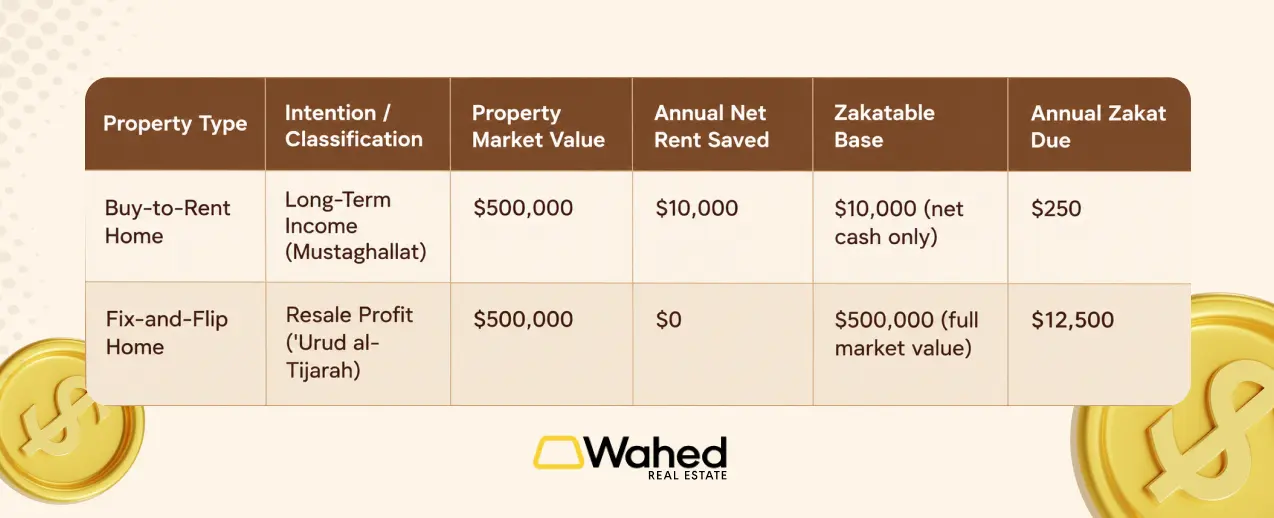
When it comes to rental properties, there is a common myth that needs to be clarified. Where a property is held for rental and not for sale, landlords do not pay Zakat on its full market value. Zakat is paid strictly on net rental income remaining in your bank account at your Zakat date after deducting operating expenses. The physical building itself is considered an income-producing tool and is exempt from Zakat, as outlined in SeekersGuidance's Long-Term Investment Rulings.³
Allah tells us in Surah Al-Baqarah (2:267): "O you who have believed, spend from the good things which you have earned and from that which We have produced for you from the earth..." ⁴
Zakat is owed on what we've earned, the fruit of productive investment, not on the tool that produced it. For reference, think about the difference between a taxi driver and a car dealership. A taxi driver owns a $40,000 vehicle to drive passengers around the city. He owes $0 in Zakat on that $40,000 car, because it's his working tool (Mustaghallat). The tree, not the fruit. What he does owe Zakat on is the net fares he's saved up in his bank account by the end of his Zakat year.
A car dealership, on the other hand, owns 10 cars sitting on the lot, listed for sale. The dealer owes Zakat on the full $400,000 combined value of those cars, because they aren't tools being used, they're trade inventory ('Urud al-Tijarah) waiting to be sold. A buy-to-rent property works exactly like a taxi. The physical structure is your working tool, generating rent the same way the taxi generates fares. SeekersGuidance's ruling on long-term investments confirms this directly. Long-term rental properties are zakatable only on net rental cash earnings, not on the value of the building itself.
The Prophet Muhammad (peace and blessings be upon him) said, "The truthful, trustworthy merchant is with the Prophets, the truthful, and the martyrs" (Sunan al-Tirmidhi 1209). ⁵
Getting your Zakat calculation right as a landlord isn't just about the math. It's part of the same honesty this hadith is describing. Overpaying out of confusion isn't generosity, and underpaying out of carelessness isn't an accident worth repeating. Both come from not doing the work to understand what's actually owed.
Here's how that math actually works:
- Property market value: $500,000 (exempt)
- Gross rent collected: $24,000
- Operating expenses (repairs, management, property taxes): -$6,000
- Net rental cash collected: $18,000
- Personal living expenses paid out of that rent: -$8,000
- Remaining rental cash on your Zakat anniversary: $10,000
- Zakat calculation: $10,000 × 2.5% = $250 owed
Notice what didn't factor into that number anywhere: the $500,000 property value. It never enters the equation. Even if your rental unit sits vacant for a prolonged period, the same logic holds, provided it remains held for rental rather than sale. Zakat only applies to whatever net rental cash you've actually accumulated by your Zakat date.
What if You Buy and Resell Property?
What if You Buy and Resell Property?
This is where the tree-and-fruit framework flips entirely, and it's worth paying close attention to, as the financial difference is significant.
Allah reminds us in Surah An-Nisa (4:29): "O you who have believed, do not consume one another's wealth unjustly but only [in lawful] business by mutual consent." ⁶
Buying and reselling property for profit is an entirely legitimate trade under this verse. However, that legitimacy comes with a corresponding obligation. Any funds generated through trade carries a different Zakat treatment than wealth generated through use. If a property is acquired or subsequently held for resale for profit, that property isn't a tree anymore. It is trade goods ('Urud al-Tijarah), the same category as the dealership's cars.³ That means it's zakatable annually at its full current market value, at 2.5% per lunar year, whether or not you've actually sold it yet.
Here's what that looks like:
- Property purchase price: $400,000
- Current renovated fair market value: $500,000
- Net rental income collected: $0 (property is being renovated, not rented)
- Zakatable base: $500,000 (full current market value)
- Zakat calculation: $500,000 × 2.5% = $12,500 owed annually
Compare that $12,500 to the $250 owed on the rental property example from the previous section, both properties are worth $500,000. The key difference between them is their intention and classification.
What About Real Estate Funds and REITs?
This idea can understandably create confusion amongst Muslim investors, since you don't own a physical property directly, you own a share of a fund that does.
While the general rule stays the same (2.5% per lunar year on your zakatable asset base), what changes is how you figure out that base in the first place.
Where sufficient detail about a fund's underlying holdings is available, a look-through approach may be applied. Wahed’s Shariah Committee guidance on WREF has confirmed that this approach may be used where sufficient underlying information is available. This methodology is outlined in institutional guidance from firms like Saturna Capital/Amana Funds.⁷ It separates what the fund actually owns into two categories:
- Physical properties held for rental inside the fund: These are excluded from the Zakat base, the same way any income-producing tool is exempt.
- Relevant zakatable cash and receivables held inside the fund: These are included in the Zakat base, since these represent actual liquid assets sitting on the fund's balance sheet.
To calculate your obligation, you'll look through to your proportional share of the fund's actual liquid cash and net receivables as reported on its financial statements. Once this is sorted, apply 2.5% to that share for the lunar year.
Another piece worth understanding is that rental distributions the fund pays directly into your personal bank account follow the same rules as ordinary cash. For example, if you've spent that distribution before your Zakat anniversary, you owe nothing on it. However, if it's still sitting in your account, it gets added to your personal cash savings and zakated at 2.5% along with everything else.
For the applicable figure, refer to the Fund's official financial disclosures and Wahed's applicable Zakat guidance.
.webp)
Zakat Rules by Real Estate Type
Building a Halal Real Estate Portfolio
Allah tells us in Surah Al-Ma'arij (70:24–25): "And those within whose wealth is a known right, for the petitioner and the deprived..." ⁸
Calculating Zakat with precision across complex assets like real estate isn't bureaucratic busywork. It's how we fulfill a known right (Haqqum Ma'lum) on the wealth we've been trusted with, a sacred act of stewardship (Amanah). Understanding these rules doesn't just keep us Shariah-compliant. It gives us the confidence to build real estate positions, knowing exactly how our assets generate halal yield and fulfill what's owed. For those looking to build that kind of portfolio without landlord duties or interest-bearing property financing, the Wahed Real Estate Fund offers a way to start, with a minimum investment of just $100.
Primary Sources & Reference Directory
- Quran.com. Surah At-Tawbah, 9:103. https://quran.com/9/103
- Fiqh Council of North America (FCNA). Zakah on Stocks & Utilized Asset Guidelines. https://fiqhcouncil.org/zakah-on-stocks/
- SeekersGuidance (Shaykh Faraz Rabbani). How Is Zakat Calculated on Long-Term Investments? https://seekersguidance.org/answers/hanafi-fiqh/how-is-zakat-calculated-on-long-term-investments/
- Quran.com. Surah Al-Baqarah, 2:267. https://quran.com/2/267
- Sunan al-Tirmidhi, Hadith 1209. https://sunnah.com/tirmidhi:1209
- Quran.com. Surah An-Nisa, 4:29. https://quran.com/4/29
- Saturna Capital / Amana Funds. Investing and Zakat Educational Guide. https://www.saturna.com/insights/investor-education/investing-and-zakat
- Quran.com. Surah Al-Ma'arij, 70:24–25. https://quran.com/70/24
Risk Disclosure:
This article is for educational and informational purposes only. It does not constitute financial, investment,legal, or religious advice. Wahed Financial, LLC ("Wahed"), as a manager of Wahed Real Estate Fund I LLC; Wahed Real Estate Series I, LLC (the “Wahed Issuer”), operates the wahed.com/real-estate website (the "Site") and is not a broker-dealer or investment advisor. All securities related activity is conducted through Dalmore Group LLC, a registered broker-dealer and member of FINRA/SIPC, located at 525 Green Place, Woodmere, NY 11598.
This investment is speculative, illiquid and involves substantial risk, including the possible loss of your entire investment. Securities are offered through Dalmore Group LLC, Member FINRA/SIPC. Wahed and Dalmore are not affiliates. Investors will be clients of Wahed. An offering statement has been filed with the SEC. SEC qualification does not imply approval or endorsement of the offering’s merits. Please review the full offering circular for complete terms and risks.
Investors are purchasing shares of a Fund and not the underlying asset(s) of the Fund. There is no assurance any Fund will achieve its objectives, is not listed on an exchange and may not be suitable for all investors. Distributions are subject to and are not guaranteed.


.webp)