



Key Takeaways:
529 Plans for Muslim Families: What Should You Know?
If you've started researching college savings options in the U.S., you've almost certainly encountered the 529 plan. It's the most commonly recommended education savings vehicle in American personal finance - and for good reason. The tax advantages are real and meaningful, contribution limits are generous, and the account structure is flexible in ways that matter for families navigating long planning horizons.
For Muslim families, however, there's a layer of evaluation that most mainstream guides skip entirely: are the underlying investments in a 529 plan compatible with Islamic finance principles?
The answer, as with most investment account types, is: it depends - not on the account itself, but on what you put inside it. For Muslim families, the key question isn't only which account to use. It's whether the underlying investments align with Islamic principles and your long-term financial goals.
This guide explains how 529 plans work, what Muslim families need to examine before opening one, and how to make a well-informed decision about whether a 529, a custodial account, or a combination of both is right for your family.
What Is a 529 Plan?
A 529 plan - named after Section 529 of the Internal Revenue Code - is a state-sponsored, tax-advantaged savings account designed specifically for education expenses. Think of it as a dedicated investment account where your contributions grow tax-free, and withdrawals used for qualified education expenses are also tax-free at the federal level.
Any U.S. resident can open a 529 plan. The account owner is typically a parent or grandparent; the beneficiary is the child whose education costs will be funded. Unlike a custodial account, the account owner retains control of the funds - the money doesn't automatically transfer to the child at a set age.
Qualified education expenses that can be paid from a 529 without tax or penalty include tuition and fees at colleges, universities, and vocational schools, room and board, textbooks and required supplies, computers and technology needed for school, up to $10,000 per year in K-12 private school tuition, and up to $10,000 lifetime in student loan repayment. Under the SECURE 2.0 Act, unused 529 funds can also be rolled into a Roth IRA (up to $35,000 lifetime after the account has been open for 15 years) - a relatively new benefit that adds meaningful flexibility.
Who can open one? Almost anyone. Parents, grandparents, aunts, uncles, or family friends can open a 529 for a child. Multiple people can contribute to the same account. There are no income limits for contributors, and the account owner can change the beneficiary to another qualifying family member if circumstances change - a useful feature if plans shift.
Why 529 Plans Are Popular in the U.S.?
The appeal of college savings plans structured as 529s comes down to four key advantages.
Tax-free growth and withdrawals. Investment gains inside a 529 accumulate completely free of federal income tax. Withdrawals for qualified education expenses are also tax-free. Over an 18-year compounding horizon, this tax-free growth can represent a meaningful addition to the total fund - avoiding capital gains tax that would apply to equivalent gains in a standard brokerage account.
High contribution limits. There are no annual contribution limits imposed by the federal government on 529 plans, though individual contributions above $19,000 per donor per year (the current gift tax annual exclusion) may have gift tax implications. Aggregate balances are capped by each state's plan - typically $300,000–$550,000 per beneficiary - which is more than sufficient for most families' education goals.
State income tax benefits. Approximately 34 states offer state income tax deductions or credits for contributions to their own state's 529 plan. For a family in a high-tax state contributing $10,000 annually, this deduction alone can be worth hundreds of dollars per year. Some states allow deductions for contributions to any state's 529, not just their own.
Flexibility. Funds can be used at virtually any accredited college, university, or vocational school in the U.S. - and many institutions abroad. The beneficiary can also be changed, and the SECURE 2.0 Roth IRA rollover option provides an exit ramp for families who over-save relative to their child's actual educational needs.
Are 529 Plans Shariah Compliant?
This is the question that brings most Muslim parents to this article - and the most important thing to understand is the distinction the brief's content angle calls out directly.
The 529 account itself is a tax wrapper, not an investment. It is a legal structure that provides tax advantages for a specific purpose. As with an IRA, a 401(k), or a custodial UGMA account, the account type does not inherently determine Shariah compliance. The compliance question is primarily about what you invest in - not the account type alone.
Where the 529 structure creates a practical challenge for Muslim families is in the fund menu. Every 529 plan offers a predetermined selection of investment options. Unlike a standard brokerage account where you can purchase virtually any publicly traded security, a 529 investor can only choose from the funds the plan makes available. And the overwhelming majority of 529 plans offer only conventional fund options: age-based target-date funds (which include significant bond allocations and non-compliant equities), total market index funds (which hold conventional banks, alcohol companies, and other excluded sectors), and money market funds (which generate interest-based returns).
If none of the available funds in a given 529 plan meet Shariah screening criteria, then investing through that plan raises compliance concerns regardless of the account's tax advantages. The tax benefit is real, but it cannot override the need for compliant underlying investments.
What to look for: Some 529 plans - particularly those with broader menus or self-directed brokerage windows - may offer access to Shariah-compliant ETFs or equity funds. A self-directed brokerage option within a 529 is the most promising avenue for Muslim families, as it would allow selection of screened halal ETFs just as you would in a standard brokerage account. These are not universal, but they exist in some state plans and are worth researching before concluding that a 529 is unavailable to you compliantly.
For a broader framework on what makes an investment fund Shariah-compliant - sector exclusions, financial ratio thresholds, and the principles that govern compliance evaluation - see our guide on how Muslim parents can start investing for college in America.
What Should Muslim Families Look for in a 529 Plan?
If you're evaluating whether a specific 529 plan is usable for your family, four factors matter beyond the tax benefits.
Investment options. The single most important factor. Review the complete fund menu before opening an account. Specifically: does the plan offer any equity funds that exclude conventional financial services, alcohol, gambling, weapons, and other prohibited sectors? Does the plan offer a self-directed brokerage window that would allow purchase of halal ETFs? If the answer to both is no, the investment options available are unlikely to be Shariah-compliant.
Shariah compliance of underlying holdings. If a plan does offer a broadly diversified equity fund or a self-directed option, apply the applicable Shariah screening criteria: sector exclusions for prohibited industries, and financial ratio thresholds, such as those relating to debt, interest income and non-compliant revenue. The same evaluation applied to any halal investment applies here.
Diversification and risk alignment. A well-structured education fund needs to reflect the time horizon to the target date - aggressive growth-oriented during early years, progressively more conservative as college approaches. If compliant fund options are limited, you may have less flexibility to construct a properly diversified, time-appropriate allocation. This is a real constraint that should factor into the decision.
Fees. 529 plans vary significantly in expense ratios and administrative fees. These costs reduce net returns over time and are worth comparing across state plans before committing. Many states allow out-of-state residents to open their plans, which means you're not limited to your home state's offering - particularly relevant if your state's plan has poor fund options or high fees.

529 Plans vs Custodial Investment Accounts
For Muslim families who find that their state's 529 plan doesn't offer suitable compliant investment options, a custodial investment account (UGMA or UTMA) is the most practical alternative. Understanding the differences helps clarify which is more appropriate for your situation - and whether using both makes sense.
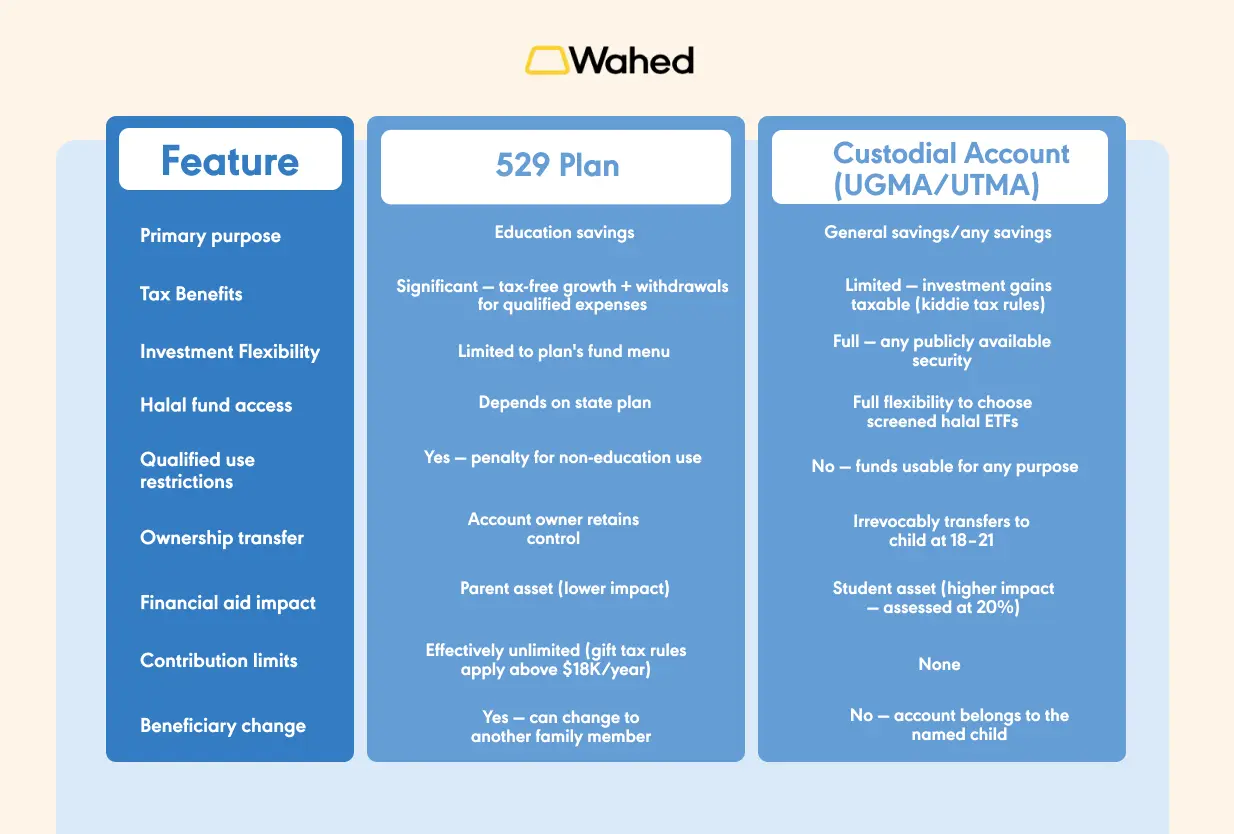
When a 529 may be appropriate: If your state's 529 plan offers a self-directed brokerage option or a Shariah-screened equity fund, and you are specifically saving for education expenses, the tax advantages of a 529 are genuinely worth capturing. Tax-free compounding over 15–18 years on consistent contributions adds meaningfully to the final balance.
When a custodial account may be more appropriate: If your state's 529 plan offers no compliant investment options, a UGMA or UTMA custodial account gives you full freedom to invest in Shariah-compliant ETFs and halal portfolios. The trade-off is reduced tax efficiency - gains are taxable - but Shariah-compliant investing is achievable, and the fund can be used for any purpose, not just education. For a complete breakdown of custodial accounts for Muslim parents, see our guide on should Muslim parents open a custodial investment account?
Can Parents Use Both?
Yes, and for many Muslim families with well-established financial foundations, using both accounts in parallel is a thoughtful strategy.
A family might open a 529 plan in a state that offers a self-directed brokerage window (allowing halal ETF selection), capturing the tax-free growth benefit for education-specific savings. Simultaneously, they maintain a custodial UGMA account for broader, more flexible halal investing - giving the child assets at maturity that can be used for a home purchase, business investment, or any other goal that education-specific funds cannot legally cover without penalty.
The practical result: tax-efficient education savings through the 529 (where compliant options are available) alongside full investment flexibility through the custodial account. Neither vehicle crowds out the other, and together they provide both the tax efficiency of the 529 and greater control over the Shariah compliance of the custodial portfolio. For a framework on how education savings fits within a broader family financial strategy, including retirement and investment prioritisation, see our new Islamic year financial checklist for Muslim families.
Common Mistakes to Avoid
Choosing investments without reviewing the fund's underlying holdings. Opening a 529 and selecting the default age-based portfolio - which almost always includes bond funds and non-screened equity index funds - without reviewing what's inside is the most common mistake Muslim parents make. The default option in most 529 plans is not Shariah-compliant. Choosing investments actively, rather than accepting defaults, is essential.
Starting too late. The most powerful variable in education savings is time. A family that begins contributing when a child is born has 18 years of compounding ahead; one that starts at age 10 has 8. The tax-free compounding benefit of a 529 is most valuable over long horizons. Delaying the decision while evaluating options has a real and quantifiable cost. For a direct comparison of starting ages and outcomes, see our college investing guide for Muslim parents.
Focusing only on the tax benefits. The 529's tax advantages are genuinely attractive - but they're only valuable if the underlying investments are both compliant and appropriately structured for long-term growth. A 529 with non-compliant investments or a poorly constructed allocation is not better than a well-constructed halal custodial portfolio simply because it has a tax wrapper.
Ignoring long-term investment strategy. A 529 is not a savings account - it's an investment account. The investment allocation within it needs to be actively managed: growth-oriented in the early years and progressively more conservative as the target date approaches. Setting contributions on autopilot without revisiting the allocation is a significant missed opportunity.
How to Build an Education Savings Strategy
Step 1 — Define your goal. Estimate the future cost of the education you're planning for. A 4-year public university currently costs approximately $110,000–$120,000* total; a private university $220,000–$240,000. Apply a 3–4%* annual tuition inflation rate to project what these figures will be in 10–18 years. Decide what coverage percentage you're targeting - full tuition, partial funding, or supplemental to scholarships and part-time work.
*For illustrative purposes only
Step 2 — Choose the right account. Evaluate your options in the following order. First: does your state's 529 plan offer a self-directed brokerage option or explicitly Shariah-screened fund? If yes, consider using it for the tax advantages. If no: is a different state's plan worth using for its fund menu or fees? If still no compliant 529 option exists: a custodial UGMA/UTMA account or general halal investment account gives full investment control at the cost of the tax benefit.
Step 3 — Select appropriate investments. Regardless of account type, the underlying investments must meet Shariah screening criteria: sector exclusions, financial ratio thresholds, and diversification across compliant equities. For 529 accounts with self-directed options, select Shariah-screened ETFs as the core holding. For custodial accounts, a professionally managed Shariah-compliant portfolio may provide both diversification and ongoing Shariah monitoring. For guidance on building a diversified halal portfolio, see our halal portfolio diversification strategy and can you earn halal returns? for how to handle the liquid portion appropriately.
Step 4 — Invest consistently. Automate contributions where possible. A fixed monthly transfer into the education account - regardless of market conditions - captures the dollar-cost averaging benefit and removes the temptation to pause during market downturns. Consistency over 18 years is the primary driver of outcomes.
Step 5 — Review annually. As the child grows, the appropriate investment allocation changes. An allocation suitable for a newborn - heavily growth-oriented - is typically not appropriate for a 15-year-old whose college start date is three years away. Review and rebalance at least annually. Also review whether the account structure still serves your goals - life circumstances change, and the strategy should adapt.
Plan for Your Child's Future With Confidence
The 529 question is ultimately a subset of a larger question: how does this family build wealth for their children in a way that is financially sound, tax-efficient where possible, and fully aligned with Islamic principles?
The answer will differ by family - by state, by plan, by the specific investment options available, and by how far in advance the planning begins. But the framework is consistent: evaluate the underlying investments, not just the account label; maximise tax efficiency where compliance allows it; and build consistently over time, letting compounding do the work that no single contribution decision can match.
Disclosure:
This article is for educational purposes only and does not constitute financial, investment, legal, or tax advice. 529 plan rules, fund options, and tax treatments vary by state and are subject to change. Wahed Invest does not provide tax or legal advice. Consult your own advisors regarding your own individual situation.
Wahed Invest LLC (Wahed) is a U.S. Securities and Exchange Commission (SEC) registered investment advisor. Wahed Invest provides brokerage services to its clients through its brokerage partner Apex Clearing Corporation, a member of NYSE - FINRA - SIPC and regulated by the SEC and the Commodity Futures Trading Commission. Registration does not imply a certain level of skill or training. Wahed does not intend to offer or solicit anyone to buy or sell securities in jurisdictions where Wahed is not registered or a region where an investment practice like this would be contrary to the laws or regulations. Any returns generated in the past do not guarantee future returns. All securities involve some risk and may result in loss. Any performance displayed in the advertisements or graphics on this site are for illustrative performances only. Diversification does not guarantee a profit nor protect against loss.