%20(1).webp)


Key Takeaways:
Can Muslims Contribute to Both a 401(k) and an IRA?
Saving for retirement is one of the most important future prospects for all Muslim professionals in the United States. The decision of where to allocate your savings to prepare for this holds a lot of weight, but ultimately comes down to two questions: can Muslims contribute to both a 401(k) and an IRA, and are both of these accounts halal? The good news is, there is an easy way to navigate this crucial life decision. The first step is understanding the difference between 401(k) and IRA accounts and how they can guide every Muslim professional to a fruitful and abundant future.
Understanding the Difference Between a 401(k) and an IRA
A 401(k) is an employer sponsored retirement plan and the way it functions is very straightforward. The company you work for sets it up for you, and contributions towards it come out of your paycheck before income tax is calculated. This allows you to deduct them from your income on your annual tax return. The money invested in a 401(k) is allowed to grow tax free until the full amount (contributions plus growth) is withdrawn, at which point it will be taxed as ordinary income.
Additionally, a lot of employers offer a matching contribution. This means that they add money to your account based on the amount you contribute, up to a certain percentage of your individual salary. However, it is important to note that investment options within a 401(k) are limited to whatever your employer’s plan provider offers. The fund lineup is coming from a pre-set menu of investment options, which typically include mutual and index funds the track the S&P 500. You generally can’t buy any individual stocks or outside funds beyond what your employer provides.
An IRA (individual retirement account) is a much more flexible retirement plan, as it is directly managed by you independent of your employer. This allows a greater degree of autonomy over investment options within your portfolio as you choose the provider and how your contributions will be taxed.
There are two main types of IRAs: a Traditional IRA and a Roth IRA. Deciding between the two ultimately comes down to whether you prefer to pay now or pay later for your retirement savings. For example, in most cases with a Traditional IRA, you get to deduct the amount of your contributions from your taxable income annually. The money in the account grows tax free until you withdraw it upon retirement. Those withdrawal taxes are why some prefer a Roth IRA instead. With a Roth IRA, you are contributing money that has already been taxed (i.e. from your W-2 paycheck), so there are no taxes to be paid upon withdrawal, and the money in the account still is allowed to grow tax free. That said, it is recommended you consult with a qualified tax professional before making any final decisions as it pertains to this matter.
Can You Contribute to Both?
Yes. Having a 401(k) through your employer does not prevent your ability to open and contribute to an IRA. It is fairly common for many Americans and Muslim professionals to contribute to both accounts simultaneously as part of their retirement strategy. That said, there are a few important caveats that can affect how contributions are impacted.
401(k)s and IRAs have individually capped annual contribution limits set by the IRS. Fortunately, contributing the full amount (maximum) to your 401(k) does not reduce the allowed annual contributions to an IRA, and vice versa. These contribution limits are adjusted on a yearly basis and depend on factors such as age and income. Specific information on 401(k) and IRA limits as well as additional details for the 2026 fiscal year have been published on the IRS website.
Furthermore, it is important to note that the IRS sets income limits for Roth IRA contributions. This is based on modified adjusted gross income (MAGI), not just salary, and is updated annually. Detailed information on this matter for 2026 can be found in Publication 590-A on the IRS website.
If you’re covered by a workplace retirement plan like a 401(k), the tax deductibility of your Traditional IRA contributions may also be reduced or phased out depending on income status. This, however, does not impact your ability to contribute the full amount to a Traditional IRA alongside a 401(k), only whether that annual contribution is tax deductible. The money contributed to either account still grows tax-free regardless.
Given how these rules shift based on income, age, filing status, annual IRS adjustments, and more, the most reliable path forward is to speak with a qualified tax professional as it pertains to your individual circumstances.

Why Many Professionals Use Both Accounts
As noted earlier, choosing to contribute to both a 401(k) and IRA account is a popular retirement strategy for many professionals. The reason being is that there are many practical advantages and it is important to understand what they are.
The most obvious advantage is increased retirement savings. Using both a 401(k) and IRA account allows individuals to save more money for retirement than either account would permit on its own. By consistently contributing to both accounts over the course of your career, your savings compound over a long time horizon. This can meaningfully accelerate progress for long term goals and build wealth to support financial stability upon retirement.
Pairing an employer sponsored plan like a 401(k) with an IRA also allows for flexibility through diversification of tax treatment. Having both taxable and tax-free income sources available upon retirement can help you manage your tax bracket more strategically once you decide to initiate withdrawals.
The last notable advantage is investment diversification. Since employer 401(k)s have limited fund selections, some of the available options may not align with Shariah investment principles. By opening and contributing to a self-directed IRA, individuals have a much wider range of investment options to select that align with their goals and values.
Together, these advantages make it clear that a 401(k) and IRA are not competing options for your retirement plan but complimentary tools that strengthen your overall strategy when utilized in unison. That said, it is important for Muslim professionals to make investment decisions that are aligned with core values, which raises a significant question.
Are 401(k)s and IRAs Halal?
This is a question of great importance for Muslim professionals and deserves a clear answer. At the core, 401(k) and IRA accounts are simply a saving and tax structure, meaning they are not inherently halal or haram. What determines whether or not your retirement savings align with Islamic principles largely depends on what is invested in the account.
Since employer 401(k) plans offer a fixed menu of investment options, they are not designed for Shariah compliance as they are built for a general population. This means that many of the default or commonly recommended options within a 401(k) may include exposure to financial institutions or industries that don’t align with the values of Muslim professionals. It is worth reviewing your funds menu carefully before deciding where to allocate your contributions. If Shariah-compliant options are not available, certain employers may be open to adding new funds if requested.
Self-directed IRAs such as a Roth IRA or Traditional IRA offer much more flexibility for Muslim professionals looking for halal investment options. As mentioned earlier, these offer the ability to personally choose from a wide range of investment options including those specifically screened for compliance with Islamic investment principles. This is one of the key reasons why an IRA account can be a valuable compliment to a 401(k) for Muslim investors.
The account type and investment selection are two separate decisions that can be evaluated for alignment with Islamic values.
Which Account Should You Prioritize?
Beyond adhering to Islamic values, there is no single correct approach to retirement strategy that can be applied to all Muslim professionals. Fortunately, there are five reliable factors that can be used as a framework to guide you in making informed investment decisions for the future.
Employer Match: Taking advantage of the employer match on your 401(k) is a good place to start, provided a suitable Shariah-compliant investment option is available within the plan. Generally, employers will match a certain amount of contributions to your 401(k) up to a set percentage of your salary. This is essentially free money added directly to your retirement account on behalf of your employer so long as your contributions meet a certain threshold. Contributing below that threshold means that a portion of that free money will go unclaimed, so it is important you consult with your employer to understand the full scope of this arrangement. Overall, it is a beneficial and easy opportunity to utilize as it provides an additional employer contribution that is not available through an IRA.
Investment Choices: Once you have secured the employer match, it is a good idea to weigh the quality of investment choices available to you in your 401(k). If there are not many Shariah-compliant investment options available, it may be worth allocating money beyond the match towards an IRA. This is because, as stated earlier, with an IRA you have more control over what you invest in.
Fees: Account fees are another important factor to weigh into your retirement strategy, as they directly impact how much of your savings grow and stay invested over time. In a 401(k), fees typically come from the plan’s administrative costs and expense ratios charged by each fund. These are solidified into the plan your employer selected, leaving you little room to avoid them or shop around. IRAs offer more flexibility when navigating the issue of fees. Since you choose the provider yourself, you have the ability to compare account fees and fund expense ratios across providers before you sign up for a plan.
Tax Strategy: Your individual tax strategy is also a significant factor but is highly dependent on individual preference. As discussed earlier, most 401(k) plan contributions are pre-tax and are only taxed upon withdrawal. However, some employers offer a Roth 401(k) which works the opposite way. The tax structure of traditional and Roth IRAs function the same. Overall, the decision ultimately falls upon whether you prefer to pay now, save later, or save now, pay later. Whether you prioritize tax-deferred or tax-free growth depends on your current tax bracket, expected future tax bracket, and how you want to balance flexibility in retirement.
For more information on building a diversified retirement strategy with Shariah-compliant investment portfolios, check out Halal Retirement Planning for Muslim Professionals.
Building A Balanced Retirement Strategy
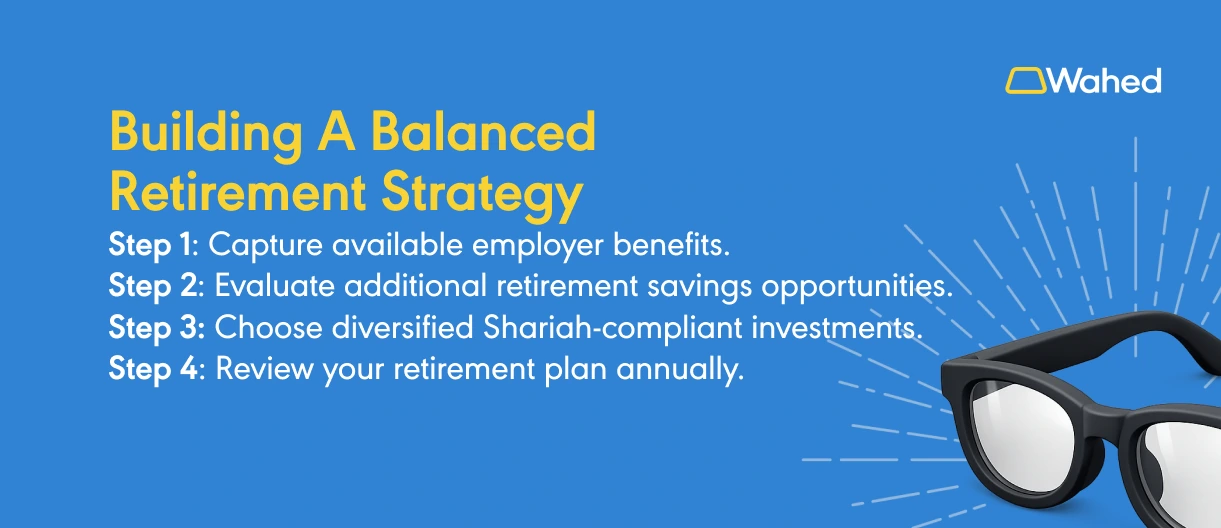
Step 1: Capture available employer benefits. Where a suitable Shariah-compliant investment option is available, contribute enough to your 401(k) to receive the full employer match, if one is offered. This is typically the most efficient use of your first retirement dollars.
Step 2: Evaluate additional retirement savings opportunities. Once you've captured the match, consider directing further contributions toward an IRA, particularly if it gives you access to better-aligned investment options.
Step 3: Choose diversified Shariah-compliant investments. Within both accounts, review the available funds carefully and select those that meet appropriate Shariah-screening criteria, aiming for reasonable diversification across asset classes and sectors.
Step 4: Review your retirement plan annually. Contribution limits, income thresholds, employer plan offerings, and your own financial circumstances can all change year to year. An annual review helps ensure your strategy stays current and aligned.
Common Mistakes to Avoid
Building a retirement strategy across both a 401(k) and an IRA involves a lot of moving parts. This makes it easy for even well-intentioned investors to fall into a handful of common traps along the way. Being aware of these pitfalls ahead of time can help you avoid setbacks that are often simple to prevent.
- Assuming all retirement investments are automatically halal: Default fund selections in employer plans are rarely screened for Shariah compliance, so this needs to be verified rather than assumed.
- Ignoring employer matching opportunities: Where suitable Shariah-compliant investment options are available, skipping the match, even in favor of a self-directed IRA with better fund options, usually means leaving free money on the table.
- Delaying retirement investing: Waiting for the "ideal" account setup before starting to save can cost years of potential growth. It's often better to begin with available Shariah-compliant options and refine your strategy over time.
- Focusing only on tax benefits instead of investment quality: Tax advantages matter, but they shouldn't come at the expense of choosing investments that align with your principles.
- Failing to diversify: Concentrating retirement savings in too few funds or sectors can increase risk unnecessarily, regardless of how those investments are screened.
Disclaimer:
Wahed Invest does not provide tax advice and this should not be considered tax advice. Tax laws and regulations are subject to change. For more information on IRA accounts please visit IRS.gov. Consult with your tax or financial advisor for more guidance on your situation. The term 'Halal' denotes that it is permitted and follows Islamic law
Wahed Invest LLC (Wahed) is a U.S. Securities and Exchange Commission (SEC) registered investment advisor. Wahed Invest provides brokerage services to its clients through its brokerage partner Apex Clearing Corporation, a member of NYSE - FINRA - SIPC and regulated by the SEC and the Commodity Futures Trading Commission. Registration does not imply a certain level of skill or training. Wahed does not intend to offer or solicit anyone to buy or sell securities in jurisdictions where Wahed is not registered or a region where an investment practice like this would be contrary to the laws or regulations. Any returns generated in the past do not guarantee future returns. All securities involve some risk and may result in loss. Any performance displayed in the advertisements or graphics on this site are for illustrative performances only.