


Key Takeaways:
Where Should Muslims Keep Money They Need Within the Next 12 Months?
Not every dollar should be invested. And understanding why is one of the most practical things a Muslim professional can do for their financial health.
Investing is one of the most powerful tools available for building long-term wealth - but it is not the right tool for every situation. The most important question to ask before deciding where to keep any sum of money is not "what will generate the best return?" It's simpler than that: when will I need this money?
The answer to that question should drive almost every decision about where money is held. For money needed within the next 12 months - an emergency fund, a home down payment, a wedding, upcoming tuition payments - the priority is not growth. It's access and stability. This guide explains why, and what halal savings options are available for Muslim families managing short-term financial goals.
Why Your Time Horizon Matters?
Time horizon is the single most important variable in financial planning - and the most commonly overlooked one. The principle is straightforward: the sooner you'll need your money, the less investment risk you should take with it.
This isn't a conservative or cautious position. It's mathematically rational. Markets have historically generated strong returns over long periods precisely because they're volatile over short ones. The two-decade average annualized return of a diversified equity portfolio is meaningfully positive. The one-year return in any given year could be anywhere from deeply negative to strongly positive - and there's no reliable way to know in advance which it will be.
Market volatility over short windows is the core problem. In April 2025, broad equity markets fell roughly 11% - 15% within days following sudden tariff announcements - one of the sharpest short-term declines in recent years. Long-term investors could hold through it. Someone who needed to access that money for a home closing, a wedding payment, or a tuition deadline during those same days had no such option.
Liquidity is the second consideration. Money held in a market investment may not be accessible immediately without realising a loss. Even liquid assets like publicly traded equities can require time to sell and settle before funds are available - typically two business days. For true emergencies, even brief delays matter.
Purchasing power is the third factor. While inflation is real and erodes cash over time, the risk of a 20–30% portfolio drop on a 12-month horizon is far more damaging to a specific financial goal than the 3% annual inflation effect on a short-term cash holding.
Aligning the home of your money with when you'll need it isn't about being timid - it's about being intentional. Every dollar should have a purpose, and that purpose should determine where it lives.
Examples of Short-Term Financial Goals
Short-term financial goals are those with a defined need date within approximately 12 months. Common examples for Muslim families in the U.S. include:
Emergency fund: Accessible cash reserves covering 3–6 months of essential expenses, intended to be used when unexpected events occur. The timing of need is unknown but potentially immediate.
Home down payment: For families planning a purchase within the year, the accumulated down payment needs to be intact and accessible at the closing date. A market drop in the months before closing could derail the purchase entirely.
Wedding expenses: A planned major expense with a set date, requiring predictable access to specific funds.
Tuition payments: Semester-based education costs with fixed due dates that cannot be deferred based on market conditions.
Major home repairs: Urgent or scheduled maintenance with non-negotiable timing.
Vehicle purchase: Whether replacing a failed vehicle or making a planned upgrade, the timeline is typically defined.
Travel: Planned family or hajj expenses with fixed booking and payment dates.
For any of these, the question isn't whether to earn a return on the money - it's whether risking the principal for a return is appropriate given the specific timing constraint. For most of these goals, the honest answer is no.
Should You Invest Money You'll Need Soon?
The general answer for money needed within 12 months is: not in equity markets or volatile asset classes. Here's why each of the key risk factors points in the same direction.
Market volatility. A diversified halal equity portfolio - or any equity portfolio - can decline meaningfully over a short window. In August 2024, markets dropped roughly 8-10% in just a few days as recession fears briefly spiked. Then in April 2025, a sudden tariff announcement sent broad equity indices S&P 500 down approximately 6% within a week. Both declines were largely recovered by long-term investors who had the luxury of waiting - but a family whose down payment was tied up in an investment account during either episode had no such luxury. They faced a stark choice: sell at a loss, or delay a planned purchase with real consequences. Historical data consistently confirms that the shorter the time horizon, the wider the range of possible outcomes — and the higher the probability of being forced to sell at the wrong time.
Sequence risk. Sequence risk refers to the danger of needing to liquidate investments at exactly the wrong time. For long-term investors, a market decline followed by a recovery is merely a paper loss - patience resolves it. For someone with a fixed financial deadline, a decline that hits just before their need date cannot be waited out. The sequence of returns in the window before you need the money can be devastating for short-term goals in a way it simply isn't for long-term investing.
Liquidity needs. Some emergency situations require same-day or next-day access to cash. Even liquid market investments involve settlement periods. For genuine emergencies - a medical expense, an urgent family need, a home repair that cannot wait - investment accounts are not the right repository.
Emotional decision-making. Watching money intended for a specific purpose fluctuate up and down in a market account creates real psychological pressure. Investors managing short-term goal money in investment accounts frequently make poor decisions - selling during downturns out of fear, or holding too long out of hope that markets will recover before their deadline. Keeping short-term money in a stable, accessible account removes this temptation entirely.

Where Can Muslims Keep Short-Term Savings?
For money needed within 12 months, the priority ranking is: accessibility first, stability second, return third. With that framework, the practical options for Muslim families are as follows.
Cash accounts. A non-interest-bearing bank current or savings account generally keeps money liquid, accessible, and protected from market volatility. The primary limitation is inflation - cash sitting still loses real purchasing power at approximately 3% per year. For very short timeframes (under 3 months), this erosion is minor relative to the risk avoided. For 6–12 month timeframes, it's worth considering whether a slightly more productive option is available.
For Muslim savers, the important caveat is that interest-bearing savings accounts - including high-yield savings accounts (HYSAs) - generate riba, which is not permissible. The solution is a non-interest bank account or a current account where no interest is credited. The purchasing power loss from holding cash this way is real but modest over a 12-month horizon and may be an acceptable trade-off for maintaining liquidity while avoiding interest.
Shariah-compliant cash management solutions. Some Islamic financial platforms offer accounts designed to seek capital stability and potential returns through Shariah-compliant structures, such as profit-sharing or investment-agency arrangements, rather than interest. Where appropriately structured and subject to Shariah oversight, they may offer a middle path between idle cash and higher-risk market investments. These are the closest halal equivalent to what a HYSA does for conventional savers, and they are worth exploring when available.
Conservative short-term investment solutions. For money with a 6–12 month horizon and a degree of flexibility around exact timing, a very conservative allocation - heavily weighted toward sukuk or stable halal instruments - might provide modest growth while maintaining relatively low volatility. This is not appropriate for emergency funds or money with a fixed, immovable deadline, but may be reasonable for planned goals where a 3–6 month flexibility window exists. Risk tolerance and the firmness of the deadline both matter here.
What About Emergency Funds?
The emergency fund is a special case that deserves its own clarity: emergency funds should almost never be invested in equity markets.
The entire purpose of an emergency fund is to be available immediately, in full, without conditions. Job losses, medical emergencies, urgent family needs - these don't wait for markets to recover. An emergency fund that drops 25% in a market downturn at the same moment you most need it has failed its purpose entirely.
The recommended approach for emergency fund savings is a non-interest-bearing bank account or a Shariah-compliant cash-management account designed to provide ready access to funds, subject to its terms and liquidity arrangements. The target balance is 3–6 months of essential living expenses — housing, utilities, groceries, transport, and any other non-discretionary costs. Families with variable income, single-income households, or higher fixed monthly obligations should aim for the upper end of that range.
The opportunity cost of holding this amount in cash - the return forgone by not investing it - is a real but acceptable cost. It is the premium paid for having a financial safety net that actually works when needed.
When Does Investing Make More Sense?
The flip side of the short-term argument is equally important: money with a longer time horizon should generally be invested, not held in cash indefinitely.
For goals 3–5 or more years away - retirement, a child's education, long-term wealth building, keeping significant sums in cash is its own form of financial risk. Inflation erodes purchasing power steadily, and the compounding benefit of long-term halal investing is forfeited year by year that money sits idle.
A Muslim professional saving for retirement 20 years away who holds their retirement contributions in cash is not being cautious - they are guaranteeing that their purchasing power shrinks while the opportunity to compound it meaningfully passes. The same principle applies to children's education savings starting from birth, long-term wealth building for generational purposes, and any goal with a multi-year horizon.
For a practical framework on how to invest for these longer-term goals through Shariah-compliant vehicles, see our guides on halal investing for young professionals and how Muslim parents can start investing for college in America.
Investing money needed within the next few months. The most direct application of this article: if you'll need the money in 6 months, a market downturn in month 4 can force a liquidation at a loss. The risk is real and the timeline is too short for recovery.
Leaving long-term money entirely in cash. The opposite error is equally costly. A 35-year-old who keeps all their savings in a non-interest account "because investing feels risky" is losing purchasing power every year and forfeiting decades of compounding. Cash is appropriate for short-term goals; investment portfolios are appropriate for long-term ones.
Confusing emergency savings with investment accounts. These are different pools serving different purposes. Emergency savings need to be liquid, stable, and untouched until genuinely needed. Investment accounts are for capital that can stay invested through market cycles. Mixing them - investing emergency funds, or treating investment accounts as accessible savings - undermines both.
Chasing higher returns for short-term goals. The temptation to earn "just a little more" on a down payment or tuition fund by investing it in equity markets introduces risk that isn't justified by the timeline. The potential gain rarely outweighs the risk of needing to access the money during a market downturn.
A Simple Framework for Choosing Where to Keep Your Money
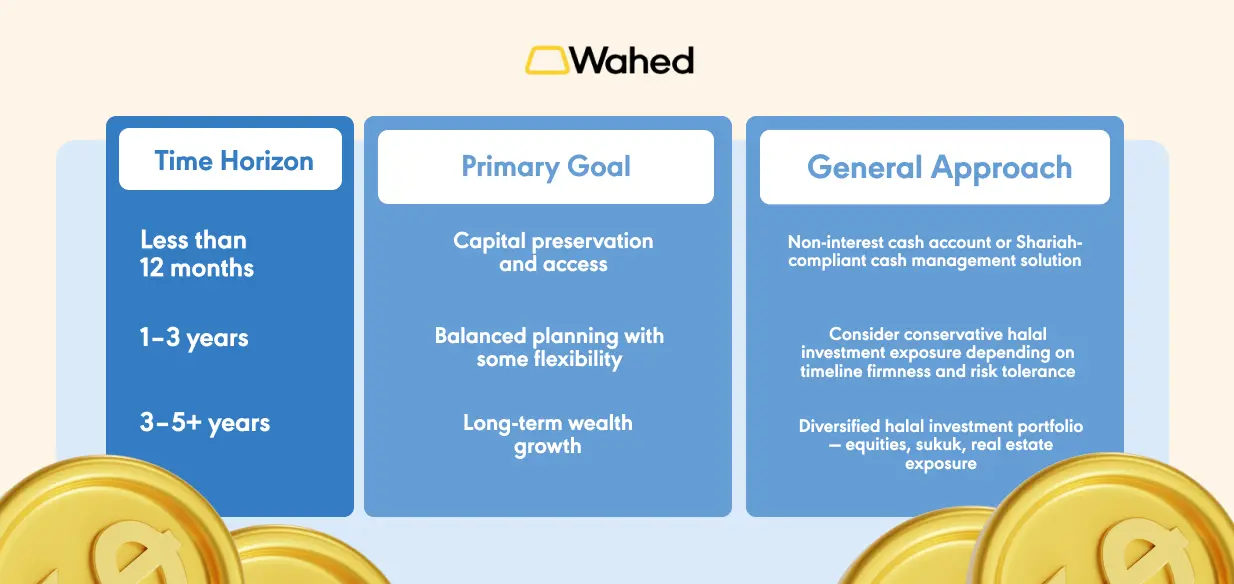
This table is a starting point, not a rigid rule. A down payment fund for a purchase 18 months away might sit in the "consider conservative investment" category, but only if the family is genuinely comfortable with the possibility that markets could be lower in 18 months and the purchase could be delayed. A down payment needed in 6 months should stay in cash regardless of how the market looks.
The underlying logic in every case is the same: match the risk of where you keep money to the flexibility you have around when you'll need it.
Build a Financial Plan Around Your Goals
Sound financial planning doesn't start with picking investments. It starts with understanding what you're saving for and when you'll need it - and then choosing the right vehicle for each goal accordingly.
For short-term needs, the right answer is often simpler than people expect: keep it accessible, keep it stable, keep it halal. For goals with longer horizons, the investment tools available to Muslim families today, Shariah-screened portfolios, halal ETFs, diversified managed accounts - make it genuinely possible to build meaningful wealth without compromising on values.
The two approaches are not in conflict. They are complementary: a stable short-term foundation that protects near-term goals, and a long-term investment strategy to help build the wealth your family needs over time.