

Key takeaways
Start early. Time is the lever you have at 25 that you won't have at 45.
Keep emergency money liquid and separate from investing money.
Know what your investments actually hold. The account wrapper isn't enough.
Avoid riba, haram industries, and unscreened conventional funds.
Start small and stay consistent. The habit matters more than the headline amount.
Use diversified halal options instead of guessing individual stocks.
For busy young Muslim professionals, a managed halal portfolio can remove most of the friction.
You just got your first real paycheck. Or your second promotion. Or your stipend finally turned into a salary - and there's actual money sitting in your checking account at the end of the month. You know cash alone won't build anything long-term, but the moment you open an investing app, the picture gets complicated.Most investments don't ask whether your holdings are halal. They typically include conventional banks, alcohol producers, gambling, weapons manufacturers, and interest-bearing bonds.
You can build a real net worth that way, but you can't fully control what you're profiting from. Halal investing options in the U.S. have matured significantly over the past decade, and halal investing for beginners isn't about waiting until you're rich, debt-free, or a finance expert. It's about building the right foundation early, and a few clear rules carry most of the weight.

Why Starting Early Matters
The single biggest advantage you have at a young age is time. Compounding only works if your money has decades to grow on top of its own growth, and there's no real workaround for that. As an example, a 26-year-old who invests consistently for 30 years has a structural advantage a 40-year-old beginner can't easily replicate. It isn't because they're smarter. They just had more time.
Consistent contributions through ups and downs tend to outperform attempts at perfect entry points. For instance, young professionals putting $150 a month into a diversified halal portfolio over three decades is doing meaningful long-term work, even if it feels modest on the monthly statement. Waiting until you "know everything" before you start investing halal usually means losing years you can't get back.

What Is Halal Investing?
Halal investing, often referred to as Shariah-compliant investing, applies Islamic finance principles to how you build wealth. The goal is the same as any other form of investing, which is to grow your money over time. The constraint is what you grow it through.
Three core rules generally define Shariah-compliant investing:
- Avoid riba (interest). Returns generated by lending money at interest are prohibited. This is why most conventional bonds, savings instruments, and interest-bearing money market funds aren't halal.
- Avoid haram industries. Alcohol, gambling, conventional banking and insurance, weapons, tobacco, pork products, and adult entertainment are excluded.
- Invest in ethical, productive businesses. Halal investing favors real economic activity rather than speculation.
Identifying compliant companies involves two layers of screening. Business activity screening removes companies in prohibited sectors. Financial ratio screening removes companies whose balance sheets rely too heavily on interest-based debt or generate too much impermissible income, even if their industry is otherwise permissible. Independent Shariah scholars typically oversee this process, which is what distinguishes a genuinely Shariah-compliant fund from a self-labeled "ethical" one.
This is why a standard index fund or your employer's default target-date retirement fund usually isn't halal out of the box. They're built without these filters.
Common Mistakes Young Investors Make
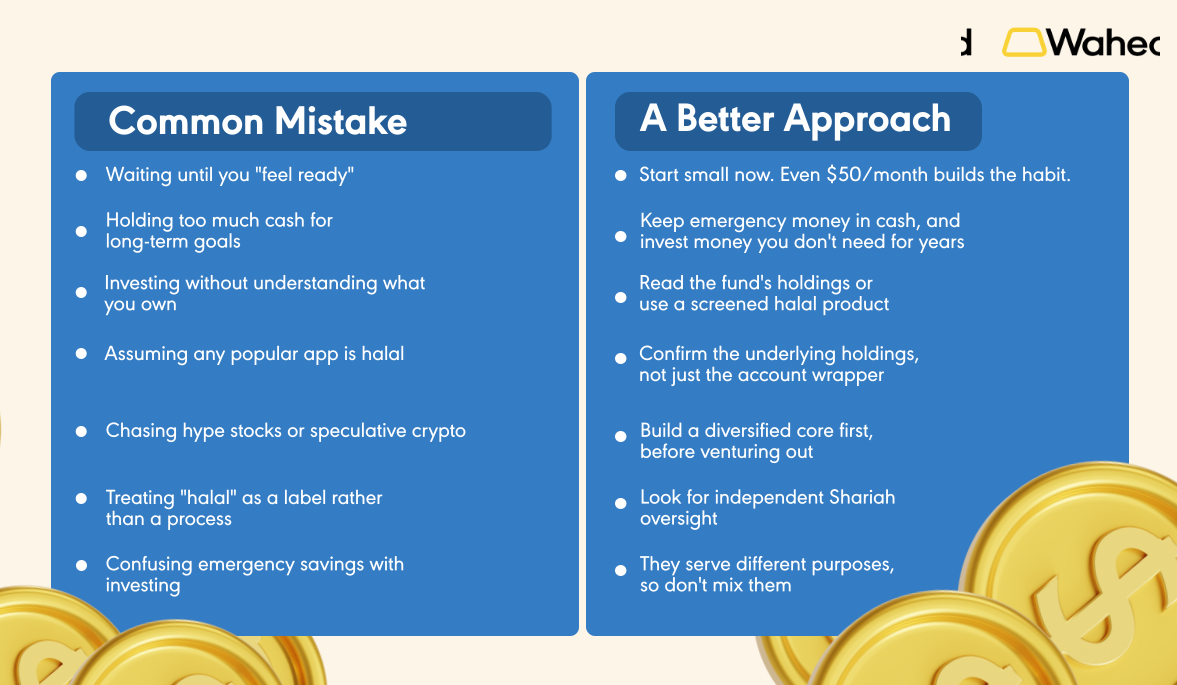
Cash is useful for short-term needs, but it struggles to keep up with inflation over decades. Investment money is different. It's money you can leave invested through downturns without panic-selling, and mixing the two is one of the most common reasons new investors lose confidence early.

Step-by-Step: How to Start Halal Investing
1. Build an Emergency Fund
Before any investing, you need liquidity. An emergency fund keeps you from selling investments at the worst possible time, such as during a market dip when an unexpected car repair, medical bill, or job change hits.
A reasonable target is three to six months of essential expenses in a safe, liquid account. If that feels far away, start with a "starter" fund of one month's expenses, then build your halal investment portfolio alongside it.
2. Set Clear Financial Goals
Different goals deserve different homes.
- Short-term (0 to 2 years): rent, a car, a wedding, moving costs, tuition, the emergency fund itself. This money belongs in cash or low-risk holdings.
- Medium-term (2 to 7 years): home down payment, family planning, career transition. Moderate investing may be appropriate, but the time horizon limits how aggressive you should be.
- Long-term (7+ years): retirement, financial independence, sadaqah and legacy goals. Equity-heavy halal portfolios fit best here, because there's time to ride out volatility.
Money you'll need soon shouldn't sit in an aggressive equity portfolio.
3. Choose Halal Investment Options
You have three main paths, and each fits a different appetite for DIY work.
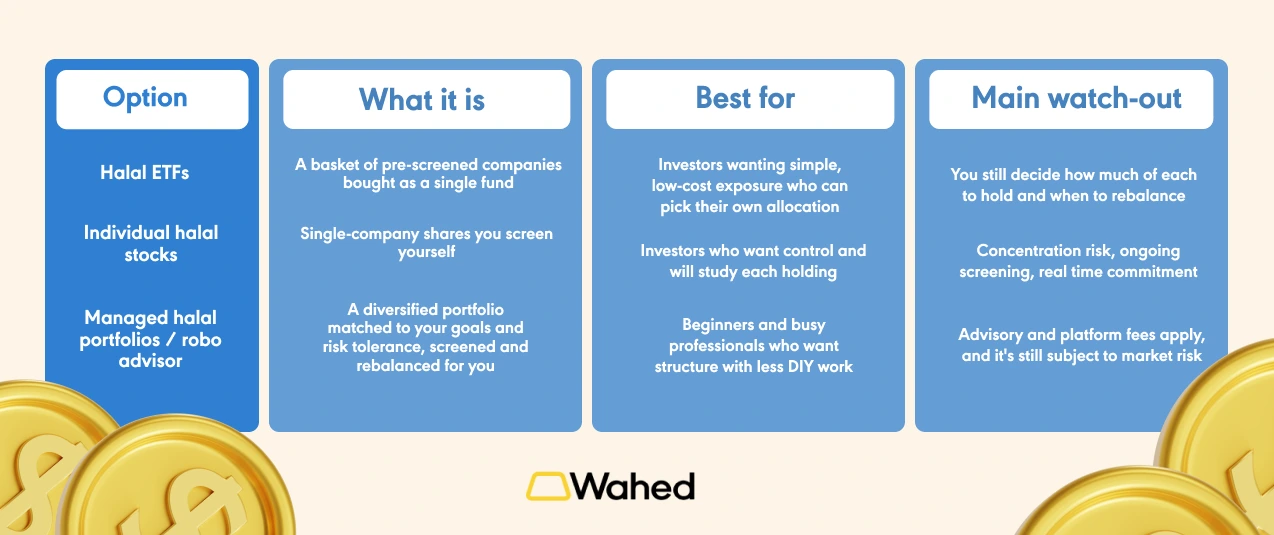
There's no universally "best" option, just the one that fits the time, interest, and expertise you have. For most young Muslim professionals juggling a demanding job, a managed halal portfolio reduces the friction of getting started.
4. Start Small and Stay Consistent
Dollar-cost averaging means investing a set amount on a regular schedule, and it turns investing into one decision you only make once: how much, how often. A young professional might start with $50, $100, or $250 a month and raise the contribution as income grows. In year one, the habit matters more than the dollar amount.
Best Halal Investment Options for Beginners
A few practical categories worth knowing for beginner investing in the U.S.:
- Diversified halal portfolios. Managed across U.S. equities, international equities, and sukuk. A hands-off, Shariah-screened starting point.
- Shariah-compliant ETFs (halal ETFs). Listed on U.S. exchanges and growing in number. Useful for low-cost passive exposure if you're comfortable picking allocations.
- Halal retirement investment. Roth and Traditional IRAs are tax wrappers. The wrapper itself isn't halal or haram. What matters is what you hold inside. Read our blog on Roth IRA vs Traditional IRA for Muslims in the U.S.
- Halal real estate. A separate category once your basic portfolio is in place. Read: Is Real Estate Investing Halal in the U.S.?
Best fit: Want simplicity? A managed halal portfolio. Want control and willing to learn? Halal ETFs or screened halal stocks. Investing for retirement? Halal IRA options. Diversifying beyond equities later? Halal real estate.

Example: Starting With $1,000
Meet Amina, 27, who works in tech, has $1,000 saved, no investing experience, and wants to start investing the halal way. This isn't personalized advice, just a framework.
Scenario A: No emergency fund yet. Amina keeps the $1,000 liquid as a starter emergency fund. Over the next few months she builds a basic cushion, then begins investing with new monthly contributions. She doesn't put her last available dollar into a market that could drop next quarter.
Scenario B: She already has a small emergency fund. Amina considers investing some or all of the $1,000 into a diversified halal portfolio aligned with her long-term goals and risk tolerance. She sets up a recurring $100 to $200 monthly contribution and avoids investing money she'll need in the next 12 to 24 months.
A hypothetical scenario, for illustration only: if someone invested $1,000 and added $100 per month for 10 years, the habit and time horizon end up mattering far more than the opening balance. Actual returns vary and investments can lose value.
How Much Should You Invest Each Month?
The honest answer is "as much as you can sustain," but a few benchmarks help.
- 5% to 10% of take-home pay is a reasonable starting range for a young professional getting serious.
- 10% to 15% is a stronger long-term target as income grows.
- Consistency beats amount. A reliable $100/month often outperforms an inconsistent $500/month.
A simple sequence: cover essentials first, then build emergency savings, stay current on required debt obligations, invest consistently for long-term goals, and raise contributions whenever your income raises.
Start Your Halal Savings Journey
You don't need to be a finance expert to invest halal in the U.S., and you don't need a six-figure portfolio to start investing halal way. You need a clear foundation: liquidity, defined goals, Shariah-compliant choices, and consistent contributions.
Wahed’s Everyday Shariah Account helps Muslim by providing a halal savings tool designed to help reach short-term goals, by seeking returns on par with the nations best high yield savings accounts. Best of all, the savings grow on a foundation that is completely riba-free.
Disclosure:
Risk Disclosure: For U.S. audience. The Everyday Shariah Account is a WRAP investment account managed by Wahed Invest LLC. Wahed Invest LLC is a U.S. Securities and Exchange Commission (SEC) registered investment advisor. This content is for informational purposes only and does not constitute investment advice or a recommendation to buy or sell any securities. All investments have market risk, including loss of principal. Past performance does not guarantee future result and there is no assurance any investment strategy will achieve its objectives or is suitable for all investors. The term halal denotes that permissibility in accordance with Islamic law.
This material is strictly for illustrative, educational or informational purposes only and does not constitute financial, investment, or legal advice. This information should not be relied upon as research, investment advice, or a recommendation regarding any products, strategies, or any security in particular.
Certain content represents an assessment of the market environment at a specific time and is not intended to be a forecast of future events or a guarantee of future results; material is as of the dates noted and is subject to change without notice.
Frequently asked questions
Investing can be halal when the underlying holdings comply with Islamic finance principles, which means no riba, no haram industries, no excessive uncertainty, and proper Shariah screening. The account or app itself doesn't make something halal. The holdings inside do. For personal religious guidance, consult a qualified Islamic scholar.
You don't need to be wealthy. The more useful question is whether your basic financial foundation, including emergency savings, debt payments, and predictable expenses, is in place. Start small and let consistency do the work.
Nothing is risk-free. It depends on your time horizon as well. Cash and Shariah-compliant savings may suit short-term needs, while diversified Shariah-compliant portfolios may suit long-term goals but can fluctuate in value. Be skeptical of anyone selling "guaranteed" halal returns.
Stay current on required payments first, because delinquency is costly. Build a small emergency fund. Whether to invest extra cash or accelerate loan payoff depends on income stability, loan terms, religious considerations, and personal comfort with debt. Consider speaking with a financial professional and a qualified scholar for your specific situation.
It depends. A standard U.S. or total market fund typically includes conventional banks, alcohol producers, gambling, and interest-bearing bonds. Shariah-compliant index funds and halal ETFs that apply proper screening do exist and are growing in number on U.S. exchanges. See Wahed’s Halal ETFs.