
%20(1).webp)

.webp)
Key takeaways
You don't need a large amount of money to begin investing, many platforms allow you to start with as little as $100.
Consistency matters more than the size of your starting balance, small, regular contributions compound meaningfully over time.
Investing should fit within a broader financial plan that includes an emergency fund and manageable debt.
Starting now, rather than waiting for a "perfect" amount or moment, gives your money more time to grow.
How Much Money Do You Need to Start Investing?
For many first time Muslim investors in the United States, figuring out how much money you need to start can feel complicated. In the age of social media, there is an abundance of information available which claims to provide the “proper” advice on this topic. With so many different articles, influencers, and information sources throwing solutions from a million different angles, it can create a sense of “analysis paralysis” for many first time investors.
When one feels as though a certain dollar amount is required to begin investing, they may end up putting off starting for years while they wait to reach it. In reality, long-term wealth is built through consistency and discipline, not with a large lump sum of cash. For those holding off on investing because you’re waiting for the right time, don’t feel as though you have enough savings, or are confused by conflicting information, it’s time to tune out the noise. This guide walks you through what actually it takes to get started, how to think about doing so, and how to build an investing plan suitable for your current financial situation.
The Biggest Myth About Investing
Over time, many have become accustomed to the idea that to start investing, it requires thousands of dollars just to get your foot in the door. Fortunately, this is an outdated perspective. The reason it exists in the first place can arguably be tied to the fact that older brokerage accounts did require high minimums, though reasons vary. Regardless, this myth is a dangerous concept because it can cost people the one thing money can never buy: time. Putting off investing until one reaches a designated dollar amount means losing years of growth that could’ve been utilized by starting small and building from there.
In reality, the barrier to entry that may have existed generations ago has become completely irrelevant. Progress of financial technology and the internet in the 21st century has made it so that anyone can get started investing regardless of income level or net worth. Many platforms, including Wahed, allow you to start investing with as little as $100. That said, with the abundance of financial applications today even that amount is not a required starting point. The key here is that the earlier you begin, even modestly, the more time your money has to work for you. Even if you believe you’re getting a late start, getting started in the first place is all that matters.
Why Starting Now Matters More Than Starting Big
The reason it is important to start investing early as opposed to starting with a large amount is compounding. Consider this example: if 5 days a week you had invested just $10 a day in the S&P 500 starting in August of 2016, by August 2026 you would have made over $53,0001. That $200 consistent and modest contribution demonstrates the power of compounding. This doesn’t have to be a difficult feat to accomplish either with modern financial technology. You can open up a brokerage account of your choice, connect your bank account, and set it up so that $10 is automatically withdrawn from your bank every day and put straight into a suitable Shariah-compliant fund or investment portfolio.
The point here is that the longer your money has to compound, the more meaningful that growth becomes. Time spent investing in the market on a consistent basis matters much more than the size of your initial contribution. Consistency is the key to building long-term wealth.
How Much Do You Actually Need?
The previous example should not be seen as a universal guideline for everyone to follow. The amount of money any individual investor needs to get started depends on a variety of factors. These include available cash flow, financial goals, investment platform of choice, and whether you have already have emergency savings established. That said, here’s what starting with several different amounts can look like:
Starting with $100 is often enough to open an account and begin investing on many financial platforms like Wahed. While a one time investment of this level won’t build significant wealth overnight, it is a good starting point to establish the habit of consistent investing.
Starting with $500 is a slightly larger initial investment to start with but still comfortably fits into many early career budgets. It can also give you more flexibility for diversification into multiple assets depending on platform and portfolio choice.
Starting with $1,000 is a good choice for those who have been able to accumulate sufficient savings before deciding how to invest and where to begin. This amount provides a stronger initial foundation, although it should still be viewed as a starting point, not a one-and-done type of ordeal.
Overall, the honest takeaway is that the specific number you choose to start investing with matters far less than actually starting in the first place and staying consistent. As mentioned previously, investing monthly instead of waiting is arguably the best course of action as it pertains to this matter. Even if it is modest, committing to a consistent monthly contribution is a more reliable way to build wealth as opposed to waiting for a particular number to begin with.
Should You Save Before You Invest?
This is a common and important question for many first time investors. The answer depends largely on personal preference and individual circumstances as there is no single universal rule. Generally speaking, it’s smart to establish an emergency fund in a suitable savings account before investing meaningfully. This is so that when you do begin investing, an unexpected expense doesn’t force you to prematurely liquidate any of your investments to cover it. It’s also a good idea to prioritize addressing any interest-bearing debt or credit card balances before investing as interest cost on that debt tends to overshadow typical investment returns.
That said, many people are comfortable with investing and saving simultaneously, especially at modest levels. It is certainly possible and easily attainable for many to build up an emergency fund while investing so long as your financial situation allows for it. Still, this is worth reviewing on an individual level before proceeding as it is highly dependent on personal circumstance. Beyond this, your financial life doesn’t necessarily need to be in perfect order before starting to invest, just in a stable enough place that you are comfortable with.

What Should Beginners Invest In?
A good rule of thumb for first time investors is to avoid putting all your eggs in one basket. Instead of selecting a single winning investment, it is more important to build a solid foundation that supports your long-term financial picture.
Beginners should focus on establishing a diversified portfolio where investments are spread across a broad mix of diversified Shariah-compliant mutual funds, index funds, and ETFs. This helps manage risk while still capturing long-term growth potential. Concentrating funds in a single stock or sector creates unnecessary risk and can be subject to significant losses during a market downturn.
For Muslim investors looking to build wealth that aligns with Islamic principles, Shariah-compliant ETFs are a great place to start. Exchange-traded funds screened for Shariah compliance offer diversified exposure without having to individually vet the underlying holdings themselves. At Wahed, we offer three different ETF options available to Muslim investors looking to gain exposure to halal investments structured in accordance to Islamic principles. For more information, visit the ETF tab on our website.
How Much Should You Invest Each Month?
The determination of how much to contribute to your investment portfolio on a monthly basis is highly dependent on personal preference and individual circumstances. That said, there are a few simple frameworks that can be used to help you make the best decision.
The first is to designate what percentage of income you are comfortable allocating toward investment. As mentioned, the amount doesn’t necessarily have to be significant. The key is consistent contribution so that it can scale naturally as earnings grow over time. A fixed monthly amount (or daily) serves the same purpose. For those that prefer predictability, setting a specific dollar amount to invest every month (or day) can simplify budgeting and establish a habit that is easy to maintain. Additionally, as your income grows and financial circumstances improve, consider increasing contributions over time. When permissible, this helps your investing strategy stay aligned with your financial life and long-term goals.
A Simple First Year Investing Plan
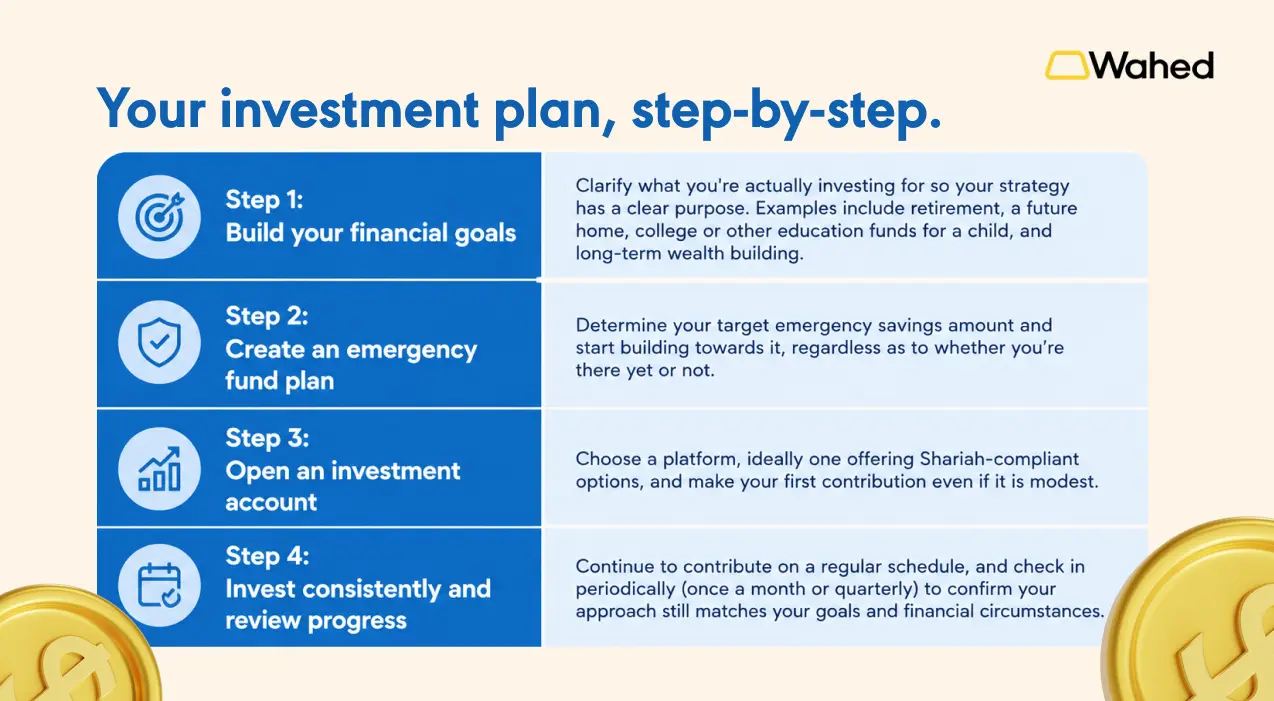
For young professionals and other first time investors unsure of where to begin, this graphic can serve as a simple roadmap to reference. This is not a rigid or fixed timeline to be followed, but rather a simple structure to help you move from intention to action over the course of a year. For those looking to get started quickly, the first three steps of this same framework can also be applied in a shorter time span such as a month or a week.
Common Mistakes New Investors Make
- Waiting for the "perfect time." Markets will always feel uncertain in some way, and waiting for ideal conditions often just means waiting indefinitely.
- Believing they need more money than they actually do. As covered above, this belief alone keeps many people from starting years earlier than they otherwise would.
- Trying to pick winning stocks. Beginners are often better served by diversified, long-term investing than attempting to identify individual outperforming stocks.
- Investing before building basic financial stability. Skipping an emergency fund or ignoring high-interest debt in favor of investing can create unnecessary financial strain.
- Stopping after short-term market declines. Reacting to short-term volatility by halting contributions or withdrawing funds often undermines the long-term strategy that was working in the first place.
Take the First Step Toward Long-Term Wealth
You do not need to have your whole life figured out or acquire a large sum of money to begin building long-term wealth. Ultimately what is most important is getting started, staying consistent, and building a strategy aligned with your financial goals and values. When it comes to investing for the first time, confidence and clarity, not perfection, is what moves one from intention to action.
Sources:
- DQYDJ.com: The S&P500 Periodic Investment Calculator*
Disclaimer:
*For illustrative purposes only and does not represent a real investment. Rates of return vary over time. You cannot invest directly in an index. S&P 500 is a stock market index tracking performance of 500 companies and considered to be a general measure of US equity market performance. Past performance does not guarantee future results.
Wahed Invest LLC (Wahed) is a U.S. Securities and Exchange Commission (SEC) registered investment advisor. Wahed Invest provides brokerage services to its clients through its brokerage partner Apex Clearing Corporation, a member of NYSE - FINRA - SIPC and regulated by the SEC and the Commodity Futures Trading Commission. Registration does not imply a certain level of skill or training. Wahed does not intend to offer or solicit anyone to buy or sell securities in jurisdictions where Wahed is not registered or a region where an investment practice like this would be contrary to the laws or regulations. Any returns generated in the past do not guarantee future returns. All securities involve some risk and may result in loss. Any performance displayed in the advertisements or graphics on this site are for illustrative performances only. Diversification does not guarantee a profit nor protect against loss.
Frequently asked questions
Yes. Many platforms, including Wahed, allow you to begin investing with as little as $100.
Generally, no. Waiting to accumulate a large sum often means missing years of potential growth. Starting small and staying consistent tends to be more effective than waiting for an arbitrary "enough."
All investing carries some risk, but a diversified, long-term approach helps manage that risk more effectively than concentrated or short-term strategies, which tend to be riskier for anyone, not just beginners.
It depends on the type of debt. Interest-bearing debt should generally be prioritised appropriately alongside saving and investing, based on the individual’s circumstances and obligations.
Rather than a single specific investment, a diversified, Shariah-compliant portfolio designed for long-term growth is generally a strong starting point, giving you broad exposure while staying aligned with Islamic principles.
.webp)
