


%20(1).webp)

.webp)

Key Takeaways:
Is Real Estate a Safe Investment During a Recession? A Muslim Investor's Guide
This year has been plagued with a great deal of economic uncertainty. This being the case, many economic experts and market participants have been raising concerns that the US economy may be heading into a recession in the near future. Whether you’re figuring out how to save for a house, currently own property, or are in the process of doing so, the idea of an incoming recession can feel troubling. Since there is no definitive way to predict when or if this will actually happen, understanding how to prepare for its potential arrival is ultimately the best course of action.
That said, it’s important to first note that no investment can be considered entirely risk free under any circumstance. However, real estate acquired without mortgage debt may remove certain systemic pressures (i.e. bank-driven foreclosures) that tend to affect leveraged property during economic downturns. For Muslim investors who already avoid conventional debt on religious grounds, this distinction can be worth understanding in more depth. This guide walks through how recessions have historically affected real estate, what went wrong during the 2008 housing crisis, how a debt-free approach to property investing is beneficial during economic downturns, and more.
What is a Recession & How Does it Affect Real Estate?
The National Bureau of Economic Research (NBER) traditionally defines a recession as “a significant decline in economic activity that is spread across the economy and that lasts more than a few months.1” This is reflected across measures like real GDP (Gross Domestic Product), employment, industrial production, and retail sales. During a recession, public markets tend to react swiftly: hiring often slows or freezes, consumer spending pulls back, corporate profits can fall, and investor sentiment shifts. This typically causes financial markets to experience significant volatility. Real estate, however, tends to respond through a different set of mechanics.
- Home buyer demand: Rising job uncertainty and tighter bank underwriting standards can reduce the pool of active buyers.
- Housing supply: Property owners without debt pressure are generally not forced to sell, which can help keep available market supply lower during a downturn.
- Rental market demand: Demand for rental housing may hold steady or even increase, as some households delay a home purchase, which can help keep residential rental activity relatively stable.
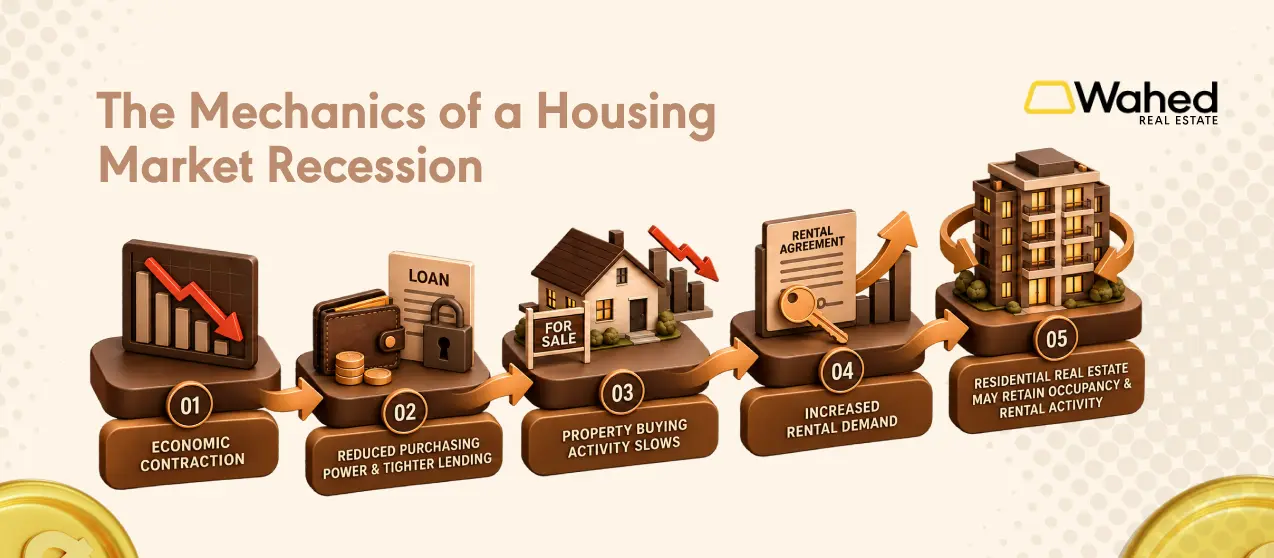
This graphic further illustrates the flow of how a widespread economic contraction tends to move through the housing market:
Historical Performance of U.S. Real Estate During Recessions
The “Great Recession” of 2008, triggered by the infamous housing crisis, has understandably led many to believe every recession automatically triggers a property market crash. However, historical data suggests that this isn’t necessarily true. In fact, in four of the last six official US recessions, home prices actually held steady or even appreciated.
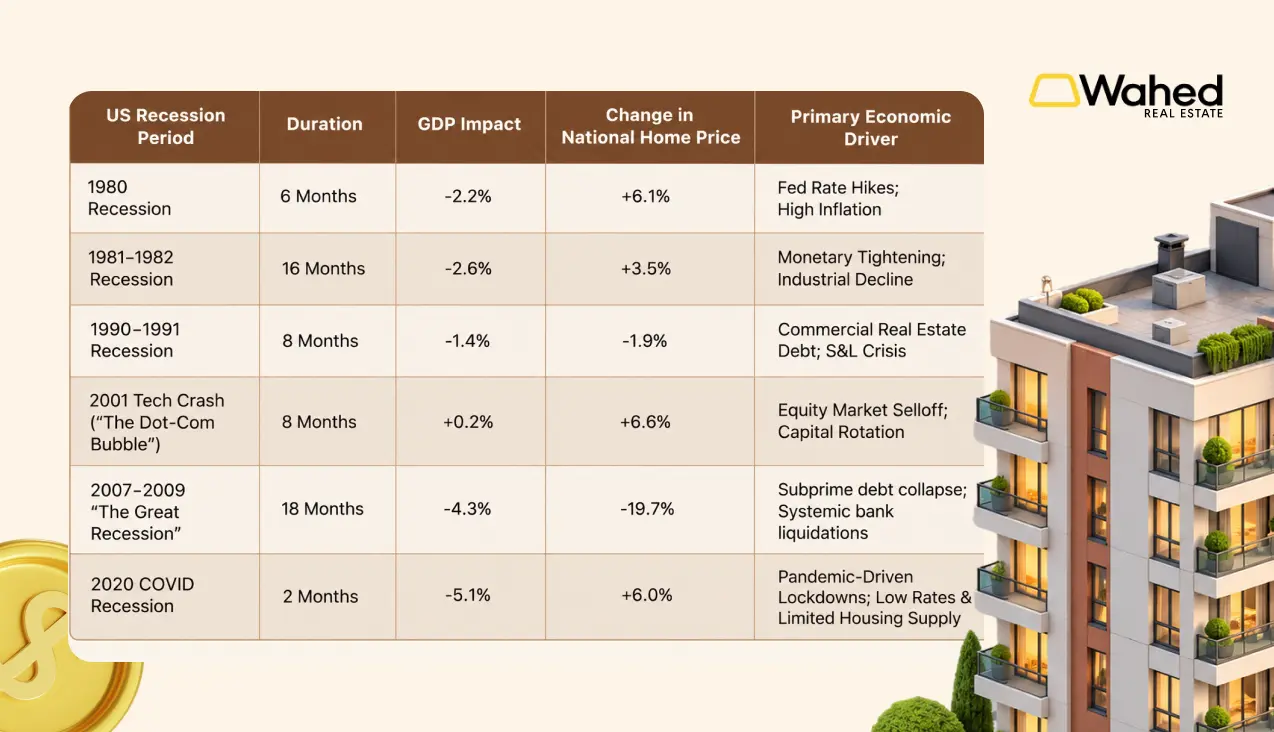
It is important to note that the two primary indices used to track these figures measure slightly different things. The FHFA House Price Index2 tracks conventional, conforming mortgages specifically, and shows roughly a 12.0% decline during the 2008 downturn. The Case-Shiller index3 includes distressed sales in its calculation, which is part of why it shows a steeper 19.7% decline over the same period. This does not mean that either figure is "wrong," but rather that they're simply measuring different slices of the market. This is worth understanding before comparing headline statistics from different sources. Regardless, the 2007-2009 period from the previous graphic stands out as a clear structural outlier in relation to the other five recessions on the chart. There is a substantial reason for this, which is why it is important to cover in detail.
What Caused the 2008 Housing Crash?
The Great Recession of 2008 is often remembered as being triggered by a collapse of the US real estate market. In reality, it can be more accurately described as a debt and financial leverage collapse of which the housing market happened to be in the center. Not the systemic failure of real estate itself as an asset class. These are the three stages that triggered the historic recession:
- Subprime debt expansion: Lenders issued interest-based mortgages without properly verifying the borrowers’ ability to actually repay them.
- Securitization: Banks bundled these high-risk loans into complex financial instruments which were then sold globally. These included Mortgage-Backed Securities (MBS) and Collateralized Debt Obligations (CDOs).
- Extreme institutional leverage: Major firms held massive balance sheets, including large positions in MBS and CDOs, against a comparatively small equity base, meaning even a modest decline in asset values could erase their equity entirely.
A good case study as it pertains to the point of extreme institutional leverage is with Lehman Brothers. By 2007, Lehman Brothers held roughly $680 billion in total assets against only about $22.5 billion in firm equity4. The remainder was financed through borrowed debt, producing a leverage ratio near 31-to-1. Under that structure, a decline of just 3% to 4% in the value of its underlying real estate-related assets was enough to erase the firm's entire safety net of equity. Lehman filed for the largest bankruptcy filing in US history in September 20085, listing roughly $639 billion in assets at the time.
Regardless, what followed was a disastrous foreclosure cascade. Between 2007 and 2010, roughly 3.8 million American households experienced foreclosure6, with filings peaking at roughly 2.87 million in 2010 alone. In fact, some sources even cite this number being as high as 6 million foreclosures7 occurring during this timeframe. As lenders seized and resold these properties (often at discounted, liquidated prices), it placed additional downward pressure on surrounding home values nationwide, compounding the initial decline.
How Interest Rates and Debt Leverage Increase Real Estate Risk
These two related concepts can help explain why leveraged real estate can behave so differently from debt-free property during a downturn: leverage and interest rate risk. Leverage refers to borrowing debt to acquire property in an effort to amplify potential returns. Interest rate risk refers to what happens when borrowing costs rise. As central banks raise rates, debt coverage can tighten. As a result, property values may adjust downward.
These two factors often combine to force bank-financed real estate into a sale during economic downturns, which typically happens through one of the following mechanisms: margin calls and refinancing risk. When commercial property values decline, lenders may demand additional cash collateral to maintain the loan, known as a margin call. If the borrower can't supply that cash, the lender can force a liquidation, often at or near a market bottom. Public disclosures from mortgage REITs, such as those found in SEC EDGAR filings8, outline how these margin call terms are typically structured. The second mechanism, refinancing risk, comes from the fact that commercial real estate loans typically mature every 5 to 10 years, requiring the borrower to refinance the remaining balance. If prevailing interest rates have risen since the original loan was issued, refinancing at that higher rate can increase monthly payments meaningfully, which may erode the income available for distribution.
Why Debt-Free Real Estate May Perform Differently in a Recession
Overall, a debt-free structure may offer a few specific operational differences from a leveraged one for the following reasons:
- No lender pressure: Without a bank loan attached, there are no monthly interest obligations, no debt covenants, and no margin call triggers to manage.
- No forced sales: If property values decline temporarily during a downturn, an owner without debt isn't compelled to sell at a loss to satisfy a lender. Holding the property and collecting available rental income while values potentially recover remains an option.
- Rental income without interest drag: Net rental income can flow to investors as distributions without first being reduced by interest payments owed to a lender.
- Geographic diversification: Holding residential properties across multiple growing markets may help spread exposure across different regional economies, rather than concentrating risk in one area.
What to Expect in a Recession: Risks & Downsides
Owning real estate with no mortgage debt certainly holds obvious benefits for Muslim investors during economic downturns. When there's no bank loan attached to the properties, temporary income dips or price drops don't trigger insolvency, bank foreclosures, or forced asset sales. The fund can simply hold its properties through the cycle while collecting whatever rental income is available. However, this doesn't remove risk altogether, which is why it's worth being direct about what can still happen to a zero-debt fund during a recession for the following reasons:
- Tenant vacancy risk: If local unemployment rises during a recession, tenants may face financial hardship, which can lead to higher turnover or longer vacancy periods on individual properties.
- Moderating rental distributions: Temporary drops in rent growth or an increase in vacancies can reduce net rental income, which may result in lower quarterly distributions paid to investors.
- Property valuation adjustments: Independent real estate appraisals may reflect lower property values during broader market corrections, which can temporarily reduce a fund's net asset value (NAV).
Leverage, Riba, and Financial Risk: An Islamic Perspective
Everything covered so far, the mechanics of leverage, the 2008 crash, and the risks that remain even in a zero-debt structure, connects directly to core Islamic financial principles. Taking on interest-based debt to amplify real estate returns runs against Shariah rulings on Riba in U.S. mortgages, and can introduce exactly the kind of systemic fragility described above.
Conventional mortgage structures also raise a concern around asymmetric risk. This is because the physical and market risk of the property sits entirely with the borrower, while the lender's interest-based return is largely fixed regardless of how the underlying asset performs. Islamic finance instead requires that transactions be backed by real, tangible assets and productive commercial activity. By excluding debt leverage from the structure, this approach may also naturally avoid the forced liquidations and margin calls that can affect leveraged real estate during a market contraction.
Introducing the Wahed Real Estate Fund
The Wahed Real Estate Fund is one practical application of this debt-free approach for Muslim investors.
- 100% cash-financed. Every single-family residential property in the fund is acquired outright with cash equity. No debt or mortgage leverage is used at any level.
- No lender interference. Without bank financing involved, there are no interest obligations, loan covenants, refinancing deadlines, or exposure to bank-driven foreclosure.
- Asset-backed co-ownership. Investors hold shares of a Real Estate Fund that acquires actual physical residential properties, not a debt instrument.
- Geographic diversification. The fund holds single-family rental homes across a range of growing U.S. markets, including Texas, Michigan, and North Carolina, aimed at reducing concentrated regional risk.
- Accessibility. The minimum investment starts at $100.
.webp)
Build a Resilient Investment Portfolio for any Market Cycle
In reality, recessions are virtually an economic certainty over any long investment horizon. This being the case, what tends to matter more than predicting them how a portfolio is built to withstand it. As this guide has covered, the distinction between leveraged and debt-free real estate can be significant, sometimes the difference between an asset that weathers a downturn and one forced into a sale at the worst possible moment. No single asset class performs the same way in every environment, which is part of why diversification across different types of assets tends to be a reasonable approach to long-term portfolio construction, and Wahed offers access to a range of these asset classes as part of a broader, Shariah conscious investment strategy. When approached without debt, real estate and other related investments like self-funded real estate portfolios may offer a particular kind of resilience during uncertain periods. Not because it is immune to market pressure as an asset class, but because it isn't structurally forced to react to it the way leveraged property often is. This is a distinction worth factoring into how a portfolio is put together well before a downturn actually arrives.
Sources
- National Bureau of Economic Research: Business Cycle Dating Procedure: Frequently Asked Questions
- Federal Housing Finance Agency (FHFA): House Price Index (HPI) Datasets & Reports (Historical U.S. home price changes across recessions: 1980, 1981–82, 1990–91, 2001, 2008, 2020).
- S&P Dow Jones Indices / Federal Reserve Bank of St. Louis (FRED): S&P CoreLogic Case-Shiller U.S. National Home Price Index (CSUSHPISA) (Peak-to-trough national residential price decline data during the 2007–2009 Great Recession).
- Lehman Brothers Holdings Inc. Chapter 11 Proceedings Examiner's Report: Lehman Brothers Holdings Inc. Chapter 11 Examiner's Report (Anton R. Valukas) (Balance sheet leverage data: $680B assets vs. $22.5B equity; 31:1 leverage ratio). Docket No. 08-13555.
- Yale School of Management: The Lehman Brothers Bankruptcy: An Overview
- Federal Reserve Bank of Chicago: Research on Foreclosure Filings and Mortgage Distress (2007–2010) (Data on 3.8M+ foreclosures, completed foreclosures, and peak 2010 filing totals).
- CoreLogic: National Foreclosure Report (Data on completed foreclosures nationally, reaching approximately 6 million by September 2015, cumulative since the onset of the financial crisis in September 2008). https://www.corelogic.com/intelligence/national-foreclosure-report/
- U.S. Securities and Exchange Commission (SEC EDGAR): Form 10-K Annual Reports (Mortgage REIT Risk Factors & Margin Call Disclosures).https://www.sec.gov/edgar
Risk Disclosure:
This article is for educational and informational purposes only. It does not constitute financial, investment,legal, or religious advice. Wahed Financial, LLC ("Wahed"), as a manager of Wahed Real Estate Fund I LLC; Wahed Real Estate Series I, LLC (the “Wahed Issuer”), operates the wahed.com/real-estate website (the "Site") and is not a broker-dealer or investment advisor. All securities related activity is conducted through Dalmore Group LLC, a registered broker-dealer and member of FINRA/SIPC, located at 525 Green Place, Woodmere, NY 11598.
This investment is speculative, illiquid and involves substantial risk, including the possible loss of your entire investment. Securities are offered through Dalmore Group LLC, Member FINRA/SIPC. Wahed and Dalmore are not affiliates. Investors will be clients of Wahed. An offering statement has been filed with the SEC. SEC qualification does not imply approval or endorsement of the offering’s merits. Please review the full offering circular for complete terms and risks.
Investors are purchasing shares of a Fund and not the underlying asset(s) of the Fund. There is no assurance any Fund will achieve its objectives, is not listed on an exchange and may not be suitable for all investors. Distributions are subject to and are not guaranteed.


.webp)