


%20(1).webp)

.webp)

Key Takeaways:
Real Estate Portfolio Allocation: A Halal Investing Guide
Allah says in the Quran, Surah Al-Furqan (25:67): "And [they are] those who, when they spend, do so not excessively or sparingly but are ever, between that, [justly] moderate."
For Muslim investors trying to determine how much of their portfolio should be in real estate, this passage is of great importance. The instruction to seek balance and avoid extreme excess and neglect applies just as much to how we invest as it does to how we spend. Through the lens of investment, this balance is known as asset allocation. Achieving it looks like maintaining a diversified portfolio: an approach consistent with preserving and stewarding what Allah has provided (Hifz al-Mal), rather than exposing it carelessly to a single source of risk.
This guide provides a balanced perspective on real estate portfolio allocation. It will walk through how professional investors think about this problem, why the models most people rely on don't actually work for Muslim portfolios, and what a workable alternative looks like.
The Risk of Asset Concentration
Imagine a scenario where someone has saved up a significant sum of capital and decides to invest it. This person is very passionate about technology and has seen the sector perform well recently, so they decide to invest the lump sum of that capital directly in the sector across a handful of stocks. After a few months of great performance, this individual feels as though they have made a great investment. However, out of the blue an economic downturn occurs, and the losses incurred far outpace any of the previous gains.
This is exactly how many retail investors end up building their portfolios without realizing it. Not out of recklessness, but because it's simply what they know: buy shares in companies whose products they use every day or invest in what is performing well at the moment. This is known as concentration risk, and is what the practice of diversification in asset allocation exists to solve. Diversification simply means spreading your capital across different types of investments so a downturn in any single area doesn't derail your entire financial plan.
While for experienced investors today this may seem like common sense, this wasn’t always the case. In 1990, Harry Markowitz won the Nobel Prize in Economic Sciences for mathematically proving that combining assets which behave differently from one another reduces a portfolio's overall volatility without sacrificing returns. His work became the foundation of diversification through what's known as Modern Portfolio Theory1. It remains the backbone of how professional investors, including the largest institutions in the world, build portfolios today.
How Conventional Portfolios Are Built
For decades, standard advice for the average investor has centered on what's known as the 60/40 portfolio2. This refers to a portfolio invested 60% in public equities and 40% in fixed income, typically bonds. The idea with this strategy is pretty straightforward. While equities provide growth, they can also be volatile. Bonds, on the other hand, provide steady, predictable income and tend to hold their value when stocks fall, acting as a shock absorber for the portfolio as a whole. That said, it is important to note for Muslim investors that since fixed-income instruments like bonds are built directly on Riba, they are not Shariah-compliant. We will touch more on this dilemma in the following sections.
Regardless, large institutional investors take this same 60/40 logic further by reaching beyond stocks and bonds into physical, tangible holdings like real estate. The most well-known example of this approach is the Yale Endowment Model3, pioneered by David Swensen, who served as Yale's Chief Investment Officer from 1985 until his passing in 2021. Swensen moved Yale's endowment away from a conventional stock-and-bond mix toward a broader set of asset classes. This included meaningful exposure to real assets (i.e. precious metals and real estate), a strategy that reshaped how institutional investing is done more broadly.
However, because most individual investors can't access the private equity and venture capital vehicles institutions like Yale use, Swensen later wrote Unconventional Success, adapting his institutional approach into something workable for retail investors. His recommended model allocated real estate and REITs4 at a meaningfully higher weight than most individual investors typically hold, alongside a mix of U.S. and foreign equities, emerging markets, and government-backed securities4. This graphic represents a comparison between the two strategies:
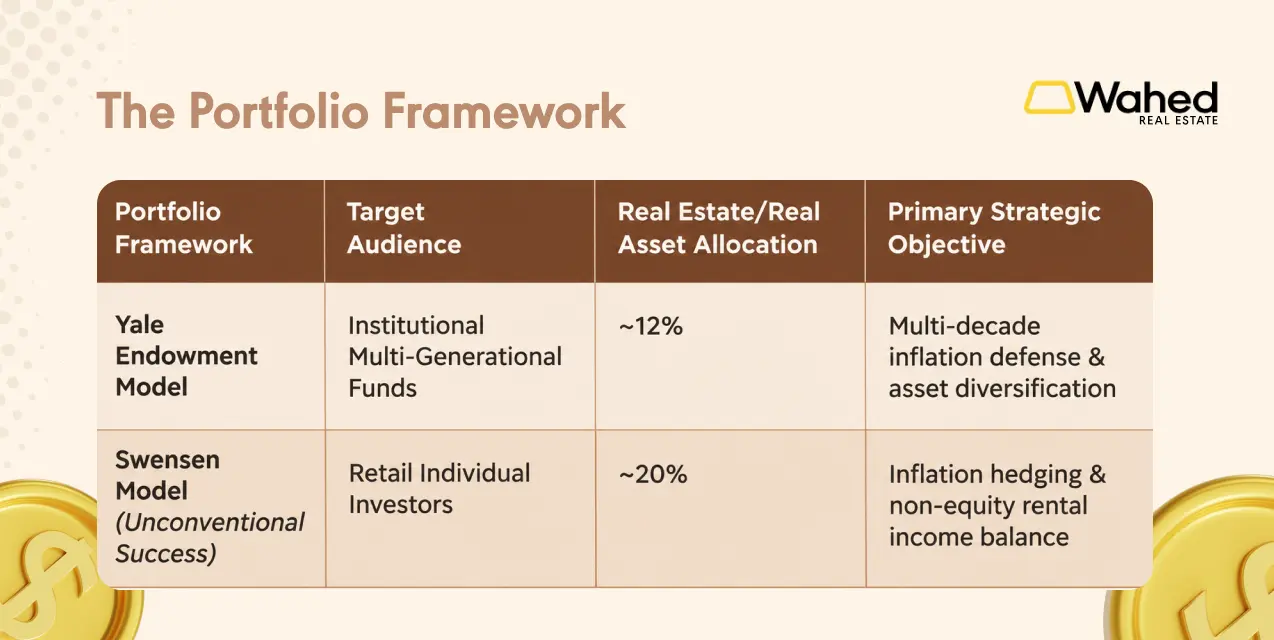
Both of these are established, published models, not arbitrary numbers, and reflect years of institutional experience managing capital across full market cycles. As you can see, the retail-focused model actually recommends a higher real estate allocation than the institutional one. This is because Swensen recognized that individual investors (without access to Yale's private equity and venture capital toolkit), needed real assets to do more of the diversification work.
Why Conventional Portfolios Create a Problem For Muslim Investors
As mentioned earlier, the 40% allocation of the 60/40 model is centered around fixed-income instruments like bonds. These are built entirely on Riba, which is forbidden. For Muslim investors looking to build a strong and stable investment portfolio, this presents a unique dilemma that most conventional investors do not have to grapple with.
By removing the 40% allocation to bonds, many Muslim investors can end up stuck between two extremes, neither of which is particularly comfortable. The first is holding 100% public equities. The issue with this is that when the stock market faces a downturn, there's nothing in the portfolio behaving differently to soften that fall. The second extreme is holding a heavy cash position instead. While this can avoid the volatility of stocks, conversely it exposes that money to a slower, quieter erosion: inflation. This steadily eats away at the cash position’s purchasing power year after year, often without the investor noticing until the damage has compounded.
Fortunately, there is a solution to this problem. It just requires substituting the role bonds play for everyone else (income and stability) with an alternative asset. This is where real world assets like real estate can become an advantage for Muslim investors.
Filling the 40% Gap with Real Estate
Real estate specifically fills the structural role bonds were built for in the 60/40 portfolio strategy, but through an entirely different mechanism. Instead of a fixed yield payment, debt-free real estate generates rental income through the actual cash flow tenants pay to use a physical property. That's commercial profit tied to real economic activity and productive use, not a guaranteed return manufactured from a loan.
There's also a practical purification advantage worth understanding. Public stock portfolios sometimes require income purification, since some underlying companies earn a small amount of otherwise non-compliant interest income as part of their normal operations. Platforms like Wahed generate purification reports to handle this automatically for equity holdings. Rental income from real property, by contrast, is already direct commercial profit from physical utility. Simply put, this type of income is earned the way Islamic finance intends because it is tied to a real asset and real productive use.
Real estate also tends to offer meaningful protection against inflation over time. Property values and rents have historically adjusted upward alongside the broader cost of living, helping protect purchasing power over long horizons in a way idle cash simply cannot.
Key Factors to Determine Your Real Estate Allocation
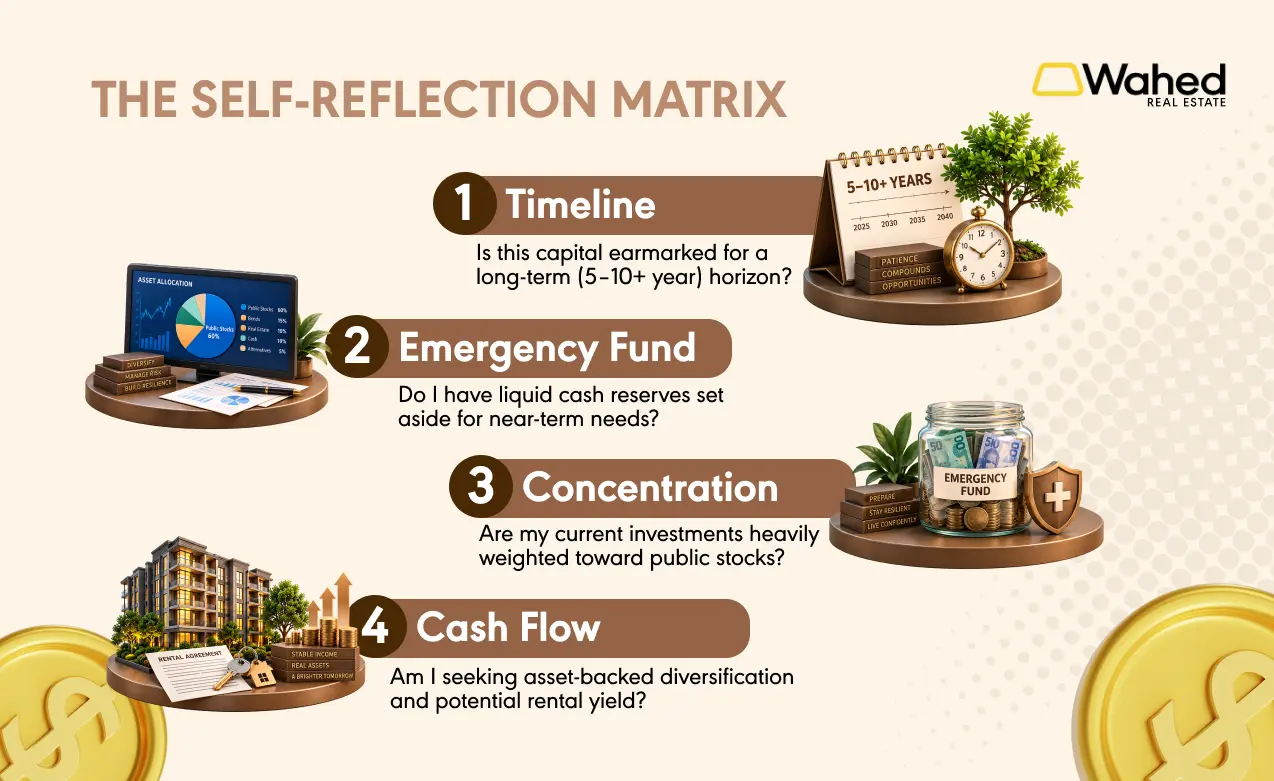
When determining an investment portfolio’s real estate allocation, it is important to note that there is no single figure that fits every household or individual. Fortunately, there are a few simple metrics that can help you think through where real estate might fit in your own plan.
- Investment Time Horizon: Capital you won't need for a long stretch (3, 5,10, or more years) can comfortably ride out the natural ups and downs of a real estate market cycle. However, money needed for the short term (3-12 months) should not be tied up this way and belongs somewhere liquid.
- Emergency Cash Reserves: Before allocating anything toward real estate, make sure you've set aside a separate, accessible emergency cash cushion for near-term needs. Real estate is not a good place to park any money you might need on short notice.
- Existing Asset Concentration: If your wealth already leans heavily toward technology stocks, equity funds, or a single sector, adding real estate provides exactly the kind of counterbalance that concentration is missing.
- Your Priorities: Income or Growth: Are you looking primarily for steady, potential rental cash flow, long-term capital growth, or some blend of both? Your answer shapes how much weight real estate should carry in your plan.
If you're still building toward a major near-term goal, like a home purchase, it's worth reading our guide on how to save for a house as a Muslim for how to think about that shorter timeline specifically.
What the Wahed Real Estate Fund Offers
What the Wahed Real Estate Fund Offers
For Muslim investors who want to access a real estate position without taking on mortgage debt or managing tenants and property maintenance themselves, the Wahed Real Estate Fund offers a practical way to build this exposure over time. Here are a few features of the Wahed Real Estate Fund that are worth understanding:
- Accessible entry: A $100 minimum allows everyday investors to begin building real estate exposure gradually, rather than needing a large sum upfront.
- 100% cash-financed: Properties are acquired outright, without mortgages or any form of conventional debt.
- Diversified residential assets: Rather than concentrating risk in a single property or a single market, the fund invests in single-family rental properties spread across multiple growing U.S. housing markets.
- Continuous Shariah governance: The fund is subject to ongoing, independent Shariah oversight and screening, not a one-time compliance check.
.webp)
If you’re looking for a more comprehensive breakdown of how the fund actually operates, from property selection through distributions, visit our complete guide to the Wahed Real Estate Fund. It covers these and more details in depth.
Build a Diversified Portfolio Aligned with Your Financial Goals
Developing a smart and stable investment strategy should not be about chasing a single winning stock or simply setting money aside and hoping for the best. Instead, it should be a deliberate process of aligning your capital with your long-term goals, timeline, and the values you're not willing to compromise on. For Muslim investors, that often means combining liquid cash reserves for near-term needs, halal equities for long-term growth, and debt-free real estate for the income stability and inflation protection that conventional portfolios get from bonds. Since financial goals differ at the individual level, it is smart to take an honest look at how your own portfolio is currently balanced, and consider whether real estate fits in that picture.
Sources:
- Nobel Prize Outreach: The Sveriges Riksbank Prize in Economic Sciences in Memory of Alfred Nobel 1990 (Harry Markowitz - Modern Portfolio Theory). [https://www.nobelprize.org](https://www.nobelprize.org)
- Vanguard Investor Education: Traditional Asset Allocation Models (The 60/40 Equity-to-Bond Benchmark). [https://investor.vanguard.com/investing/investment-strategy](https://investor.vanguard.com/investing/investment-strategy)
- Yale Investments Office / Yale News: Yale Endowment Annual Report FY2025 (Historical performance data & real asset allocation (~12%)): 11.1% FY2025 return. https://news.yale.edu/2025/10/24/yale-reports-investment-return-fiscal-2025
- Cambria Investments (Meb Faber Study): Can We All Invest Like Yale? Swensen's Individual Portfolio Model Analysis (Data on Swensen's Unconventional Success retail model: 20.0% real estate recommendation). [https://www.cambriainvestments.com/wp-content/uploads/2025/02/20250219-Can-We-All-Invest-Like-Yale-Approved.pdf](https://www.cambriainvestments.com/wp-content/uploads/2025/02/20250219-Can-We-All-Invest-Like-Yale-Approved.pdf)
Risk Disclosure:
This article is for educational and informational purposes only. It does not constitute financial, investment,legal, or religious advice. Wahed Financial, LLC ("Wahed"), as a manager of Wahed Real Estate Fund I LLC; Wahed Real Estate Series I, LLC (the “Wahed Issuer”), operates the wahed.com/real-estate website (the "Site") and is not a broker-dealer or investment advisor. All securities related activity is conducted through Dalmore Group LLC, a registered broker-dealer and member of FINRA/SIPC, located at 525 Green Place, Woodmere, NY 11598.
This investment is speculative, illiquid and involves substantial risk, including the possible loss of your entire investment. Securities are offered through Dalmore Group LLC, Member FINRA/SIPC. Wahed and Dalmore are not affiliates. Investors will be clients of Wahed. An offering statement has been filed with the SEC. SEC qualification does not imply approval or endorsement of the offering’s merits. Please review the full offering circular for complete terms and risks.
Investors are purchasing shares of a Fund and not the underlying asset(s) of the Fund. There is no assurance any Fund will achieve its objectives, is not listed on an exchange and may not be suitable for all investors. Distributions are subject to and are not guaranteed.


.webp)