%20(1).webp)

.webp)

Key Takeaways:
8 Questions Muslim Investors Should Ask Before Investing In Any Real Estate Fund
Allah says in the Quran, Surah Al-Hujurat (49:6): “O believers, if an evildoer brings you any news, verify ˹it˺ so you do not harm people unknowingly, becoming regretful for what you have done.” ¹
In Islam, we are taught the duty of Tabayyun; independent verification, as opposed to taking a claim at face value. This matters greatly for Muslims in the U.S. looking to invest according to Islamic values. Whether real estate investing is halal ultimately depends on how the investment is financed, structured, and operated. Not simply the asset class itself. For example, a "Shariah-compliant" label on a fund's marketing page tells you nothing on its own about that fund's actual debt ratios, fee layers, or SEC registration status. Those details only come from asking the right questions and reviewing the actual documentation.
For real estate funds, that means looking beneath the marketing materials at the fund's debt, fees, Shariah governance, regulatory structure, liquidity, diversification, and downside risks. This guide provides eight concrete, verifiable questions every Muslim investor should ask before allocating capital to any real estate fund. Each section provides an additional set of useful takeaway questions to ask the manager of your fund of choice.
1. What Percentage of the Fund is Financed with Debt?
The Prophet Muhammad (peace and blessings be upon him) said: “Leave what makes you in doubt for what does not make you in doubt.” (Jami` at-Tirmidhi 2518) ²
Few areas of real estate investing generate more doubt for Muslim investors than debt, and for good reason. Some Islamic financial screening methodologies don't require zero debt outright. They instead allow a limited tolerance for interest-bearing debt, provided it stays within certain thresholds. Those allowances were developed largely for screening publicly traded companies, and they differ from one methodology to the next rather than forming a single universal rule that every scholar or institution applies the same way. Even where some debt is tolerated, carrying interest-based debt on a property can still create real moral and financial doubt for many investors. Riba in U.S. mortgages and the alternatives available to Muslim investors is therefore an important part of evaluating how a real estate investment is financed. Leverage also introduces tangible fiduciary risk: debt payments don't pause just because rental income does.
A 100% cash-financed, zero-debt structure represents a different standard entirely, eliminating both Riba and mortgage default risk at the source rather than managing them within a tolerance threshold. The Wahed Real Estate Fund operates on exactly this basis. It is 100% cash-financed with zero mortgage leverage at any level.⁵
Questions to ask the fund manager:
- "What percentage of each property's purchase price is financed with debt?"
- "Does the fund allow a tolerance for interest-bearing debt, or is it 100% cash-financed with zero mortgages?"
2. Who Certifies Shariah Compliance and How Often?
There's a meaningful difference between a fatwa issued once at a fund's launch and genuine, ongoing operational oversight. A fund's Shariah compliance isn't a fixed, one-time deal. More broadly, whether real estate investing is halal depends on how the investment is financed, structured, and operated. Property acquisitions, tenant changes, and cash management all continue to happen well after launch, and each of those activities deserves periodic review, not a single sign-off years ago that's never revisited.
The Wahed Real Estate Fund's governance is facilitated by the Shariyah Review Bureau (SRB), with periodic Shariah audits conducted under SRB supervision rather than relying solely on a launch-day certification.⁶
Questions to ask the fund manager:
- "Who is the named Shariah advisory body certifying the fund?"
- "Is Shariah compliance audited periodically on an ongoing basis, or was approval given only at launch?"
3. What’s the Actual Net Return After Fees?
Gross rental income and the yield you actually receive are two very different numbers, and the gap between them matters. As an example, suppose a portfolio collects $100,000 in gross rent. Before anything can potentially reach investors, the fund may need to account for property management, maintenance, vacancies, insurance, taxes, reserves, and fund-level management expenses. A realistic breakdown might look like this:
- Gross rent collected
- Less: property management fees (typically 8%–10% of collected rent)⁷
- Less: maintenance and capital reserves (roughly 5% as a planning estimate)⁸
- Less: vacancy and collection-loss reserve (roughly 8%, or approximately one month of rent per year)⁹
- Less: fund management fee (often expressed as a percentage of invested capital or net assets and varying by manager)¹⁰
- = Net cash available for distribution
This is why headline yield alone tells an investor very little. What matters is the return remaining after the actual cost of operating the portfolio. Because fee structures vary by manager, investors should review each fund's disclosures carefully. Wahed investors can find a detailed breakdown of Wahed Real Estate costs and fees in the Real Estate Learning Center. More importantly, real estate distributions depend on tenant occupancy and broader market performance, and are never guaranteed. Any fund unwilling to walk you through this breakdown in detail is worth treating with caution.
Questions to ask the fund manager:
- What is the projected net distribution yield after expenses and fees?
- Which expenses are deducted before distributions?
- Are there acquisition, disposition, management, redemption, or performance fees?
4. Is the Fund Registered Under SEC Regulation A+ or Regulation D?
The fund is registered under regulation A+. The two regulations are genuinely different regulatory frameworks, and the distinction affects both who can invest and the disclosure requirements that apply.
Regulation A+ (Tier 2) offerings require audited financial statements along with annual, semi-annual, and certain current reporting with the SEC. Accredited investors generally aren't subject to Regulation A's investment limit, while non-accredited investors participating in certain Tier 2 offerings are generally limited to 10% of the greater of their annual income or net worth.¹¹
Regulation D (506(b)/506(c)) covers private-placement exemptions and operates differently. Rule 506(c) permits general solicitation but requires all purchasers to be accredited investors and requires the issuer to take reasonable steps to verify that status. Rule 506(b) prohibits general solicitation but can include up to 35 non-accredited investors who satisfy applicable sophistication requirements, in addition to accredited investors.¹²
It's worth being precise here: qualification by the SEC does not mean that the SEC has approved or endorsed an investment, nor does it guarantee investment returns.
Questions to ask the fund manager:
- "Under which SEC regulation does the fund operate, and who is legally permitted to invest?"
- "Can I inspect the fund's qualified offering circular and audited financials on the SEC EDGAR database?"
For reference, the Wahed Real Estate Fund's SEC Offering Circular is publicly available through the SEC's EDGAR database.¹³
5. When Can You Actually Get Your Money Back?
Real estate is fundamentally less liquid than publicly traded stocks. A house cannot normally be converted into cash at the click of a button, and investors shouldn't assume shares in a real estate fund can be either. Before investing, understand the fund's lock-up period, redemption schedule, withdrawal limits, and any fees associated with exiting early. For example, a fund might allow redemptions only during predetermined windows rather than every trading day. During periods of market stress, liquidity may become even more constrained.
For a practical example of how these terms work in a specific fund, How to Redeem Your Wahed Real Estate Fund Investment explains Wahed's redemption process, including the terms investors should understand before committing capital.
Questions to ask the fund manager:
- Is there an initial holding period?
- How often are redemption requests accepted?
- How much of my investment can I redeem during each window?
- What fees or restrictions apply?
- What happens if redemption requests exceed available liquidity?
6. How is the Fund Legally Structured?
There's an important legal distinction between purchasing a single physical property outright and purchasing fractional shares in a limited liability fund that holds multiple assets. In a properly structured fund, that limited liability structure should shield your personal wealth from property-level debts and legal liabilities, rather than exposing you directly.
Questions to ask the fund manager:
- "Am I purchasing fractional shares in a limited liability entity, and am I shielded from personal property liabilities?"
7. How Diversified are the Fund’s Holdings?
Real estate performance is tied closely to local employment trends and housing supply. A fund concentrated in a single housing market exposes every investor in it to whatever happens in that one local economy. These include factors such as a factory closure, a regional downturn, or an oversupply of new construction.
Holding assets spread across multiple distinct Metropolitan Statistical Areas (MSAs) instead helps dampen that kind of localized volatility, since a downturn in one market doesn't necessarily affect the others the same way. For more on how real estate fits within a broader diversification strategy, see our guide on how much of your portfolio should be in real estate.
Questions to ask the fund manager:
- How many properties does the fund currently own?
- Across how many distinct housing markets or MSAs?
- What percentage of the portfolio is concentrated in its largest market?
- How are new markets selected?
8. Examining Downside Risks and Stress-Test Scenarios
“O Messenger of Allah, should I tie my camel and trust in Allah, or should I leave her untied and trust in Allah?” The Prophet (peace and blessings be upon him) said: “Tie her and trust in Allah.” (Jami` at-Tirmidhi 2517) ¹⁴
The Bedouin's question gets at an important distinction in Tawakkul, or reliance upon Allah. Trust does not mean being passive with what has been entrusted to us. The Prophet's instruction was to take the practical steps available to protect the asset first, then place trust in Allah regarding the outcome.
For a real estate investor, “tying your camel” means stress-testing an investment before committing capital. Instead of assuming rents will remain stable and properties will continue appreciating, consider what happens when conditions move in the opposite direction. If local vacancy surges to 15%, for example, how much would distributions decline? If an oversupply of housing puts pressure on rents, how is the portfolio affected? And if a recession freezes real estate liquidity, what happens when investors simultaneously want to redeem their shares?
Tenant quality matters here as well. Screening standards can influence the risk of missed rent, turnover, and eviction-related costs, so investors should understand how a fund evaluates prospective tenants and manages deteriorating occupancy.
Your own finances should be stress-tested too. Real estate funds are generally long-term, relatively illiquid investments and should not replace liquid emergency reserves. Money you might need next month should not depend on a redemption being available during a market downturn.
Asking these difficult questions isn't a lack of faith. It's applying the same principle behind the Prophet's instruction: take reasonable precautions with what has been entrusted to you, then place your trust in Allah.
Questions to ask the fund manager:
- What happens to distributions if local vacancy surges to 15%?
- How does the fund respond to housing oversupply, falling rents, or an economic recession?
- What tenant-screening standards are used to reduce occupancy and payment risk?
- What happens to distributions and redemptions during severe market drawdowns or liquidity freezes?
- Could redemptions be delayed, limited, or suspended if market liquidity deteriorates?
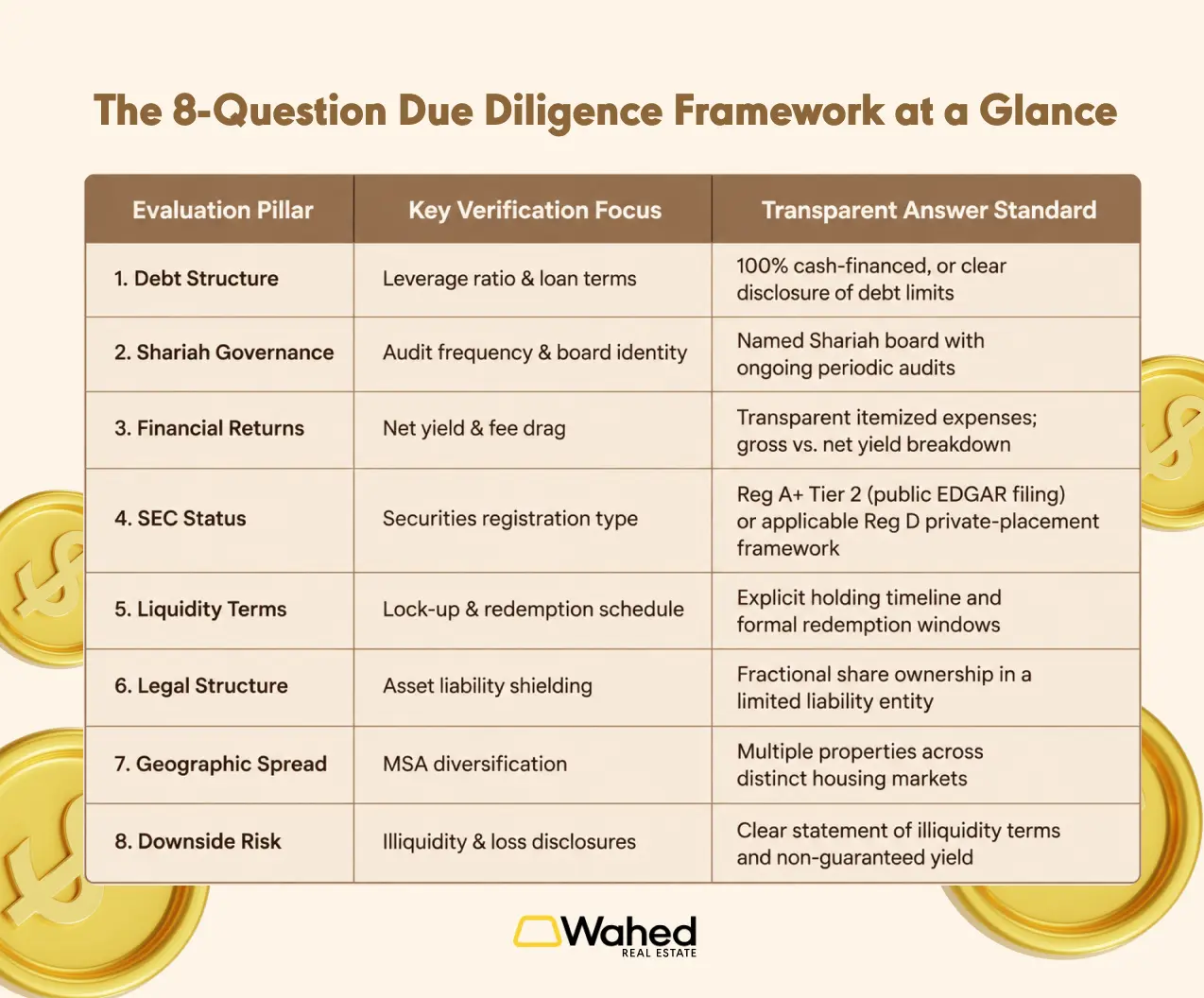
The 8-Question Due Diligence Framework at a Glance
Building Wealth With Diligence, Not Assumptions
A well-structured real estate fund should welcome rigorous investor scrutiny, not resist it. Asking about debt ratios, net yields, SEC filings, and redemption schedules isn't excessive caution, it's simply good stewardship of the wealth entrusted to you (Amanah). We'd encourage applying all eight of these questions to any real estate fund you evaluate, including the Wahed Real Estate Fund, where offering circulars, Shariah governance details, and fund terms are publicly accessible for exactly this kind of review.
Primary Sources & Reference Directory
- Quran.com — Surah Al-Hujurat (49:6)
https://quran.com/49/6 - Sunnah.com — Jami` at-Tirmidhi 2518, “Leave what makes you in doubt for what does not make you in doubt.”
https://sunnah.com/tirmidhi:2518 - Accounting and Auditing Organization for Islamic Financial Institutions (AAOIFI) — Shari'ah Standard No. 21: Financial Paper (Shares and Bonds)
https://aaoifi.com/shariaa-standards/?lang=en - S&P Dow Jones Indices — Dow Jones Islamic Market Indices Methodology
https://www.spglobal.com/spdji/en/documents/methodologies/methodology-dj-islamic-market-indices.pdf - Wahed — A Complete Guide to the Wahed Real Estate Fund
https://www.wahed.com/blog/a-complete-guide-to-the-wahed-real-estate-fund - Wahed Real Estate Learning Center — Shariah Audits and Shariyah Review Bureau Oversight
https://www.wahed.com/real-estate/learning-center/relc-article/are-shariah-audits-conducted-regularly - Apartments.com — How Much Does It Cost to Hire a Property Manager?
https://www.apartments.com/rental-manager/resources/expenses/how-much-does-it-cost-hire-property-manager - LeaseRunner — Property Management Cost: Typical Fees and What They Include
https://www.leaserunner.com/blog/property-management-cost - McBride Property Management — Augusta Rental Property Cash Flow Analysis: A 2026 Breakdown: https://mcbride-pm.com/blog/csra-rental-property-cash-flow-analysis-augusta-ga/
- U.S. Securities and Exchange Commission — Real Estate Fund Management Fee Disclosure (PGIM U.S. Real Estate Fund)
https://www.sec.gov/Archives/edgar/data/1051562/000168386325004901/R51.htm - U.S. Securities and Exchange Commission — Regulation A: Guidance for Issuers
https://www.sec.gov/resources-small-businesses/small-business-compliance-guides/regulation-guidance-issuers - U.S. Securities and Exchange Commission — Regulation D / Rule 506(b) and Rule 506(c) Guidance
https://www.sec.gov/resources-small-businesses/small-business-compliance-guides/facilitating-capital-formation-expanding-investment-opportunities-improving-access-capital-private - U.S. Securities and Exchange Commission, EDGAR — Wahed Real Estate Fund I LLC Offering Circular
https://www.sec.gov/Archives/edgar/data/2092195/000121390025124113/ea0270438-253g2_wahed1.htm - Sunnah.com — Jami` at-Tirmidhi 2517, “Tie her and trust in Allah.”
https://sunnah.com/tirmidhi:2517
Risk Disclosure:
This article is for educational and informational purposes only. It does not constitute financial, investment,legal, or religious advice. Wahed Financial, LLC ("Wahed"), as a manager of Wahed Real Estate Fund I LLC; Wahed Real Estate Series I, LLC (the “Wahed Issuer”), operates the wahed.com/real-estate website (the "Site") and is not a broker-dealer or investment advisor. All securities related activity is conducted through Dalmore Group LLC, a registered broker-dealer and member of FINRA/SIPC, located at 525 Green Place, Woodmere, NY 11598.
This investment is speculative, illiquid and involves substantial risk, including the possible loss of your entire investment. Securities are offered through Dalmore Group LLC, Member FINRA/SIPC. Wahed and Dalmore are not affiliates. Investors will be clients of Wahed. An offering statement has been filed with the SEC. SEC qualification does not imply approval or endorsement of the offering’s merits. Please review the full offering circular for complete terms and risks.
Investors are purchasing shares of a Fund and not the underlying asset(s) of the Fund. There is no assurance any Fund will achieve its objectives, is not listed on an exchange and may not be suitable for all investors. Distributions are subject to and are not guaranteed.