


.png)

.webp)

Key Takeaways:
How Muslims Build a Halal 60-40 Retirement Portfolio
As narrated by Anas ibn Malik (May Allah be pleased with him),
“O Messenger of Allah (ﷺ), should I tie my camel and trust in Allah, or should I leave her untied and trust in Allah?” The Prophet, peace and blessings be upon him, said, “Tie her and trust in Allah.” at-Tirmidhi 2517
Retirement today is not what it once was
When the retirement age of 65 was instituted in 1935, the life expectancy at birth was 60 years. Today, the life expectancy at birth is 79 and rising. When it was first instituted, many were not expected to ever reach retirement age. Longevity risk, or the risk that a person will outlive their savings, is rising and at the same time, Social Security cannot be totally relied upon, given the fiscal situation of governments around the world.
At the same time, company pension plans have all but disappeared. In 1980, over 40% of those retiring had a pension plan that would pay them until death. Today that number is less than 20% and continues to decline toward zero outside of government workers.
Against this backdrop, the cost of a house has gone from being 3.6x of the median annual income in 1980 to 5.0x today and college tuition has gone being 0.2x of the median annual income to 0.6x today.
All of this means that you must prepare for retirement using your own resources and that your children cannot afford to support you, given the cost of a university education and buying a home. Even if you intend to live with family, being able to support and contribute to your household in retirement will be critical in ensuring a peaceful retirement, inshallah.
What is 60-40 and why is diversification critical?
Harry Markowitz won a Nobel Prize in 1990 for his work on modern portfolio theory. He famously said, “Diversification is the only free lunch.” His work mathematically proved that by investing in a diversified way you are able to achieve strong returns over time, and also reduce risk at the same time.
While Markowitz proved this mathematically, we know this, and our ancestors knew this. Allah says in the Quran, Surah Yusuf (verse 67):
And he said, "O my sons, do not enter from one gate but enter from different gates; and I cannot avail you against [the decree of] Allah at all. The decision is only for Allah; upon Him I have relied, and upon Him let those who would rely [indeed] rely."
The verse teaches us that prudence and reliance on Allah are not in tension. Prophet Yaqub (as) took a precaution against risk while stating plainly that he could not avail his sons against Allah's decree. For investors, the lesson carries directly: no investment is certain, whether a stock or a property, and at the end of it Allah wills what Allah wills. Recklessness with what He has entrusted to us, though, is another matter.
The preservation of wealth (Hifz al-Mal) is also prescribed for Muslims. In the Quran, we read in Surah An-Nisa (Verse 5):
“And do not give the weak-minded your property, which Allah has made a means of sustenance for you, but provide for them with it and clothe them and speak to them words of appropriate kindness.”
Abu Isa Al-Mughirah bin Shubah (May Allah be pleased with him) also reported:
The Prophet (ﷺ) said,
"Allah has forbidden you: disobedience to your mothers, to withhold (what you should give), or demand (what you do not deserve), and to bury your daughters alive. And Allah dislikes idle talk, to ask too many questions (for things which will be of no benefit to one), and to waste your wealth." (Sahih al-Bukhari 5975)
Being reckless with investments (giving it to unscrupulous or ill-qualified people, or putting all your money in gold, or any single investment) is a dangerous strategy that has more risk than you may realize, but it is also a way of investing that may not be consistent with the principles of wealth management as prescribed by Islam. Your wealth is an Amanah, and a Barakah and it must be treated accordingly.
From Harry Markowitz’s work the basis of all modern investment was formalized into the idea of the 60-40 portfolio. An investment portfolio that is broadly invested 60% in equity (listed stocks) and 40% in fixed income (bonds). The idea being that fixed income investments with their predictable yield (income) provide a foundation to your investments, and the equities provide the growth and returns, but they are riskier and more volatile. By having both, you provide support to your portfolio in market downturns, where it should not decline as much as a 100% equity portfolio.
The 60-40 portfolio has evolved over time as the investable asset classes have grown, and sophistication has evolved. Individual investors have access to target-date funds now, where the portfolio will tilt towards stocks when you are younger and can take more risk, and will tilt towards more fixed income (bonds) as you get older and are able to take less risk with your investments.
The broad concept of diversification remains, and the best investors in the world all consistently practice diversification.
Fixed income, in a broad context, has historically been dominated by government-issued debt, whether it’s US Treasuries or UK gilts, they provide a foundation, and in finance theory are considered ‘risk-free’ investments. They provide a coupon (income) and at maturity of the bond, you get your money back. Over time, this expanded to corporate bonds (companies issuing debt) with the same concept of paying income over time and giving you back your initial investment at maturity. There are hundreds of variations of this (real-return bonds, zero-coupon bonds, PIKs, etc.), but the general concept is the same. If an issuer cannot pay interest, they have defaulted and you have a claim on their assets. Your income is considered to be guaranteed regardless of how the counterparty does because of your claim over their assets. Even if the interest is not paid, the sale of assets will make you whole.
For Muslims looking to avoid Riba, conventional interest-bearing bonds are not Shariah-compliant. At the same time, the use of labels such as Sukuk, Ijarah or Murabahah does not by itself establish Shariah compliance; the actual structure and implementation must be reviewed. This is the challenge: how do Muslims prepare for retirement, major expenses, and bequests while avoiding Riba and at the same time use modern portfolio theory to benefit from diversification?
Alternative investments such as real estate, farmland and infrastructure are better substitutes for fixed income as anchors for your portfolio, not only for Muslims but for all investors. For individual investors, unfortunately, it remains difficult to gain access to farmland and infrastructure, but there are several ways to invest in real estate today that make it a viable foundation for your investment portfolio.
What should be the ‘40’ in a Muslim 60-40?
After food and water, the core need for all humans is shelter. This fundamental need means that real estate has a core utility that will always exist. Anything with a fundamental utility can only fall so much before it stabilizes. This is true of farmland, real estate, commodity prices, and anything else that has a fundamental purpose.
Real estate is the largest asset class on earth and makes every other asset class look tiny in comparison; it is also the largest component of inflation (over 40%). One of the main objectives of saving for the long-term is to outpace inflation (the cost of goods), real estate effectively ensures that you will outperform inflation, because it is the largest component of inflation.
You may ask, what about 2008? Every single real estate crisis, every single one, was induced by excessive leverage. No debt, no crisis. If you have no debt on real estate, you will not be forced to sell, and any downturn can be patiently withstood until a recovery takes place. Even in a downturn, a prudently invested real estate portfolio should generate some income, but it may be lower due to declining rents.
Real estate pays a reliable income which tends to be 1.5% to 3.0% more than what government bonds pay over time, and in addition provides upside from the appreciation of real estate, something which bonds do not offer.
An individual home is actually quite volatile (risky). A single home has a volatility of approximately 13%, which is not much different from equities (S&P 500 long-term volatility is about 15%). A portfolio of 12 homes or more brings volatility down to 6.6% which is very comparable to an intermediate US bond portfolio, which has a long-term volatility of about 5-7%. Real estate also provides the added benefit of having no exposure to successive US governments that run deficits and erode the value of the dollar.
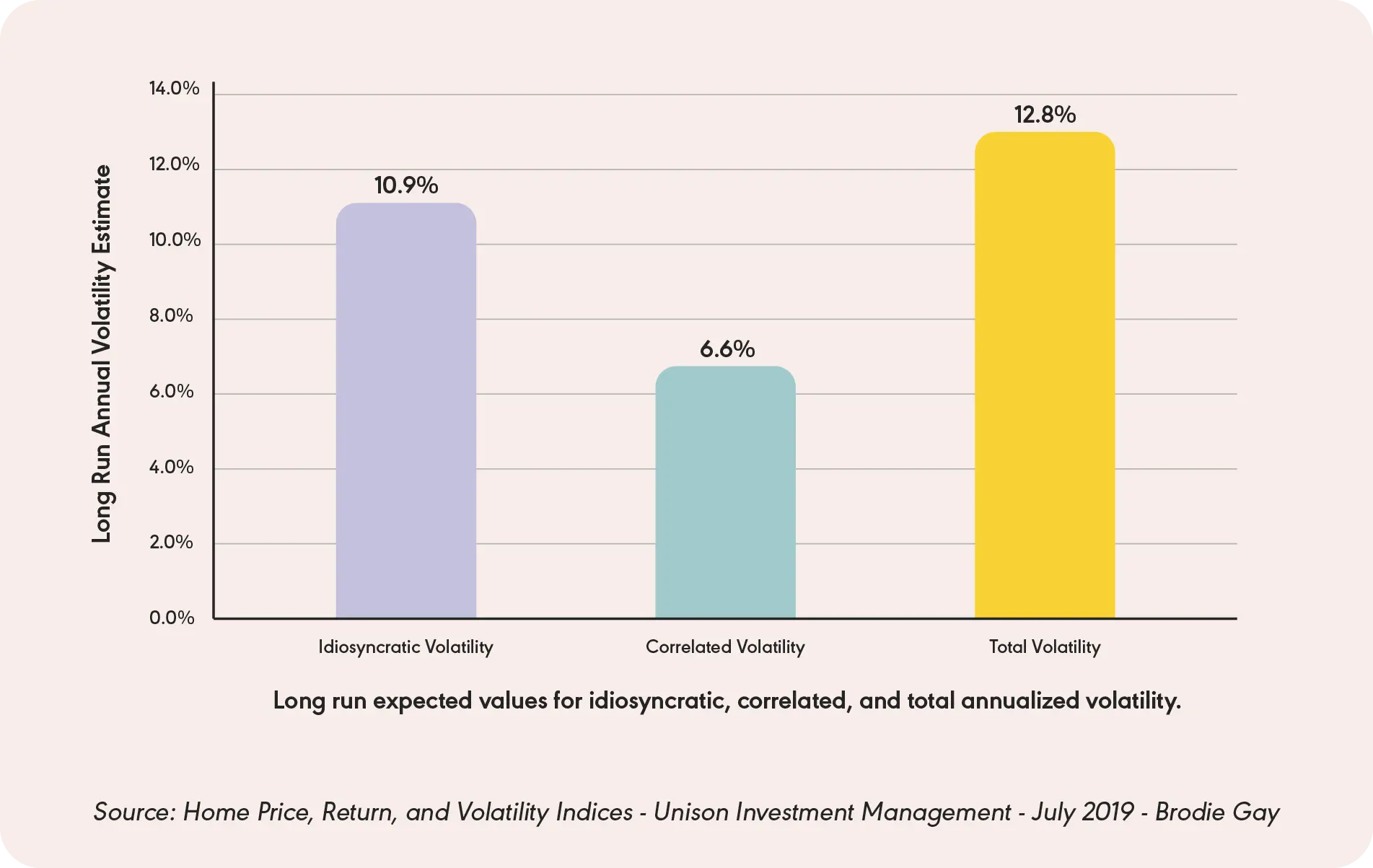
Even in real estate, diversification is critical. General finance theory also excludes your home from your investment portfolio or your net worth because its main purpose is the utility you get from living in it. Getting exposure to different geographies, property types, and price points is a critical way to ensure that you do not have exposure that has a higher chance of significant loss due to insufficient diversification. These types of losses can be caused by changing neighborhood dynamics, natural disasters, oversupply from new construction, deteriorating city finances (resulting in poor services and poor schools, and a whole host of other factors). Achieving this kind of diversification independently is exceedingly difficult unless you have a sizable net worth and the time to invest prudently on your own.
For this analysis, we model real estate on an unlevered, cash-funded basis. Traditional real estate funds and publicly listed REITs are heavily leveraged, which is why they have historically been more volatile and have had steep losses in individual years. In this Muslim 60-40 illustration, the real estate allocation is modeled without property-level leverage. A non-obvious benefit of real estate versus bonds is that if you are investing with taxable money, the accelerated depreciation allows you to enjoy multiple years of rental income without any tax obligation. The only fixed income product with a similar benefit are municipal bonds.
Real estate does have its issues; the main one is that in times of crisis it can become illiquid, which means your money can be stuck for some period of time. If you wait out a downturn, real estate has always recovered. This does not help however, if you have an immediate need for cash. This is particularly true for commercial, retail, and industrial real estate where there is a very small pool of buyers (for an office building or a declining retail plaza), but it is less true for single-family real estate which always maintains some level of liquidity. For example, in the United States, the long-term average for homes sold is approximately 4.9 million, and in the aftermath of 2008, the number of homes sold was over 5 million.
A diversified single-family real estate portfolio can serve as an alternative diversifying allocation for Muslim investors seeking to avoid conventional fixed income until other similar assets such as infrastructure and farmland become more accessible to non-institutional investors in a non-equity format. It provides stability and income, which can enable the other part of the portfolio to take greater risk, just as fixed income does in a 60-40 portfolio.
.webp)
What about the ‘60’ in the 60-40?
It is useful to think of the 60-40 framework as a basket of baskets. Meaning, within each type of investment, you should also be endeavoring to diversify. In modern finance, we think of the ‘40’ part of the bucket as the liability-matching bucket, meaning that you are investing in something safe and secure that will match your liabilities (your intended expenses in the future). These could be retirement expenditures, large purchases like paying for a wedding or college tuition for children, or giving charity.
The ‘60’ in this parlance is the risk-seeking or return-maximizing bucket. This can be seen as riskier investments that have higher expected returns but also higher expected risk. When diversified, much of this risk is mitigated but only with appropriate risk guardrails. The needs of this part of your portfolio can be easily met with a broadly diversified equity portfolio, such as those offered by the various Shari’ah ETFs that are on the market. This is the traditional component of the ‘60’ part of diversification, and continues to fulfill its purpose well. It is generally recommended to invest recreationally in stocks and single-stocks outside of your retirement portfolio unless you are an expert. Money used to ‘play’ stocks should be funded such that, if you lost it, it would cause you no trouble or distress.
Cryptocurrency sits in genuinely unsettled territory. Scholars differ in how they treat digital assets, and much of that discussion turns on whether a given token involves gharar (excessive uncertainty) or maysir (gambling and speculation). We are not issuing a ruling here, as that determination rests with qualified scholars and is beyond the scope of this piece. What we can say from an investment standpoint is that highly speculative holdings, whatever their Shariah treatment turns out to be, do not serve the role the '60' is meant to play in a retirement portfolio
Other investments in the right allocations - subject to appropriate Shariah structuring - that can also make sense are the following:
- Riskier types of real estate such as multifamily real estate, commercial/retail/industrial, construction/development, fix-and-flip.
- Venture Capital - A well-diversified fund that is a small portion of your overall portfolio.
- Commodities - Sensible investment in actual commodities or commodity-producing assets (not paper trading synthetic commodity investments which are very risky and have other issues as well).
- Diversification within the equity portfolio (small-cap, international, high-growth equities, emerging and frontier markets)
What does a Muslim 60-40 look like historically compared to a traditional 60-40?
It is a wonderful thing if you can stay true to your principles and still do well. In our look-back tests, we see that a portfolio that substitutes single-family real estate for bonds does as well from a return perspective while reducing risk for a portfolio. This is demonstrative that cash-based single-family residential real estate can provide an alternative to conventional fixed income investments.
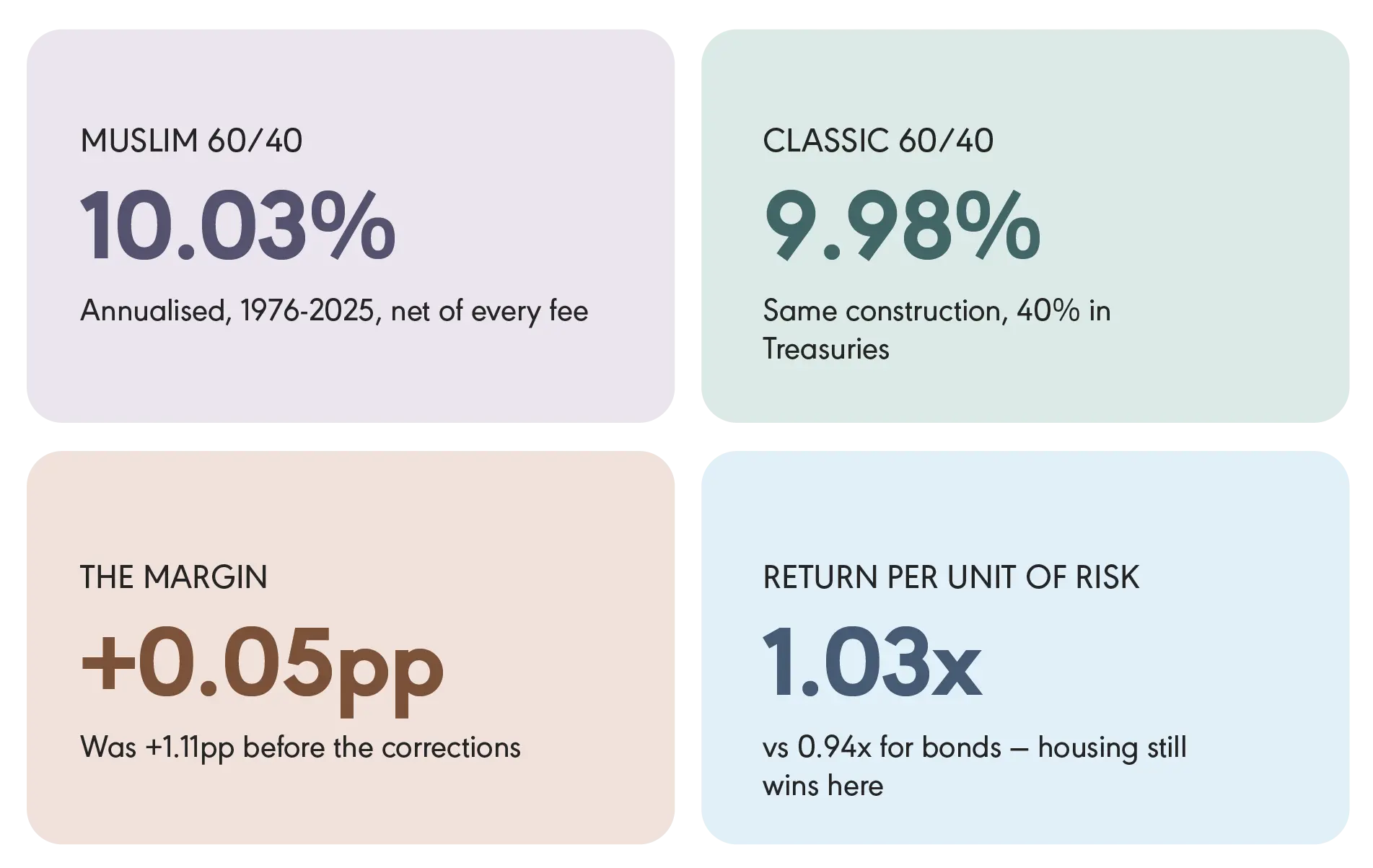
Over the last 50 years, inclusive of the 2008 Financial Crisis, your returns would have been similar, but better per unit of risk, if you replaced bonds with single-family real estate. What this analysis does not take into consideration is the ability to select better assets in a city by filtering for things such as growth neighborhoods, better schools, and lower crime. With some added judgment it is certainly possible to do even better by investing in real estate, whereas the ‘classic 60/40’ does reflect active asset management of fixed income. Between 2007-2011, an equal-weight housing portfolio only fell only -5.6%, this is the power of diversification, when many neighborhoods fell over 50%.
While bonds are considered to be safe, in 2022, US Treasuries fell -17% and stocks fell -18%, and home prices went up 5.8%. In any given year, any of these relationships can break, but 2022 does highlight that Islamic principles aside, bonds are not as safe as many assume, and the risks are heightened given the geopolitical skirmishes the US is involved in, and the spending habits of the government.
If we focus on the Muslim 60-40 portfolio above, a 10% annualized return, if you for example start investing at age 25 with $10,000 and then invest $10,000 a year till age 65, would result in a retirement portfolio worth almost $5 million dollars. This is the power of time, patience and constant investment. If you retire at 65 and draw down $5 million, assuming you live till 95, this means an annual income of approximately $450,000. This is good living, anywhere in the United States.
If you would like to play with our analysis, you can do so here.
Final Thoughts
Thinking about retirement is consistent with Islamic financial responsibility. You cannot assume that others, such as your children, will take care of you, nor should you neglect reasonable preparation while relying on Allah. We must prepare to the best of our abilities and have faith in Allah.
We are fortunate to live in a time where there are now many options to be able to invest based on your own religious beliefs, and their availability is increasing. There remains a gap in terms of what is available on 401k platforms, particularly for the ‘40’ part of the portfolio, but this is also soon changing.
There remains a lack of awareness around retirement planning, and Wahed is committed to increasing the awareness of retirement planning and offering tools that can be considered as part of your planning for retirement.
Please consider taking some time and thinking through your retirement needs - what are your major expenses, when do you plan on retiring, and how are you going to prepare for these major expenses and retirement. How will you do your part to prevent being a burden on others?
Sources:
- Greeman Toomey PLLC. (2019, January 17). Life expectancy has always been a factor for Social Security benefits. https://greemantoomey.com/life-expectancy-has-always-been-a-factor-for-social-security-benefits/
- U.S. Government Accountability Office. (2007, January 18). Employee Benefits Security Administration: Enforcement improvements made but additional actions could further enhance pension plan oversight (GAO-07-22). https://www.gao.gov/assets/a255494.html
- Banerjee, S. (2024, September 12). The success of defined contribution plans and the road ahead. T. Rowe Price. https://www.troweprice.com/institutional/us/en/insights/articles/2024/q3/the-success-of-defined-contribution-plans-and-the-road-ahead-na.html
- Conte, N. (2025, July 30). Charted: American income vs. home prices (1985–2025). Visual Capitalist. https://www.visualcapitalist.com/charted-american-income-vs-home-prices-1985-2025/
- College Board. (2025, November). Trends in college pricing: Highlights. College Board Research. https://research.collegeboard.org/trends/college-pricing/highlights
- Sukuk represent interests in underlying assets, usufructs, services or investment activities depending on the structure; Ijarah is a lease and Murabahah is a cost-plus sale. Each has a legitimate basis in Shariah, although the actual structure and implementation must be reviewed to ensure it does not merely replicate a conventional debt arrangement.
- Tostevin, P., & Rushton, C. (2025, October). How much is global real estate worth? Savills Impacts. https://impacts.savills.com/market-trends/how-much-is-global-real-estate-worth.html
- REI Prime. (n.d.). Spread. In REI Prime glossary. Retrieved September 15, 2026, from https://reiprime.com/glossary/spread
- Gay, B. (2019, July). Robust home price, return and volatility indices: Fast and robust algorithms for computing benchmark indices. Unison Investment Management. https://contentimages.o-prod.unison.com/images/downloads/Home_Price_Index_Official.pdf
- Ibbotson, R. G., & Harrington, J. P. (2021). Stocks, bonds, bills, and inflation (SBBI) 2021 summary edition. CFA Institute Research Foundation.
Risk Disclosure:
This article is for educational and informational purposes only. It does not constitute financial, investment,legal, or religious advice. Wahed Financial, LLC ("Wahed"), as a manager of Wahed Real Estate Fund I LLC; Wahed Real Estate Series I, LLC (the “Wahed Issuer”), operates the wahed.com/real-estate website (the "Site") and is not a broker-dealer or investment advisor. All securities related activity is conducted through Dalmore Group LLC, a registered broker-dealer and member of FINRA/SIPC, located at 525 Green Place, Woodmere, NY 11598.
This investment is speculative, illiquid and involves substantial risk, including the possible loss of your entire investment. Securities are offered through Dalmore Group LLC, Member FINRA/SIPC. Wahed and Dalmore are not affiliates. Investors will be clients of Wahed. An offering statement has been filed with the SEC. SEC qualification does not imply approval or endorsement of the offering’s merits. Please review the full offering circular for complete terms and risks.
Investors are purchasing shares of a Fund and not the underlying asset(s) of the Fund. There is no assurance any Fund will achieve its objectives, is not listed on an exchange and may not be suitable for all investors. Distributions are subject to and are not guaranteed.


.webp)