%20(1).webp)


Key Takeaways:
Should Muslims Keep Cash or Invest It in 2026?
As we enter the final stretch of 2026, it has become quite apparent that this year has been plagued with a great deal of economic uncertainty. The landscape of investing in 2026 has become rather volatile, leading many Muslim families to wonder where they should keep money they need within the next 12 months However, the idea of whether now is a good time to invest or not is a framing that tends to leave many people stuck. Since nobody can reliably predict short-term market direction, waiting for certainty often leaves one waiting indefinitely.
For Muslims in the US looking for a halal investing strategy in 2026, inflation, interest rates, and market headlines can make things seem more complicated than they need to be. That said, the question isn’t really whether maintaining a majority cash position or investing right now is better. Instead, it should be framed as whether or not your money is aligned with the purpose you may need it for going forward. This guide walks you through how to make the best decision clearly as it pertains to personal circumstances, without attempting to time or gauge the market.
Why This Question Matters in 2026?
The question of whether to keep cash or invest in 2026 is one of great prominence due to a number of economic realities the US is currently facing. Ongoing uncertainty around market volatility, inflation, and a shifting interest rate environment can make holding cash feel safer and investing it riskier than it would be in more stable market conditions. Economic headlines can create a sense of urgency to make the right decision with your money immediately. In reality, the more useful question is rarely about timing at all.
That said, even the most experienced and sophisticated long-term investors are grappling with this dilemma. Berkshire Hathaway, led by renowned investor Warren Buffet, is currently sitting on its largest cash reserve in company history, reportedly close to $400 billion in cash and short-term treasury bills1. However, that hasn’t reflected a retreat from investing altogether. Analysts have theorized that this position is based on difficulty finding investments at reasonable prices2 in light of current valuations. Buffet himself has said that cash is necessary “like oxygen,”but that it is “not a good asset”3 to hold indefinitely.
That distinction around the role of cash can also be relevant to for Muslim financial planning, while the Treasury bills mentioned above and Buffett’s broader investment approach should not be taken as Shariah-compliant investment examples. That said, no one, including Wahed, can reliably predict future market movements. Still, understanding current economic and market conditions can help inform smart decision making. The goal here isn’t to predict the future, but to build a stable framework regardless of what happens next.
The Purpose of Cash
The phrase “Cash is King” is one that you may have heard before, as it has been thrown around quite a bit throughout the years. While this is typically viewed as a subjective statement as opposed to a fixed rule, it is still worth appreciating what cash is actually good for. It’s important to know that holding cash is not a sign of poor investing principles as it serves multiple legitimate functions.
The first and arguably most important is for an emergency fund. Cash set aside as emergency savings for unplanned financial emergencies is a great use case. This remains true so long as it is accessible without any delay or risk. Keeping your emergency fund in a suitable savings account that is not subject to market volatility can be a smart and safe strategy.
Holding cash is also necessary as it pertains to short-term expenses. These include bills, mortgage or rent payments, and any other near-term predictable expenses. Factors such as these require holding pure cash that is not exposed to market fluctuations.
The same principle applies to upcoming major expenses. Saving for a car, downpayment on a home, and other major, predictable near-term expenses are legitimate reasons to hold cash opposed to investing it.
Lastly, holding cash offers financial flexibility. Outside of any specific future goals, having a cash reserve gives one the ability to respond to immediate change in financial circumstances or opportunities without being forced to inconveniently liquidate investments.
Cash serving any of these purposes shouldn’t be viewed as money sitting idle. Instead, it’s money doing the exact job it is meant to do. When cash is treated as a missed investment opportunity, it downplays the role immediate liquidity plays in a stable financial life and long-term strategy.
The Cost of Holding Too Much Catch
Although holding cash does have its benefits, holding more than the aforementioned purposes require can come with a real, measurable cost. This remains true even if the risk is less visible than a market loss.
Since the 2020 COVID-19 Pandemic, the US economy has seen a significant uptick in inflation, and inflation reduces purchasing power. Any cash position that isn’t earning a return which keeps pace with inflation loses value in real time. For example, $100 in 2020 holds the same purchasing power as $129.45 in 20264 due to a rise in core CPI inflation.
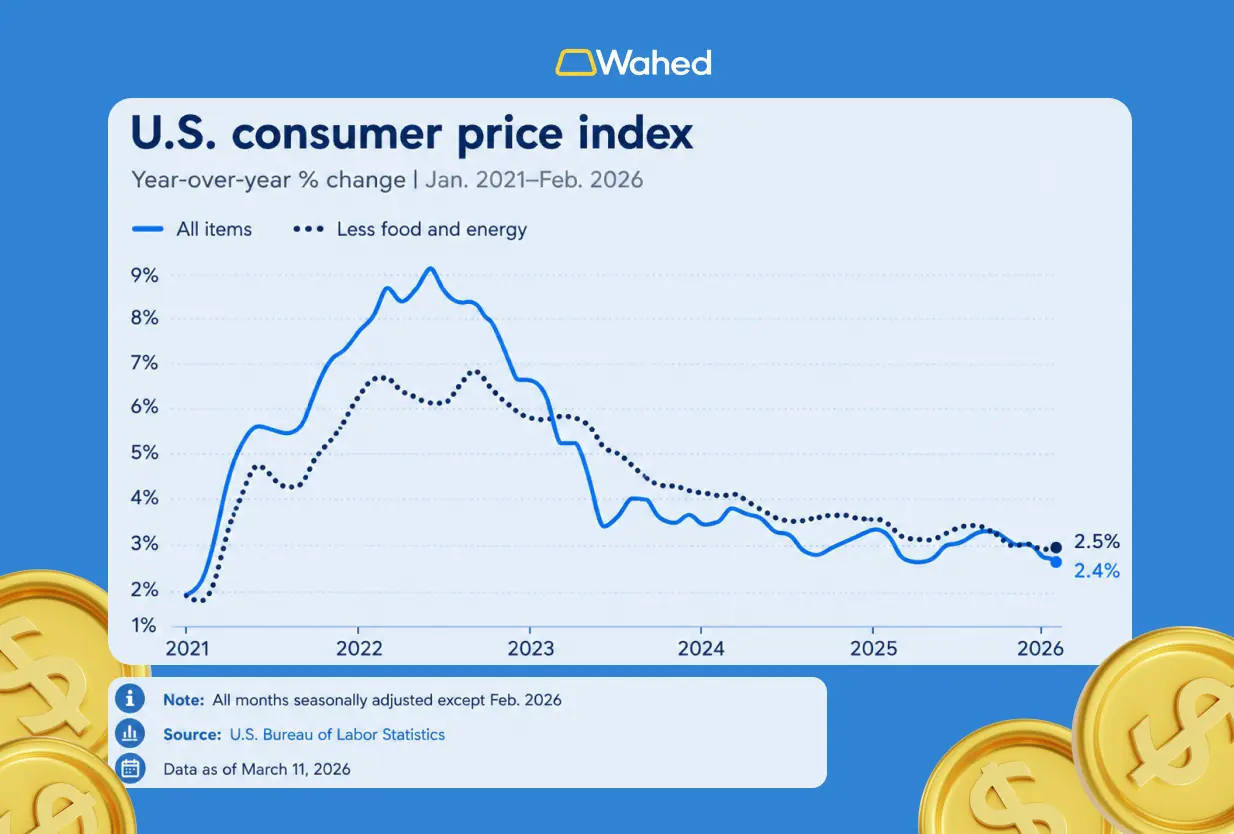
Knowing this, holding too much cash without investing means missed long-term growth. When cash is held for too long beyond what is required for near-term expenses, it can miss out on potential growth that can come from being invested. That growth plays a substantial role in building long-term wealth.
That’s why one must consider opportunity cost when determining what to do with their cash holdings. Every dollar sitting idle beyond what is necessary for liquidity purposes is one missing out on the fulfillment of long-term goals. Whether it be retirement, saving for college uition, or any other related matters, opportunity cost is a factor that should be weighed considerably with one's cash holdings.
It’s important to note that this doesn’t mean all excess cash should be invested immediately without considering the right halal investing strategy. Ultimately, the point is that holding excess cash for too long has its own tradeoffs similar to how investing too much aggressively without adequate liquidity and values consideration does.
When Investing Makes More Sense
Deciding when investing makes more sense as opposed to holding cash is largely dependent on personal preference. That said, there are several factors that generally suggest investing is worth prioritizing over holding excess cash.
For Muslims in the U.S., it is important to factor in your long-term goals. When considering retirement, building long-term wealth, or saving for a child’s future education, investing is typically a more effective approach than holding cash.c
If an emergency fund has already been established, investing your money can provide a stable financial foundation. When an individual has manageable debt levels and a stable income along with emergency savings, excess cash can be better used towards investing as doing so properly can offer compound returns on the funds.
Muslim professionals should also consider an appropriate time horizon when determining when, how, or if they should invest their cash. Generally speaking, money that will not be needed for several or more years may be better suited for investing than sitting idle as cash. This is because a longer time horizon gives one more room and comfort to ride out market volatility.
How Muslim Investors Can Think About the Decision
As mentioned earlier, trying to predict future market direction is often a futile approach compared to thinking in terms of time horizon and when you will actually need the money invested.
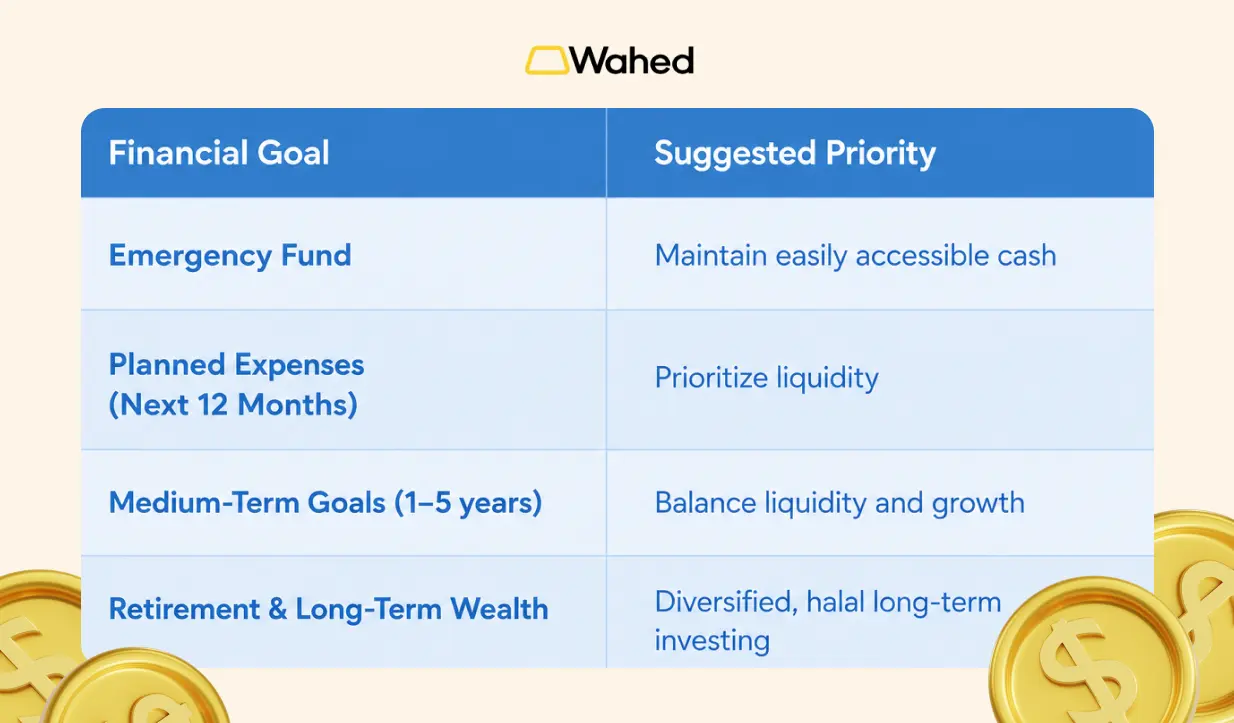
For any money needed within 12 months, it is important to prioritize liquidity. Regardless of apparently stable market conditions, these funds should stay in cash. The reason is that any potential downturns before it is needed could force you to sell at a loss.
Money needed within 1 to 5 years is more of a middle ground as it pertains to this question. In this scenario, a balance of cash allocated to both growth and liquidity may be more appropriate depending on specific goals and risk tolerance.
For longer time horizons such as money needed beyond 5 years, long term investing generally is viewed as more appropriate. This is because you will have more time to recover from any unanticipated market fluctuations.
A Practical Cash Allocation Framework
This chart shows a general framework for how to think about allocating your cash across different priorities. This is intended to be a general planning guideline as opposed to personalized financial advice. Personal allocation should reflect income, obligations, goals, and risk tolerance ideally discussed with a qualified financial advisor.
Common Mistakes to Avoid
- Investing emergency savings. Money meant for genuine emergencies shouldn't be exposed to market risk, regardless of how confident you feel about current conditions. A downturn at the exact moment you need those funds can turn a manageable emergency into a much bigger financial setback.
- Keeping every dollar in cash indefinitely. Excess caution has its own long-term cost, even if it feels safer in the moment. Over many years, that caution can quietly cost far more in missed growth than any single market downturn would.
- Making decisions based on headlines. Reacting to short-term news cycles rarely leads to sound long-term financial decisions, since headlines are designed to capture attention, not to guide a multi-year financial strategy.
- Trying to perfectly time the market. Waiting for the "right moment" to invest often means missing meaningful growth while waiting for a signal that may never come clearly, since even professional investors rarely time markets consistently well.
- Ignoring long-term financial goals. Focusing too heavily on short-term uncertainty can distract from the retirement, education, or wealth-building goals that matter most over time.
Create a Financial Plan That Works in Any Market
Regardless as to whether markets are calm or volatile, the underlying principle is that one should match their money to its purpose, not try and predict market fluctuations. A disciplined, goal oriented, faith-based approach grounded in individual circumstance and time horizon gives Muslims families the flexibility to manage whatever the future may bring.
Sources
- Forbes: Berkshire Hathaway Stock’s 2026 Outlook and What It Means for Your Portfolio
- Yahoo Finance: Buffet Explains why hes keeping $180B in cash
- CNBC: Warren Buffett: Cash is necessary ‘like oxygen’—but it’s ‘not a good asset’
- US Bureau of Labour Statistics: CPI Inflation Calculator
Disclaimer:
Wahed Invest LLC (Wahed) is a U.S. Securities and Exchange Commission (SEC) registered investment advisor. Wahed Invest provides brokerage services to its clients through its brokerage partner Apex Clearing Corporation, a member of NYSE - FINRA - SIPC and regulated by the SEC and the Commodity Futures Trading Commission. Registration does not imply a certain level of skill or training. Wahed does not intend to offer or solicit anyone to buy or sell securities in jurisdictions where Wahed is not registered or a region where an investment practice like this would be contrary to the laws or regulations. Any returns generated in the past do not guarantee future returns. All securities involve some risk and may result in loss. Any performance displayed in the advertisements or graphics on this site are for illustrative performances only.