



Key Takeaways:
For many Muslim professionals in the U.S., real estate occupies a particular place in the wealth-building imagination. It's tangible, productive, historically resilient - and for generations, it's been seen as one of the most reliable ways to build lasting wealth. The challenge is that actually owning property comes with a set of barriers that make it out of reach or impractical for a large proportion of investors: a substantial down payment, an interest-based mortgage that raises riba concerns, ongoing management responsibilities, and capital tied up in a single, illiquid asset.
The good news is that how to invest in real estate without buying property is no longer a niche question with limited answers. There are now multiple accessible, Shariah-compatible pathways to real estate exposure - some available with as little as a few hundred dollars and no landlord obligations. This guide covers five of them, explains the halal considerations for each, and provides a practical framework for building halal real estate investing into your existing portfolio.
Why Investors Look Beyond Direct Property Ownership
Direct property ownership like buying a home, rental property, or commercial unit - remains the most intuitive form of real estate investing, and for good reason. You own something real. You receive rental income directly. You control the asset.
But the barriers are real too, and they're significant.
High capital requirements are the most immediate constraint. A 20% down payment¹ on a median-priced U.S. home represents $80,000-$100,000 in cash, before accounting for closing costs, renovations, or emergency reserves. For an investor with $10,000-$50,000 in investable capital, that locks property ownership firmly out of reach for the near term.
Property management complexity is the second deterrent. Being a landlord is a second job - tenant screening, lease management, maintenance calls, legal compliance, and the occasional difficult conversation. For an engineer working long hours or a physician managing a practice, this is time most people don't have.
Illiquidity compounds both problems. Selling a property takes months and involves transaction costs of 6-10% of the sale price². If your circumstances change or a better investment opportunity appears, you cannot rebalance quickly.
For Muslim investors, there is an additional layer: Riba in conventional mortgages. Using an interest-based mortgage to finance a property raises genuine Shariah concerns, and while Islamic financing alternatives exist, they're not always accessible or competitively priced in every market.
These combined factors explain why indirect real estate investing has grown substantially in interest - particularly among younger, higher-income professionals who want the economic exposure to real estate without the associated burdens.
Can You Invest in Real Estate Without Owning Property?
Yes, and this is a well-established category of investing, not a workaround. Indirect real estate investing refers to gaining exposure to real estate assets through financial instruments rather than direct ownership.
When you invest in real estate indirectly, you participate in the potential income and appreciation generated by properties - rental revenue, property value increases - without taking on the title, financing, or management responsibilities. This makes real estate exposure accessible to investors with as little as $1,000 in capital, and it allows real estate to function as a portfolio diversifier rather than a concentrated, all-or-nothing purchase.
For Muslim investors, the critical question is whether these indirect vehicles can be accessed in a Shariah-compliant manner. As we'll cover below, the answer is yes - but it requires the same careful evaluation applied to any investment. Not all REITs, ETFs, or funds are Shariah-compliant by default, and understanding what to look for is essential. For a grounding in halal real estate investing principles before diving into specific vehicles, our detailed overview is a useful starting point.
Why Real Estate Diversification Matters
Before exploring the five pathways, it's worth understanding why adding real estate to a portfolio of stocks and ETFs is worth the effort.
Portfolio diversification is the core rationale. Real estate and equities don't move in perfect lockstep - historically, certain private real estate assets have demonstrated lower volatility than equity markets during downturns. While not immune to broader economic shifts, this lower correlation with public markets can offer a meaningful layer of diversification, helping to cushion against losses and contribute to overall portfolio stability. A portfolio that combines equities and real estate has historically exhibited lower volatility than one holding equities alone.
Income generation is the second benefit. Rental income - whether received directly or through a REIT dividend - is a yield-generating return stream that doesn't depend on market appreciation. For investors building toward financial independence, regular income from real estate can complement growth-oriented equity holdings.
Inflation hedge is the third. Property values and rents have historically tracked or outpaced inflation over long periods³. In an environment of rising prices, real estate exposure can help preserve the real purchasing power of a portfolio in ways that cash or fixed-income instruments often don't.
5 Ways to Invest in Real Estate Without Buying Property
1. REITs (Real Estate Investment Trusts)
REITs are companies that own and operate income-producing real estate - apartment buildings, warehouses, data centres, healthcare facilities, retail centres, and more. They trade on major stock exchanges like any other public company, meaning you can buy and sell REIT shares through a standard brokerage account with no minimum investment beyond the share price.
The liquidity advantage is significant. Unlike physical property, a REIT position can be liquidated in seconds. Diversification is also built in - a single REIT may hold hundreds of properties across multiple markets and asset types.
Halal considerations: REITs are not automatically halal. Compliance depends on the property types owned, the REIT's debt structure (debt-to-assets should typically remain below 33%), and the income sources involved. Mortgage REITs - which invest in interest-bearing loans rather than physical property - are generally not considered Shariah-compliant. Equity REITs that own physical properties and earn primarily from rent are a better starting point for halal evaluation.
2. Real Estate ETFs
A real estate ETF is a fund that bundles together a basket of REIT stocks into a single tradeable instrument. Rather than selecting and monitoring individual REITs, an investor in a real estate ETF gains diversified exposure across many REITs with a single purchase.
Real estate ETFs offer broad market exposure and very low minimum investment requirements. They also tend to carry low expense ratios, making them one of the most cost-efficient ways to add real estate to a portfolio.
Halal considerations: Because a real estate ETF holds multiple REITs, Shariah screening must be applied at the fund level. Standard real estate ETFs tracking benchmarks like the MSCI US REIT Index will include mortgage REITs, hotel REITs with casino or alcohol revenue, and other non-compliant holdings. A screened, Shariah-compliant real estate ETF - or a managed portfolio that applies consistent screening - is required to invest compliantly. The same financial ratio methodology used to evaluate individual stocks applies here. See our breakdown of what makes an ETF halal for the full screening criteria.
3. Real Estate Funds
Real estate funds, including private real estate funds and publicly traded mutual funds - pool capital from multiple investors to acquire and manage properties. Unlike ETFs, which are passively managed index trackers, real estate funds are often actively managed by professional investment teams who make decisions about property selection, acquisition, and disposition.
These funds provide access to professional portfolio management and sometimes to property types (large commercial assets, diversified national portfolios) that individual investors cannot access on their own. Minimum investments can range from a few thousand dollars for publicly available funds to higher minimums for private structures.
Halal considerations: The same screening principles apply - the fund's property holdings, financing arrangements, and income sources must all be evaluated. For actively managed funds, the fund manager's approach to Shariah compliance - and whether they work with a Shariah advisory board - is a key due diligence question.
4. Real Estate Syndications
A real estate syndication is a group investment structure where multiple investors pool capital to fund the acquisition of a specific property or portfolio. Syndications are typically organised by a sponsor - an experienced real estate operator - who identifies the deal, manages the acquisition, and oversees operations. Investors contribute capital and receive proportional returns from rental income and eventual sale proceeds.
Syndications offer access to larger, higher-quality deals that individual investors cannot access alone. They have historically generated attractive returns in the U.S. commercial real estate market.
Halal considerations: Syndications can be structured to be Shariah-compliant, but this requires due diligence on the financing structure (is debt involved, and if so, is it interest-based?), the nature of the underlying properties, and the income sources. Many conventional syndications use interest-bearing leverage, which creates a compliance issue. Investors should look specifically for syndications structured around Islamic finance principles - such as musharakah (partnership) arrangements - and seek appropriate scholarly guidance before participating. Syndications are also illiquid by nature, with investor capital typically locked up for the duration of the hold period (often 3-7 years), and they carry risks related to deal execution and sponsor performance.
5. Halal Managed Portfolios With Real Estate Exposure
For Muslim investors who want real estate exposure without the responsibility of selecting and screening individual REITs, ETFs, or syndications, a Shariah-compliant managed portfolio that includes real estate as an asset class offers the most streamlined path.
A Shariah-compliant managed portfolio handles asset allocation across equities, sukuk, and real estate instruments - diversifying your capital across multiple asset classes within a single account. Rebalancing is handled automatically, maintaining your target allocation as markets move. And critically for Muslim investors, the Shariah screening and ongoing compliance monitoring is managed by professionals, not delegated to the individual investor.
This approach is particularly well-suited to investors with $1,000-$50,000 who want real estate in their portfolio but don't have the time, expertise, or capital to evaluate individual REITs or participate in private syndications. For a comparison of the self-directed vs managed approach more broadly, see our guide on the halal investing guide.

Halal Considerations for Real Estate Investing
Whether you invest in REITs, ETFs, funds, or a managed portfolio, three Shariah principles govern how you evaluate every option.
Avoiding riba. Interest is the most common compliance concern in real estate investing. Any vehicle that derives meaningful income from interest-bearing instruments - mortgage REITs, funds holding mortgage-backed securities, syndications financed with conventional debt - raises this concern directly. The 33% debt-to-assets threshold applied by major Shariah screening bodies is a useful quantitative guide, but qualitative judgment about the nature of the debt matters too.
Screening investments. Sector exclusions matter even in real estate. A REIT that owns properties leased to alcohol retailers, casinos, conventional banks, or adult entertainment businesses earns income from haram activities. This income needs to be excluded - either by avoiding the investment entirely or, where non-compliant income falls below 5% of total revenue, by applying a purification calculation (disposing of or giving away the equivalent impermissible portion of your returns to charity).
Ensuring ethical income sources. Rental income from permissible tenants and properties is the gold standard - it represents real economic value, a legitimate exchange, and no element of riba or harmful activity. When evaluating any real estate vehicle, trace the income back to its source and apply this test. For a broader framework on what distinguishes halal from conventional investing across all asset classes, see our overview of halal vs conventional investing.
Example: Building Real Estate Exposure Without Owning Property
Consider a 33-year-old tech professional with $25,000 in investable capital beyond her retirement accounts. She wants real estate exposure but has no interest in becoming a landlord, and is not yet in a position for a down payment. Here is how she might allocate across the options above:
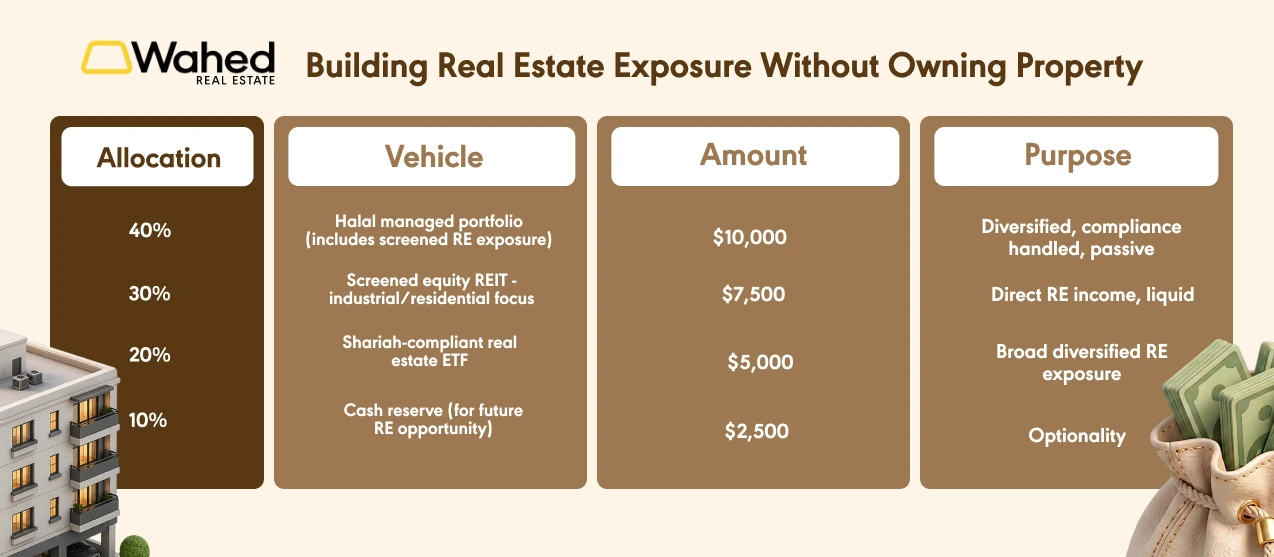
This allocation gives her real estate exposure across three distinct vehicles - with different liquidity profiles, return drivers, and risk characteristics - without a single dollar going toward a down payment, a mortgage, or property management. Total minimum investment: well under $1,000 if she wanted to start smaller. Total time commitment once set up: one quarterly review.
As her portfolio grows and her knowledge deepens, she could explore Shariah-structured syndications or direct property purchase using Islamic financing. But the foundation of halal real estate exposure is fully achievable today, at her current capital level.
Start Building a Diversified Halal Portfolio with Wahed Real Estate
Property ownership is one path to real estate wealth - but it's not the only one, and for many Muslim professionals at this stage of life, it's not the right one right now. You can build meaningful real estate exposure into your portfolio today, starting from wherever you are financially, without a down payment, without a mortgage, and without becoming a landlord.
Wahed offers Shariah-screened portfolios that include real estate exposure alongside equities and sukuk - giving Muslim investors in the U.S. access to diversified, faith-aligned halal real estate investing without the complexity of doing it themselves. Every holding is screened and monitored under Wahed’s Shariah governance framework with independent Shariah oversight. Rebalancing is automatic. And you can start with whatever you have available.
Sources:
¹ YCharts (2026), “US Existing Home Median Sales Price,” https://ycharts.com/indicators/us_existing_home_median_sales_price
² HomeLight (2026), “How Long Does It Take to Sell a House?,” https://www.homelight.com/blog/how-long-does-it-take-to-sell-a-house/
³ PIMCO (2026), “U.S. Housing Inflation: Stubbornly High to Stubbornly Low,” https://www.pimco.com/gbl/en/insights/us-housing-inflation-stubbornly-high-to-stubbornly-low
Disclaimer:
Risk Disclosure: For U.S. audience. Wahed Financial, LLC ("Wahed"), as a manager of Wahed Real Estate Series I, LLC (the “Wahed Issuer”), operates the wahed.com/real-estate website (the "Site") and is not a broker-dealer or investment advisor. All securities related activity is conducted through Dalmore Group LLC, a registered broker-dealer and member of FINRA/SIPC, located at 525 Green Place, Woodmere, NY 11598. You can review the brokercheck for Dalmore. An up-to-date Dalmore Form CRS is available. You should speak with your financial advisor, accountant and/or attorney when evaluating any offering. Neither Wahed, the Wahed Issuer, nor Dalmore makes any recommendations or provides advice about investments, and no communication, through this website or in any other medium, should be construed as a recommendation for any security offered on or off this investment platform.
This Site may contain forward-looking statements and information relating to, among other things, Wahed, the Wahed Issuer, their respective business plans and strategies, and their industry. These forward-looking statements are based on the beliefs of, assumptions made by, and information currently available to Wahed and its management. When used in the Site, the words “estimate,” “project,” “believe,” “anticipate,” “intend,” “expect” and similar expressions are intended to identify forward-looking statements, which constitute forward-looking statements. These statements reflect Wahed management’s current views with respect to future events and are subject to risks and uncertainties that could cause the Wahed Issuer’s actual results to differ materially from those contained in the forward-looking statements. You should not rely on these statements but should carefully evaluate the offering materials in assessing any investment opportunity, including the complete set of risk factors that are provided as part of the offering circular for your consideration. Investors are cautioned not to place undue reliance on these forward-looking statements, which speak only as of the date on which they are made. Wahed and the Wahed Issuer do not undertake any obligation to revise or update these forward-looking statements to reflect events or circumstances after such date or to reflect the occurrence of unanticipated events.
The Wahed Issuer is conducting one or more offerings, pursuant to Regulation A of the Securities Act of 1933, as amended (“Regulation A”), of interests in separate series established to hold residential properties to be acquired by such series. The offering circular and periodic reports for the Wahed Issuer are available on our Filings Page (https://www.sec.gov/Archives/edgar/data/2092195/000121390025100303/ea0258093-1a_wahed1.htm). An investment in a series constitutes only an investment in that particular series and not in the Wahed Issuer or the underlying asset(s) of that or any other series. From time to time, the Wahed Issuer may seek to qualify additional series offerings under Regulation A. For offerings that have not yet been qualified, no money or other consideration is being solicited and, if sent in response, will not be accepted. No offer to buy securities of a particular offering can be accepted, and no part of the purchase price can be received, until an offering statement filed with the Securities and Exchange Commission (the "SEC") relating to that series has been qualified by the SEC. Any such offer may be withdrawn or revoked, without obligation or commitment of any kind, at any time before notice of acceptance given after the date of qualification by the SEC. An indication of interest involves no obligation or commitment of any kind. You may obtain a copy of the Wahed Issuer’s offering circular at [https://www.sec.gov/Archives/edgar/data/2092195/000121390025100303/ea0258093-1a_wahed1.htm].
Please review the offering circular and the documents included as exhibits to the related offering statement before making any investment decision.
Investment overviews contained herein contain summaries of the purpose and the principal business terms of the investment opportunities. Such summaries are intended for informational purposes only and do not purport to be complete, and each is qualified in its entirety by reference to the more-detailed discussions contained in the offering circular filed with the SEC. The Wahed Issuer does not offer refunds after an investment has been made. Please review the offering circular and other offering materials for more information.
An investment in any series is illiquid and speculative. The Wahed Issuer does not have a redemption provision and, as a result, if a series does not successfully dispose of its real estate, you may have to hold your investment in that series for an indefinite period. An active trading market for series interests of any series may not develop or be sustained. If an active public trading market for such series interests does not develop or is not sustained, it may be difficult or impossible for you to resell your series interests at any price. Even if an active market does develop, the market price could decline below the amount you paid for your series interests.