


%20(1).webp)

.webp)

Key Takeaways:
How to Invest in Fractional Real Estate as a Muslim
For most Americans, the down payment is one of the biggest barriers to owning real estate. A 20% down payment on a median $400,000 home, for example, would amount to $80,000, with a mortgage covering the rest.¹ For Muslim investors seeking to avoid riba (interest), that conventional route isn't an option. Buying entirely with cash could mean saving $400,000 or more, while products marketed as “Islamic mortgages” or halal home financing may still require substantial upfront capital and careful evaluation of their underlying structure. Understanding the alternatives to riba-based mortgages is therefore an important part of approaching property ownership.
Fractional real estate offers another path. Instead of buying an entire property, investors can own a share of a property or portfolio with significantly less upfront capital. Through Wahed, for example, that entry point starts at $100. But a lower barrier to entry raises another question: Is fractional real estate actually halal? This guide explains how fractional ownership works, what determines whether it is Shariah-compliant, and how Muslim investors can access fractional real estate through Wahed.
The Real Cost of Owning Real Estate: Then vs Now
As mentioned previously, a conventional mortgage is off the table for Muslim investors due to riba. So what options does that leave for someone who still wants to own real estate?
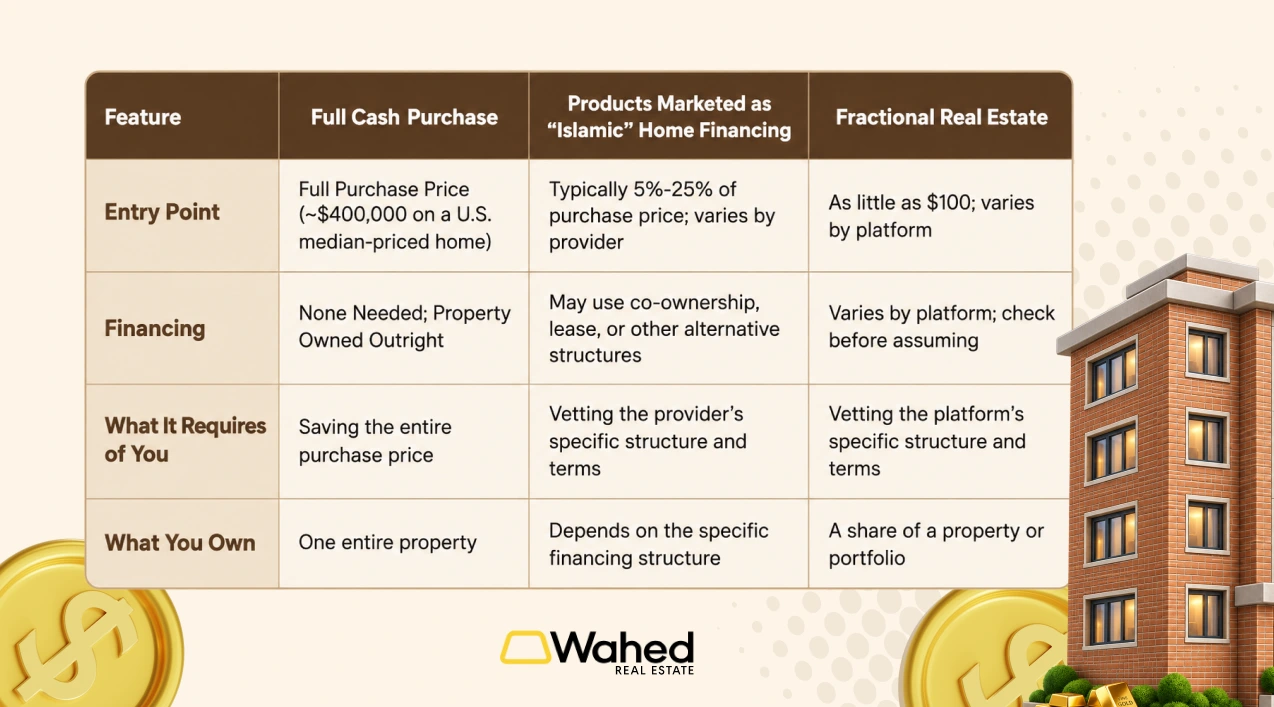
Traditionally, there have been two primary paths. The most straightforward is purchasing a property entirely with cash, which can mean saving roughly $400,000 for a median-priced U.S. home.¹ The other is turning to products marketed as “Islamic” or “halal” home financing, which may use structures such as Murabaha, Ijara, or Musharakah Mutanaqisa (diminishing partnership). These products can still require a substantial upfront contribution, ranging from around 5% at the low end to 20%-25% under more common terms.² They also require careful scrutiny of the underlying arrangement.
Fractional ownership offers a third path. Instead of purchasing an entire property, an investor can buy a share of a property or a portfolio of properties for a much smaller amount.
Whichever path a Muslim buyer considers, direct property ownership can therefore require significant capital: either the full purchase price in cash or a meaningful upfront contribution alongside careful vetting of the financing structure itself. Put side by side, the difference in both the amount of capital required and what an investor actually owns becomes much clearer:
Fractional access like this is also a relatively recent development. Historically, many private investment opportunities were limited to accredited investors. Regulatory changes associated with the JOBS Act and subsequent SEC frameworks expanded the ways everyday investors could participate in private offerings, including certain real estate investments.³ ⁶
What is Fractional Real Estate?
Fractional real estate means owning a share of a property, or a share of a portfolio of properties, instead of buying the whole thing yourself. Returns, whether rental income or appreciation, are proportional to the size of your share. For example, let's say a $500,000 property is divided into shares, and 500 investors each put in $1,000. Each investor now owns 0.2% of the property and participates proportionally in the rental income and any gain when the property is sold, subject to the investment’s terms and fees. Another way to look at it is like this: imagine a group of friends jointly owning a vacation home, except the arrangement is formalized through a legal structure, professionally managed, and open to far more than a handful of people.
%20(2).webp)
There are two common forms of fractional real estate ownership. Some structures tie your share to one specific property. Others pool your money with other investors into a fund that owns a diversified portfolio of properties. Both are fractional ownership, but they work differently, as we will cover later. For now, if you’d like a deeper explanation of the fund-based version, see our guide on how self-funded real estate portfolios work.
.webp)
Is Fractional Real Estate Investing Halal?
Fractional real estate investing can be halal, but it depends entirely on the specific structure. Fractional ownership is simply a way of dividing ownership of a property or portfolio into shares. That isn't automatically halal or haram. What matters is how the underlying property is financed, how the investment itself is structured, and how returns are generated. Three questions are crucial as it pertains to this question, tied to the principles of riba, gharar, and maysir:
- Riba: Is the property or investment structure financed using debt?
- Gharar: Is there excessive ambiguity around what you actually own, the terms of the investment, or how returns are calculated?
- Maysir: Are returns tied to ownership and economic activity, such as rental income and property appreciation, rather than primarily to chance or speculation?
The first question is particularly important with conventional fractional real estate investments. A platform may allow you to invest in only a small fraction of a property while the property itself is still financed with debt. Fractional ownership does not eliminate an investor's exposure to debt used to acquire or finance the underlying asset.⁴
Debt is also common across the broader real estate crowdfunding market. Typical loan-to-value (LTV) ratios, a measure of how much of a property's value is financed with debt, can run around 60% to 75%.⁵ By one estimate, more than 70% of commercial real estate crowdfunding deals are structured as debt offerings.⁵ In other words, gaining fractional access to real estate does not necessarily mean gaining debt-free exposure to it.
This is why Muslim investors need to look beyond the word “fractional.” Two investments can use a similar fractional ownership model while being structured very differently underneath. A debt-free, equity-only approach addresses one of the most significant Shariah considerations, but financing is only part of the picture. Ownership terms, income sources, transparency, and Shariah oversight also matter. For a broader look at these principles, see our guide on whether real estate investing is halal in the U.S..
The 3-Question Halal Fractional Ownership Checklist
1. How is the property financed?
Start with the underlying asset. Was the property purchased entirely with investor equity, or is there a mortgage or other interest-bearing debt attached to it? This is one of the most important questions for a Muslim investor because buying shares in a property doesn't make the financing behind that property disappear. Look beyond the minimum investment and projected returns to understand whether leverage is being used and, if so, how it is structured.
2. How is the investment regulated and structured?
Next, look at what you are legally buying and what information the platform is required to provide. For example, some fractional real estate offerings are conducted under the SEC's Regulation A framework, which can allow eligible companies to raise capital from the public through an SEC-qualified offering. Investors should be able to review documentation explaining the ownership structure, use of proceeds, material risks, fees, and other important terms. Where applicable, look for an SEC-qualified offering circular and audited financial statements rather than relying solely on the platform's marketing materials.
3. Who provides the Shariah oversight?
A claim that an investment is “halal” or “Shariah-compliant” should come with more than a label. Look for a named, independent Shariah supervisory board or advisor and information about what they have actually reviewed. Ongoing oversight matters as well. A structure can change over time, so investors should understand whether Shariah compliance is reviewed periodically or whether the claim rests on a one-time assessment made when the product launched.
These three questions address the core structure, but there are two additional details worth checking before investing: liquidity and fees. Understand when and how you can exit the investment, whether there is a required holding period, and what fees or expenses may reduce the returns ultimately distributed to investors. The goal isn't simply to find the word “halal” somewhere on a platform's website. It's to understand what you own, how it was financed, who is overseeing its Shariah compliance, and what terms govern your investment.
For a more extensive due-diligence framework, see our guide to 8 questions Muslim investors should ask before investing in any real estate fund
Fractional Real Estate Investing via Wahed
Wahed offers two ways to invest in fractional real estate: the Wahed Real Estate Fund and Individual Properties. Both address the three areas covered in the checklist above. They are 100% equity-financed with no debt at any level, offered under SEC Regulation A+, and independently reviewed for Shariah compliance. This zero-debt structure is specific to Wahed's approach, which is important because the same cannot be assumed of every fractional real estate platform.⁷
There is also an important structural distinction with Individual Properties. Each property is held in its own separate legal entity, known as a Series LLC, so issues affecting one property are separated from investments in another. Investors own shares in the entity associated with their chosen property, representing their proportional interest in its income and eventual sale proceeds.⁷
1. Wahed Real Estate Fund
The Wahed Real Estate Fund is a diversified, professionally managed portfolio of rental properties. When you invest, your money is spread across the portfolio rather than tied to one home.
- Open the Wahed app and go to the Real Estate Fund.
- Review the Fund's current portfolio and details.
- Enter the amount you want to invest, starting at $100.
- Confirm your investment. You now own shares in the Fund, giving you proportional exposure to the portfolio's rental income and potential growth.
Distributions are targeted to be paid quarterly. Because your investment is spread across multiple properties, a vacancy or underperformance at one property has less impact on the overall portfolio than it would with a single-property investment. The Fund also offers a structured redemption schedule after an initial holding period, providing a potential path to liquidity subject to the Fund's applicable terms.⁷
2. Individual Properties
Individual Properties allow you to choose and invest in one specific, vetted property at a time rather than a pooled portfolio.
- Open the Wahed app and browse the available Individual Properties.
- Review the details of a specific property, including its location, expected rent, purchase price, and other offering information.
- Enter the amount you want to invest, starting at $500.
- Confirm your investment. You now own shares tied to that specific property, with your returns dependent on its performance.
Distributions are potentially paid every quarter from the property's rental income. The investment is generally held until the property is eventually sold, at which point investors receive their proportional share of the sale proceeds. This option may appeal to investors who want to select and follow a specific property rather than invest across a diversified portfolio.⁷
.webp)
The Bottom Line: A New Path to Real Estate Ownership
Accessing real estate has traditionally meant navigating a difficult tradeoff for Muslim investors: saving enough to buy a property outright or carefully evaluating alternative financing structures while avoiding riba. Fractional real estate investing offers another path by allowing investors to own a share of a property or portfolio with significantly less upfront capital. But fractional ownership is only the model of ownership, not a guarantee of Shariah compliance. The underlying financing, legal structure, source of returns, regulatory framework, liquidity, fees, and Shariah oversight all still matter.
That is why the most important question isn't whether you can invest in real estate with $100 or $500, but what that investment actually represents. By checking how the property is financed, how the investment is structured and regulated, and who provides Shariah oversight, Muslim investors can evaluate fractional opportunities beyond the label. Wahed applies those principles through debt-free, equity-financed fractional real estate options starting at $100, offering a more accessible route to real estate ownership without changing the standards Muslim investors should expect from their investments.
Sources
- Redfin. “How Much Does It Cost to Buy a House?” June 17, 2026.
Used for the U.S. median home sale price, conventional homebuying costs, and down payment context.
View source - HalalWallet. “How Much Down Payment Do You Need for Islamic Home Financing? (U.S. 2026).” February 19, 2026.
Used for typical upfront contribution ranges associated with products marketed as Islamic home financing.
View source - U.S. Securities and Exchange Commission. “Regulation A” and “Regulation A: Guidance for Issuers.”
Used for Regulation A requirements, offering statements, audited financial statements for Tier 2 offerings, investor eligibility, and ongoing reporting requirements.
Regulation A | Regulation A: Guidance for Issuers - Tellus. “Equity vs. Debt Real Estate Crowdfunding Investments.” Updated March 6, 2026.
Used for the distinction between debt and equity crowdfunding and typical loan-to-value ratios in debt real estate crowdfunding.
View source - Phoenix Strategy Group. “Real Estate Crowdfunding: Key Criteria for Evaluation.” June 5, 2026.
Used for real estate crowdfunding leverage and capital structure context, including typical 60%–75% LTV ratios and the estimate that more than 70% of commercial real estate crowdfunding deals are structured as debt offerings.
View source - Knowledge at Wharton. “Is the Real Estate Crowdfunding Market Getting Too Crowded?” April 15, 2016.
Used for historical context on the JOBS Act and the emergence of online real estate crowdfunding.
View source - Wahed. Wahed Real Estate Fund materials and offering information.
Used for Wahed-specific information, including minimum investment amounts, equity-only financing, Shariah review, investment structure, distributions, liquidity terms, and the distinction between the Wahed Real Estate Fund and Individual Properties.
Wahed Real Estate Fund | Wahed Real Estate
Risk Disclosure:
This article is for educational and informational purposes only. It does not constitute financial, investment,legal, or religious advice. Wahed Financial, LLC ("Wahed"), as a manager of Wahed Real Estate Fund I LLC; Wahed Real Estate Series I, LLC (the “Wahed Issuer”), operates the wahed.com/real-estate website (the "Site") and is not a broker-dealer or investment advisor. All securities related activity is conducted through Dalmore Group LLC, a registered broker-dealer and member of FINRA/SIPC.
This investment is speculative, illiquid and involves substantial risk, including the possible loss of your entire investment. Securities are offered through Dalmore Group LLC, Member FINRA/SIPC. Wahed and Dalmore are not affiliates. Investors will be clients of Wahed. An offering statement has been filed with the SEC. SEC qualification does not imply approval or endorsement of the offering’s merits. Please review the full offering circular for complete terms and risks.
Investors are purchasing shares of a Fund and not the underlying asset(s) of the Fund. There is no assurance any Fund will achieve its objectives, is not listed on an exchange and may not be suitable for all investors. Distributions are subject to and are not guaranteed.


.webp)