
.jpeg)


Key takeaways
Stability & Tangibility: Real estate is a physical asset that fulfills a permanent human need for housing and commerce, making it steadier than volatile stock markets and cryptocurrencies.
Long-term Wealth Building: Property prices generally increase over time, making real estate a proven vehicle for building financial security.
Regular Passive Income: Rental income can give you a regular income stream without having to actively work for it.
Protection from Inflation: Real estate usually keeps up with or does better than inflation, which means it can help maintain the value of your investments even during the periods of economic downturn.
Portfolio diversification: Real estate helps diversify your investments. This means that real estate doesn’t always follow the same market fluctuations and trends as other asset classes like stocks or bonds. By adding real estate to the mix, you can make your overall investment basket steadier.
A Muslim’s Guide to Halal Real Estate Investing
You might have grown up seeing it too, from your parents scrimping and saving for their first home to your grandparents enjoying a comfortable retirement on rental income. Real estate has long been synonymous with financial stability.
And for good reason, it stands as the oldest and one of the most valuable asset classes in the world. In fact, total global real estate value sits near $393.3 trillion according to asset research from Savills, making it larger than all global stocks, shares and bonds combined.
Historically, property prices have generally gone up, even during economic slumps. However, in today’s U.S. market, buying property can feel like a distant dream, especially with housing prices shooting up while wages lag behind. According to FRED Federal Reserve Data, home prices have surged by 403% since 1985, while median household incomes grew by just 252%.
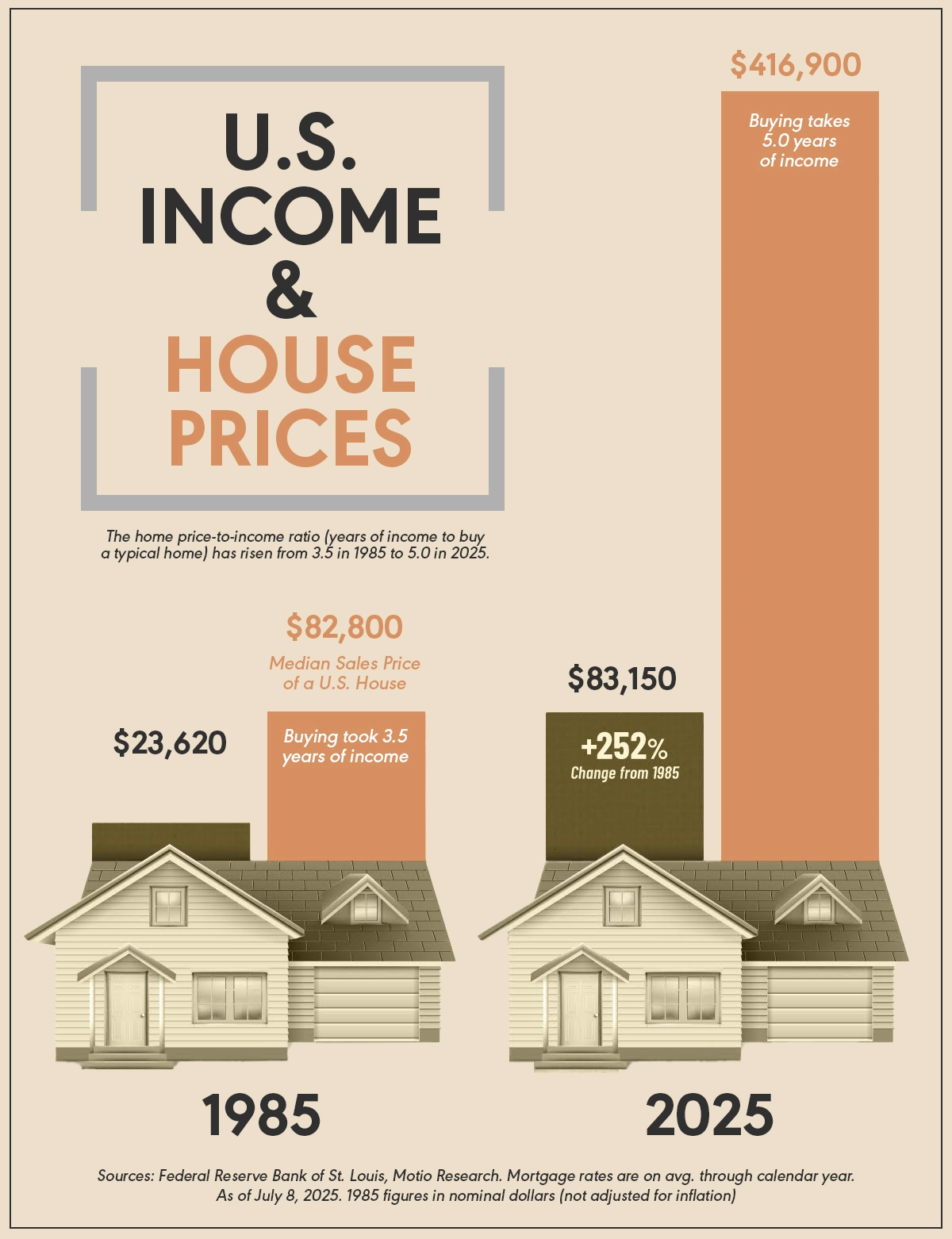
This gap means buying a typical home today requires 5 full years of household income, up from 3.5 years a generation ago.
This makes it particularly tough for young Muslims buying their first home. Many avoid buying a house on a conventional mortgage due to the prohibition of interest in Islam, and they continue to rent because they struggle to save up enough to buy a house in full.
While Islamic home financing options exist, they often come with their own set of challenges, including larger down payments, higher fees, and complex terms. On top of that, not every option is completely halal, just putting an Islamic contract label on a product doesn't mean much if the provider isn't actually taking on real property risk and true ownership with you. If a product ends up working just like a regular mortgage under a different name, it defeats the purpose, leading many to question if there are better investment routes.
But don’t let this discourage you. This guide aims to break down the basics of real estate investing, showing you how modern, Shariah-compliant solutions can make property investing more accessible, even without hundreds of thousands in your bank account.
What is Real Estate investing?
Real Estate investing, quite simply put, is the allocation of funds into property. This can be residential housing, commercial spaces, industrial buildings, or land meant for future development.
You can potentially earn from real estate in two main ways:
- Rental Income: This is the income you receive via regular rent payments from tenants. Rental income can potentially provide investors with a steady, predictable cash flow stream that can either supplement other income streams or serve as the main income source for full-time investors. However, like any investment, it is not risk-free and can fluctuate based on vacancy rates and market conditions.
- Capital Appreciation: This is an increase in your property’s value over time. For example, if you buy a house for $400,000 and its value rises to $450,000 in five years, you gain $50,000 in capital appreciation when you sell the property.
What are the types of Real Estate investments?
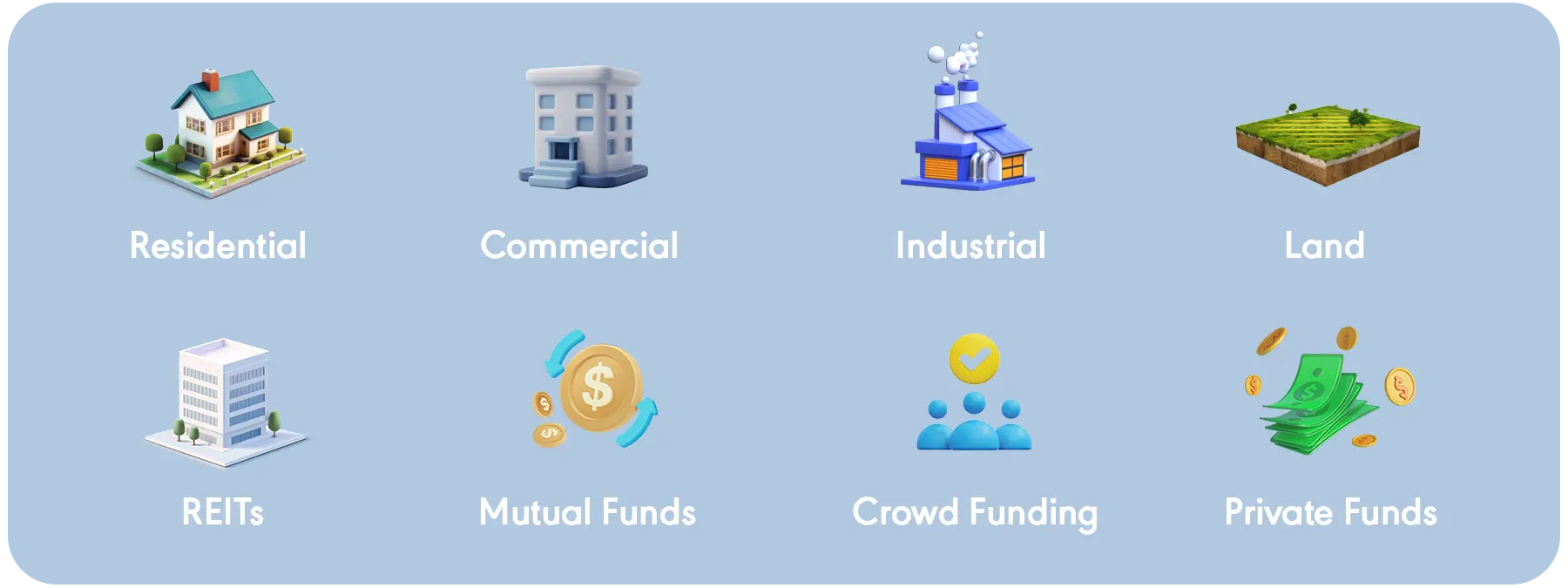
Real estate investing provides different options that fit your personal financial goals, level of risk you’re comfortable with and how involved you want to be. Knowing about these options can help you decide where to allocate your money.
We’re touching on some of the most common types of real estate investments below:
Traditional Real Estate Investments
- Residential Real Estate: Includes single-family homes, multi-family apartments, townhouses, duplexes and vacation properties. These properties are usually rented out to individuals or families.
- Commercial Real Estate: Includes office buildings, retail storefronts, and shopping centers leased to businesses. Commercial properties often offer higher rental returns compared to residential units, though economic downturns can impact tenant stability.
- Industrial Real Estate: Covers factories, warehouses and distribution centres used for manufacturing, e-commerce and distribution.
- Undeveloped Land: Undeveloped land can be used for farming or future development. While speculative, it can offer huge growth potential if developed wisely.
- House flipping: Buying undervalued properties, renovating them and selling them for a profit. This requires active renovation management, market knowledge and hands on effort.
Online Real Estate Investing Options
- Real Estate Investment Trusts (REITs): (pronounced “reets”) These are the funds that own and operate real estate. They allow investors to buy shares in a portfolio of properties on public stock exchanges, much like stocks.
- Real Estate Mutual Funds: Funds that invest in a variety of real estate securities, including REITs and property stocks, offering broad exposure to the sector.
- Real Estate Crowdfunding or Fractional Ownership: This modern method allows everyday investors to pool their capital and collectively invest in individual properties or real estate projects. It provides a lower entry point and lets you earn passive rental income without the hassle of managing properties yourself.
- Real Estate Funds: Professionally managed private funds that pool investor money to purchase a diversified portfolio of properties.
For Muslims looking for halal options, it is important to carefully check the underlying structure, debt levels, and tenant activity of REITs, mutual funds, crowdfunding deals and real estate funds to ensure they comply with Shariah principles.
For a detailed view on all the available options, read our blog: Best Halal Real Estate Investment Options in the U.S.
If you are looking to get started with a smaller starting budget, read our guide on How to Start Investing in Halal Real Estate With $5,000.
What’s the Islamic view on real estate investing?
As a Muslim investor, you must add an extra layer of scrutiny to ensure that all of your investments are in line with Shariah. This brings us up to the key question: Is real estate investing halal?
So, real estate investments can be both permissible and impermissible, depending on what’s involved in the process. As most of us are aware, traditional ways of investing in real estate can often conflict with Islamic principles because of the prevalent use of mortgages in the purchase of properties. When you get a mortgage on a property, you need to pay back interest on the payments, and involvement of any sort of interest (also known as riba) is strictly forbidden in Islam.
Additionally, engaging in speculative, volatile and unpredictable property trading can be considered similar to gambling, which is also not permissible.
However, this doesn’t mean that Muslims can’t invest in real estate. There are halal alternatives available for Muslim investors that follow these basic rules:
- Riba-free financing: Look for options that avoid interest-based loans, like buying all-cash or using scholar-approved Islamic financing structures. Always make sure the actual contracts are reviewed carefully. The focus should not just be on the label, but on making sure the setup avoids riba and does not simply replicate conventional debt-based financing in how it works or turns out.
- Transparent and just dealings: Ensure that all transactions are carried out with full transparency and that the terms are fair to all parties involved.
- Ethical practices: Make sure that the property isn’t being used for activities prohibited by Islam, such as selling alcohol or gambling establishments.
- Risk and reward sharing: Islamic principles discourage the guaranteed fixed returns. Instead, all investments should encourage the sharing of potential profits and losses.
How can you invest in halal real estate today?
Given the high costs and complexities of traditional real estate investing, many people are turning to alternatives like real estate fractional ownership and dedicated funds. This approach democratizes property investment by making it accessible to a wider audience without the need for a huge upfront payment or the hassles of actively managing the property.
In the U.S., platforms often use a structure that is equity-based and avoids debt, ensuring Shariah compliance. These investments are often structured as a Series Limited Liability Company (LLC), under the SEC's Regulation A or a registered investment fund.
Here is how the step-by-step process works:
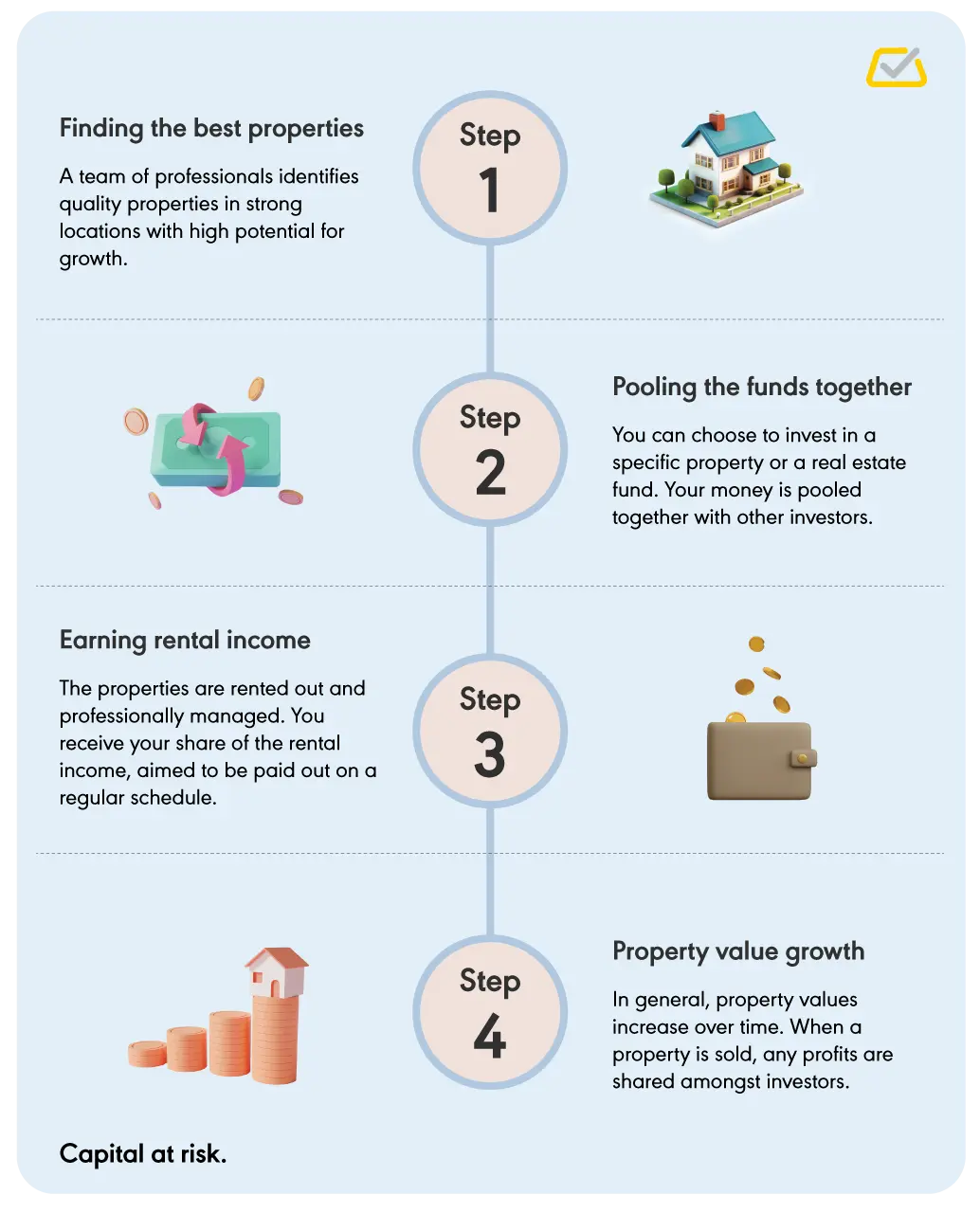
1. Individual Deals via Fractional Ownership
If you want to review specific properties and build your portfolio deal by deal, you can explore individual properties through Private Real Estate on Wahed. You buy equity shares in an LLC that owns a specific property starting from $500, earning your share of potential rental income and capital appreciation.
2. Diversified Exposure via Real Estate Funds
If you prefer immediate diversification across multiple properties without managing individual deal selection, you can invest in the Wahed Real Estate Fund. Starting from $100, the fund pools capital to purchase single-family residential homes across the U.S. with 100% cash, aiming to distribute rental income quarterly.
To understand more about how the fund structure works, read A Complete Guide to the Wahed Real Estate Fund.
Conclusion
Building wealth through property does not mean you have to bend your values or wait until you have half a million dollars sitting in the bank. The U.S. housing market has changed, and thankfully, the tools available to us as Muslim investors have evolved alongside it.
When Wahed started back in 2017, the goal was to remove the interest based hurdles that kept our community on the sidelines by building financial products around our values. Expanding into Shariah-compliant real estate is just the natural next step in that mission.
Whether you decide to save toward buying a property outright, pick specific rental houses deal by deal, or start with $100 a fund like the Wahed Real Estate Fund, what matters most is taking intentional steps with your money.
We pray that Allah grants you clarity in every financial decision you make, blesses your efforts and places enduring barakah in the wealth you build for your family.
Risk Disclosure:
This article is for educational and informational purposes only. It does not constitute financial, investment,legal, or religious advice. Wahed Financial, LLC ("Wahed"), as a manager of Wahed Real Estate Fund I LLC; Wahed Real Estate Series I, LLC (the “Wahed Issuer”), operates the wahed.com/real-estate website (the "Site") and is not a broker-dealer or investment advisor. All securities related activity is conducted through Dalmore Group LLC, a registered broker-dealer and member of FINRA/SIPC, located at 525 Green Place, Woodmere, NY 11598.
This investment is speculative, illiquid and involves substantial risk, including the possible loss of your entire investment. Securities are offered through Dalmore Group LLC, Member FINRA/SIPC. Wahed and Dalmore are not affiliates. Investors will be clients of Wahed. An offering statement has been filed with the SEC. SEC qualification does not imply approval or endorsement of the offering’s merits. Please review the full offering circular for complete terms and risks.
Investors are purchasing shares of a Fund and not the underlying asset(s) of the Fund. There is no assurance any Fund will achieve its objectives, is not listed on an exchange and may not be suitable for all investors. Distributions are subject to and are not guaranteed.
%20Open%20a%20Shariah-Compliant%20Retirement%20Portfolio%20with%20Wahed.webp)
