


%20(1).webp)

.webp)

Key Takeaways:
Gold vs. Real Estate: Which is Better for Muslim Investors?
For Muslim investors looking to build wealth without compromising their values, gold and real estate are two of the most familiar places to turn. However, besides the fact that both are tangible assets with centuries of history behind them, they serve very different roles in a portfolio. On one hand, gold is a highly liquid store of value that has historically shown particular strength during periods of severe inflation and currency instability. On the other hand, real estate can generate rental income alongside long-term appreciation, but comes with higher costs and significantly less liquidity.
This being the case, the question isn't simply whether gold or real estate is the "better" investment. Instead, one should consider the advantages (and potential disadvantages) each could bring to your portfolio. In this guide, we'll compare their historical performance, inflation protection, liquidity, income potential, ongoing costs, Zakat strategy and treatment and Shariah considerations to understand where each asset fits, and why Muslim investors don't necessarily have to choose between them.
One note before we start: "real estate" isn't one single thing. It can mean owning a property directly, like the residential homes in the Wahed Real Estate Fund, or it can mean owning shares in a Real Estate Investment Trust (REIT), a publicly-traded company that holds property and trades on a stock exchange like any other stock. The two behave differently, especially on liquidity, so this guide looks at each separately where it matters, starting with performance.
What the Data Shows: Gold, REITs, and Direct Property
Gold and real estate don't move together, and which one comes out ahead depends heavily on the inflation environment you're in. But "real estate" itself splits into two very different vehicles here: publicly-traded REITs, where we have 50 years of granular return data to draw on, and direct residential property, where the long-run data is thinner but the picture is still informative. We'll look at each in turn.
REITs vs. Gold: 50 Years of Data
An analysis from Quay Global Investors compared U.S. REIT (Real Estate Investment Trust) and gold returns across different inflation environments dating back to 1971. When annual inflation was below 3%, REITs produced average real monthly returns of 0.6%, compared with 0.3% for gold. Between 3% and 6% inflation, REITs averaged 0.9% compared with gold's 0.5%. Once inflation moved above 6%, however, the relationship reversed: REITs averaged a -0.1% real monthly return while gold remained positive at 0.2%.¹
Gold vs. REITs: Real Returns by Inflation Environment:
Average real monthly returns for U.S. REITs vs. gold, by annual inflation environment since 1971.
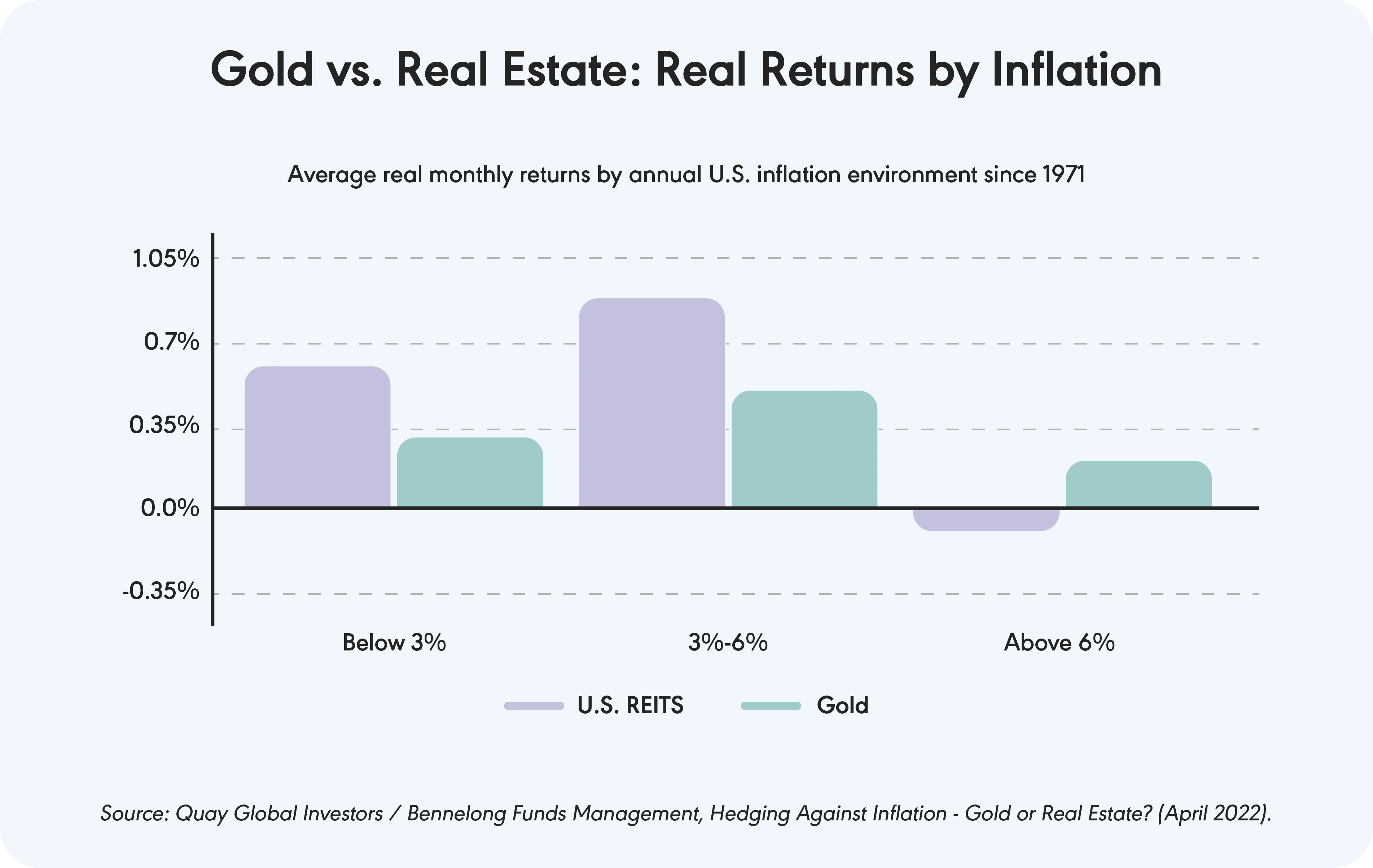
Source: Quay Global Investors / Bennelong Funds Management, Hedging Against Inflation — Gold or Real Estate? (April 2022).
Breaking the same historical data into more granular inflation bands reveals an even more interesting pattern. The crossover occurred at approximately 8% annual inflation. Below that level, real estate generally performed better. Once inflation exceeded 8%, gold generally had the advantage.¹
Direct Residential Property vs. Gold
The 1970s offer a concrete illustration of gold's strength during an inflationary crisis. During the decade's sustained high inflation, gold climbed dramatically, from an official price of $35 per ounce at the start of the decade to roughly $850 per ounce in January 1980.² Home prices rose too over the same stretch, but by comparison, the average sale price of a new U.S. home went from $26,600 in 1970 to $76,400 in 1980, according to U.S. Census Bureau data, a rise of roughly 187%.¹⁰ Gold's move was larger, and it came without the transaction costs, financing, or upkeep that come with owning a house. This period falls squarely within the kind of high-inflation environment where gold's historical advantage has been most pronounced.
Outside of those extreme inflationary periods, residential property has also demonstrated substantial long-term appreciation. The FHFA Purchase-Only House Price Index has recorded compound annual U.S. home-price growth of roughly 4.2% since 1991.³ That's price appreciation alone. Add in rental income, and the total return for an investor in occupied property climbs higher still.
Inflation also isn't the only environment worth considering when evaluating property. Comparing real estate versus stocks for Muslim investors reveals another side of the same broader principle. Different asset classes respond differently to economic conditions, which is one reason diversification matters more than trying to identify a single permanent winner.
Overall, the historical record makes the gold-versus-property question more nuanced than it first appears. Gold has demonstrated particular strength during periods of severe inflation and monetary instability. Real estate, whether through REITs or direct ownership, has historically performed better relative to gold across lower and more moderate inflation environments. Rather than proving that one is universally superior, the data shows why each can serve a different purpose within the same portfolio.
Liquidity: Which Asset Converts to Cash Faster
Liquidity is one of the clearest differences between gold and direct real estate. Physical gold can typically be converted to cash quickly through established dealers, although the amount an investor receives may be below the prevailing spot price. This is heavily dependent on the product, dealer, and market conditions.
Directly-owned real estate is inherently less liquid. A direct property sale commonly takes weeks or months, comes with transaction costs such as agent commissions and closing expenses, and can't easily be sold in fractions. An investor who owns a $300,000 property can't simply sell $10,000 worth of it when they need cash. (Publicly-traded REITs are the exception, trading as easily as any stock. Non-traded REITs don't share that liquidity, despite the name.¹²) That said, real estate funds can make property investing more accessible by allowing investors to own shares rather than purchasing and eventually selling an entire property themselves. For example, the Wahed Real Estate Fund provides access to a diversified portfolio of 100% cash-financed U.S. single-family homes starting with $100. That structure can make it easier to gain real estate exposure, but it doesn't eliminate the liquidity gap with gold. Depending on the fund, shares may still be subject to redemption windows, restrictions, and processing periods, so real estate fund investments shouldn't be treated as a substitute for cash that may be needed on short notice.
How Income and Ownership Costs Compare
Gold and real estate create returns in fundamentally different ways. Gold generates no income while you hold it.⁴ There are no dividends or rental payments, so an investor's return ultimately depends on the price of gold rising between the time it's purchased and sold.
Real estate has another potential source of return: rental income. A property can generate cash flow regardless of whether its market value is rising at the time. Gross rental yields for U.S. investment properties commonly fall in the 6%-10% range before expenses, with net yields after costs more typically around 2%-5%.⁵ REITs generate income the same basic way. U.S. tax law requires them to distribute at least 90% of their taxable income to shareholders each year, which is one reason they've historically offered comparatively high dividend yields.¹¹
Of course, that income doesn't come for free. Physical gold can involve ongoing storage and insurance costs, while real estate carries a broader range of recurring expenses. These can include property taxes, maintenance and repairs, insurance, management fees, and other operating costs.⁶
That's the tradeoff in relatively simple terms. Real estate costs more to own, but those expenses can be offset by the income the property generates. Gold costs less to hold, but produces no income along the way. For gold investors, appreciation does the work. For real estate investors, returns can come from both cash flow and appreciation.

Zakat Rules for Both Assets
Zakat is another area where gold and real estate can be treated very differently, potentially changing the effective annual cost of holding each investment.
Gold: Investment gold is generally subject to Zakat at 2.5% of its current market value once the applicable Nisab threshold is met and the required lunar year has passed.⁷ Because the value of gold changes constantly, and different scholarly methodologies may use different Nisab calculations, the dollar value of that threshold isn't fixed.
Real estate: This is where intention matters. For example, property held as a long-term rental is generally not subject to Zakat on the full market value of the property itself. Instead, Zakat may apply to qualifying rental income or cash that remains in the investor's possession. However, a property purchased specifically with the intention of reselling it for profit can be treated as trade inventory. This makes its market value relevant to the Zakat calculation.⁸ For a more detailed explanation of how intention affects the calculation, see our guide to Zakat rules on real estate investments.
REIT shares work a bit differently. Since an investor owns shares in a company rather than a property directly, Wahed’s Zakat methodology treats REIT holdings similarly to equity investments. If held for trading, Zakat is calculated on the full market value; if held for long-term wealth preservation, a 30% proxy is applied to estimate the Zakatable portion. The mechanics therefore differ from a directly-held rental property.
Consider what that difference could mean with $200,000 invested in each asset:
- $200,000 in Zakatable gold: At a 2.5% rate, the annual Zakat obligation would be $5,000 based on a $200,000 valuation.
- $200,000 in a rental property: The property's $200,000 market value would generally not itself be the basis for Zakat when the property is held for rental income. Instead, Zakat may apply to qualifying rental income or cash retained by the investor.⁸
- $200,000 in REIT shares: Under Wahed’s methodology, if held for long-term wealth preservation, a 30% proxy would apply, making $60,000 the Zakatable amount and resulting in $1,500 of Zakat at 2.5%. If held for trading, the full $200,000 market value would be used, resulting in $5,000 of Zakat.
The difference can become increasingly important as a portfolio grows. Rather than looking only at purchase price and expected returns, Muslim investors should consider how an asset's Zakat treatment affects the cost of holding it over time. That also makes it worth periodically reviewing your Zakat strategy as the size and composition of your portfolio changes.
How Shariah Compliance Differs for Gold and Real Estate
Gold comes with a Shariah consideration that's fairly unique to it: how the asset is purchased and owned matters in a specific, technical way. Since gold is classified as a ribawi commodity under Islamic law, transactions involving it are subject to specific rules around exchange, ownership, and possession. These rules have their roots in gold and silver's historical role as money and are intended to ensure that a transaction represents genuine ownership rather than a deferred or purely speculative claim.⁹
For investors today, the important question is therefore not simply, "Am I investing in gold?" but "Do I actually own the gold behind my investment?" Physical bullion provides the most straightforward example. Certain allocated gold structures can also satisfy Shariah requirements when physical gold is specifically allocated to the investor and the necessary conditions for ownership and possession are met.⁹
That distinction becomes important with products sometimes described as "paper gold." This refers to an investment that merely tracks the price of gold but doesn't necessarily give the investor ownership or possession of physical gold. Unallocated accounts, derivatives, and other structures therefore require additional scrutiny rather than being assumed Shariah-compliant simply because their value is linked to gold.⁹
Real estate doesn't carry the same ribawi exchange requirements. Instead, Shariah diligence tends to focus on areas such as how the property is financed, how the investment is structured, and whether its underlying activities are permissible. A cash-financed property, for example, avoids the interest-bearing debt that can complicate conventional real estate investing. The key distinction is that both assets require Shariah diligence, but for different reasons. With gold, ownership and possession are central considerations. With directly-held real estate, the financing and investment structure generally play a much larger role.
REITs add another layer to that screening. Under Wahed’s Shariah framework, the REIT itself should also be under Shariah supervision, in addition to meeting the applicable financial and non-permissible income screens. Any identified non-permissible income should be purified as required. That's a different, more involved checklist than the financing question that applies to a directly-owned, cash-financed property like the homes in the Wahed Real Estate Fund.
Gold vs Real Estate Data Summary
.webp)
Do You Have to Choose Between Gold and Real Estate?
For many Muslim investors, the answer doesn't necessarily have to be one or the other. Gold and real estate can serve different purposes within the same portfolio, and the differences we've covered help explain why. Gold offers liquidity and has historically demonstrated particular strength during periods of severe inflation and monetary instability. Real estate, meanwhile, can provide rental income and long-term appreciation, but generally requires investors to accept higher carrying costs and lower liquidity. Holding both can therefore provide exposure to two tangible assets that respond differently to changing economic conditions. Publicly-traded REITs, as we covered earlier, trade on public exchanges and behave more like liquid securities. Non-traded REITs don't share that liquidity, so it's worth checking which kind of REIT is actually being discussed before assuming it behaves like a stock.
Access to either asset also doesn't have to mean buying gold bars or purchasing an entire home yourself. Wahed Investing offers Shariah-compliant managed portfolios that can include exposure to physically backed gold, while investors interested in property can diversify into real estate without buying a property directly through alternative ownership structures. For example, the Wahed Real Estate Fund provides access to a diversified portfolio of 100% cash-financed U.S. single-family homes starting with $100. Investors can also view the properties held within the fund to better understand the underlying real estate they're gaining exposure to.
How much of either asset belongs in a portfolio is a separate question. The appropriate allocation depends on factors such as an investor's goals, time horizon, liquidity needs, and tolerance for risk. For investors considering a larger property allocation, understanding how much of a portfolio to put into real estate can provide a useful starting point. Ultimately, gold and real estate don't need to compete for a single spot in a halal portfolio. Gold can provide liquidity and protection during extreme inflationary environments, while real estate can provide income and long-term growth potential. The more useful question is what role each asset should play in helping an investor reach their goals.
Primary Sources & Reference Directory
1. Quay Global Investors / Bennelong Funds Management. Hedging Against Inflation — Gold or Real Estate? Investment Perspectives 77, April 2022. Historical analysis comparing U.S. REIT and gold real returns across different inflation environments since 1971.
https://www.bennelongfunds.com/sites/default/files/2022-04/Quay%20Investment%20Perspectives%2077%20-%20Hedging%20against%20inflation%20%28Apr%202022%29.pdf
2. World Gold Council. Gold Investor: Risk Management and Capital Preservation, Volume 2. Historical analysis of gold's performance during the high-inflation environment of the 1970s, including its January 1980 peak of approximately $850 per ounce.
https://www.gold.org/sites/default/files/documents/gold-investor-201304.pdf
3. U.S. Federal Housing Finance Agency (FHFA). FHFA House Price Index (HPI). Purchase-Only House Price Index data tracking changes in U.S. single-family home values since January 1991.
https://www.fhfa.gov/reports/house-price-index
4. World Gold Council. Gold as a Strategic Asset: Potential Risks and Challenges. Discussion of gold's lack of regular income or cash flow and investors' reliance on price appreciation for investment returns.
https://www.gold.org/goldhub/research/relevance-of-gold-as-a-strategic-asset/risks-challenges
5. Bullion Trading LLC. Gold vs Real Estate Investment Comparison 2025. Comparison of gold and real estate investment characteristics, including cited U.S. rental-yield ranges for investment property.
https://bulliontradingllc.com/blog/gold-vs-real-estate-investment-comparison-2025/
6. U.S. Internal Revenue Service. Publication 527: Residential Rental Property. Guidance identifying rental-property income and common expenses associated with owning and operating residential rental property, including taxes, insurance, maintenance, repairs, and other expenses.
https://www.irs.gov/publications/p527
7. Islamic Relief USA. Zakat. Guidance on Nisab, the 2.5% Zakat rate, gold, and other forms of Zakatable wealth.
https://irusa.org/zakat/
8. Islamic Relief Worldwide. Zakat on Property & Rental Income. Guidance on the Zakat treatment of rental property, rental income, and property acquired with the intention of resale.
https://www.islamic-relief.org.uk/giving/islamic-giving/zakat/zakat-on-property/
9. Accounting and Auditing Organization for Islamic Financial Institutions (AAOIFI) / World Gold Council. Shari'ah Standard No. 57: Gold and Its Trading Controls. Shariah standard covering gold transactions, including spot exchange, ownership, physical and constructive possession, and allocation requirements.
https://www.gold.org/download/file/18645/The-Shariah-Standard-on-Gold-English.pdf
10. U.S. Census Bureau. Price Indexes of New One-Family Houses Sold Including Value of Lot. Average sales price data for new one-family houses sold in the United States, used for the 1970-1980 home price comparison.
https://www.census.gov/construction/cpi/pdf/price_sold_1996.pdf
11. U.S. Internal Revenue Service. Instructions for Form 1120-REIT. Guidance on the REIT distribution requirement, including the rule that a REIT must distribute at least 90% of its taxable income to shareholders annually.
https://www.irs.gov/instructions/i1120rei
12. U.S. Securities and Exchange Commission. Investor Bulletin: Non-Traded REITs. Investor guidance on the illiquidity of non-traded REITs compared with publicly-traded REITs.
https://www.investor.gov/introduction-investing/general-resources/news-alerts/alerts-bulletins/investor-bulletins-89
Risk Disclosure:
This article is for educational and informational purposes only. It does not constitute financial, investment,legal, or religious advice. Wahed Financial, LLC ("Wahed"), as a manager of Wahed Real Estate Fund I LLC; Wahed Real Estate Series I, LLC (the “Wahed Issuer”), operates the wahed.com/real-estate website (the "Site") and is not a broker-dealer or investment advisor. All securities related activity is conducted through Dalmore Group LLC, a registered broker-dealer and member of FINRA/SIPC.
This investment is speculative, illiquid and involves substantial risk, including the possible loss of your entire investment. Securities are offered through Dalmore Group LLC, Member FINRA/SIPC. Wahed and Dalmore are not affiliates. Investors will be clients of Wahed. An offering statement has been filed with the SEC. SEC qualification does not imply approval or endorsement of the offering’s merits. Please review the full offering circular for complete terms and risks.
Investors are purchasing shares of a Fund and not the underlying asset(s) of the Fund. There is no assurance any Fund will achieve its objectives, is not listed on an exchange and may not be suitable for all investors. Distributions are subject to and are not guaranteed.


.webp)