
Key takeaways
The 50/30/20 rule divides take-home income into needs, wants, and savings and financial goals.
The framework can be a useful starting point for Muslim households, but the percentages may need to be adjusted.
Housing, childcare, healthcare, and dependents can increase the percentage of household income spent on essential expenses.
Zakat is calculated according to applicable Islamic rules, not as a fixed percentage of monthly income.
Families may choose to create a dedicated budget category for charitable giving.
Emergency savings and long-term investments serve different purposes and should be planned accordingly.
Tracking actual household expenses is essential for building a realistic budget.
A Muslim family can earn a comfortable income and still struggle to balance housing, groceries, childcare, charitable giving, and saving for the future. The 50/30/20 budget rule offers a simple way to organize household finances, but real family budgets don't always fit neatly into fixed percentages. This is especially true when housing and childcare consume a substantial portion of take-home pay or obligations like Zakat and voluntary Sadaqah need to be considered.
That’s why the 50/30/20 rule can be a useful starting point for Muslim families, but it isn't a one-size-fits-all solution. Your budget may need to reflect essential expenses, dependents, financial goals, and religious obligations rather than forcing your household into a predetermined allocation. This guide explains how the 50/30/20 rule works and how Muslim families can adapt it to their financial priorities.
What is the 50/30/20 Budget Rule?
The 50/30/20 budget rule is a framework for dividing your after-tax income among three broad categories: needs, wants, and savings and financial goals.
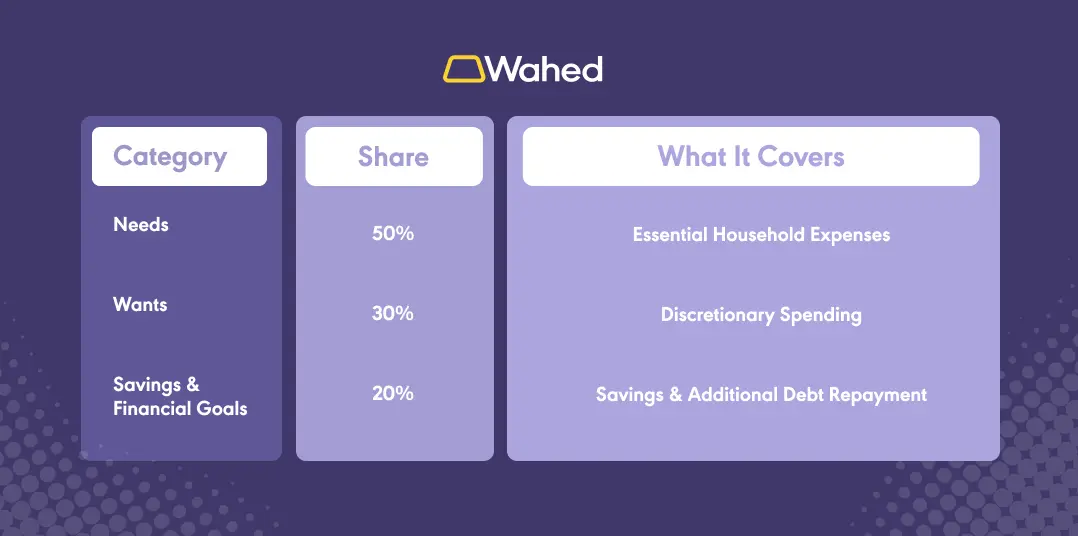
50% for Needs: Essential expenses such as housing, groceries, utilities, transportation, insurance, healthcare, childcare, and minimum required debt payments.
30% for Wants: Discretionary spending can include dining out, entertainment, vacations, hobbies, nonessential purchases, and lifestyle upgrades.
20% for Savings and Financial Goals: Emergency savings, retirement contributions, long-term investments, additional debt repayment, and other financial goals.
The percentages are guidelines rather than requirements. Importantly, the 50/30/20 rule generally applies to take-home income rather than gross salary, giving families a framework based on the money actually available to budget each month.
How Does the 50/30/20 Rule Work for a Muslim Family?
Consider a household with two adults and two children living in a U.S. metropolitan area. If their combined monthly take-home income is $8,000, a traditional 50/30/20 budget would look like this:
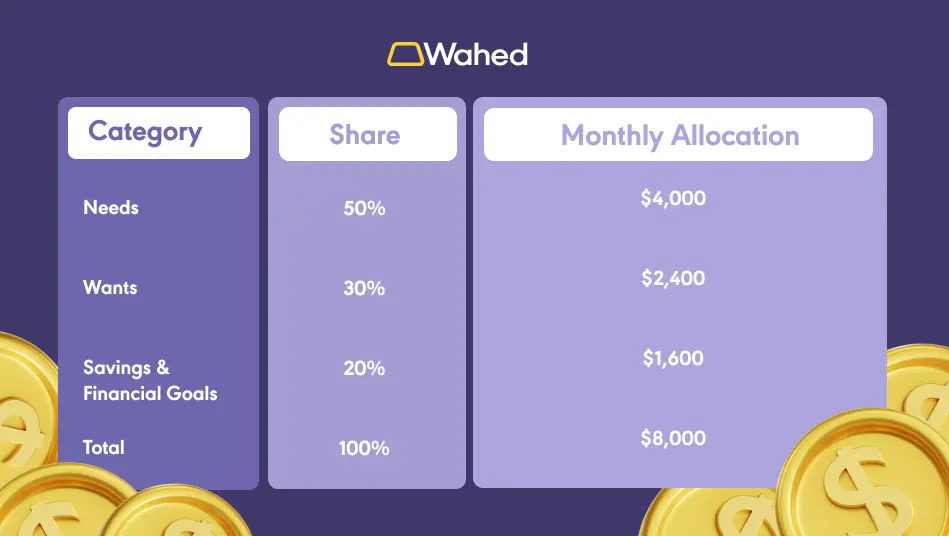
In practice, the 50% needs category may be the hardest target to maintain. For families in higher-cost areas, housing, childcare, healthcare, and other essentials can quickly consume much of the $4,000 allocation.
Before deciding whether these percentages are realistic, ask yourself: where does your money go every month? Comparing your actual spending with the framework can show where your household budget may need to adjust.

See How Your Family's Budget Adds Up
Housing, childcare, groceries, and other expenses can quickly change your budget. Use Wahed's Expense Tracker to better understand your spending and plan around your household's priorities.
Is the 50/30/20 Rule a Good Fit for Muslim Families?
It can be, depending on the household. The framework can provide useful structure without requiring every family to follow the percentages exactly.
Why the Rule Can Be Useful: Separating income into needs, wants, and savings makes it easier to see how much is going toward essential expenses, discretionary spending, and future goals. It can also encourage consistent saving and help families identify areas where discretionary spending could be adjusted.
Why the Rule May Need Adjustments: High housing, childcare, and healthcare costs can leave less room for wants or savings. Single-income households, families supporting relatives, those with variable income, and families planning for religious giving may also find that a different allocation better reflects their circumstances.
Is the 50/30/20 Rule an Islamic Budgeting Requirement? No. The 50/30/20 rule is a modern personal finance framework, not a prescribed Islamic financial allocation. The goal is to build a responsible household budget that reflects your financial obligations, personal circumstances, and Islamic values.
Where Do Zakat and Sadaqah Fit Into the 50/30/20 Rules?
Zakat and Sadaqah don't fit neatly into the traditional needs, wants, and savings categories, but Muslim families can account for both when planning a household budget.
Understanding Zakat: Zakat is a religious obligation for eligible Muslims who meet applicable conditions. It is generally calculated based on eligible wealth and applicable Islamic rules, rather than simply as a fixed percentage of monthly income. Knowing how much Zakat you really owe can help you plan for the obligation within your household budget.
Understanding Sadaqah: Sadaqah is voluntary charitable giving. Families may incorporate it into their financial planning based on their circumstances and giving goals.
Should Zakat Be Classified as a Need? Budgeting categories and religious obligations serve different purposes. Families may set aside funds for anticipated Zakat, but the amount and due date should follow the applicable Islamic methodology.
Should Sadaqah Come From the Wants Category? There is no universal classification. Sadaqah may be included within discretionary spending or budgeted separately.
Creating a Dedicated Giving Category: Some families may prefer to adapt the 50/30/20 framework by creating a separate category for charitable giving. Rather than forcing Zakat or Sadaqah into needs or wants, a dedicated giving category can make these priorities more visible and intentional within the household budget.

What If Your Family’s Needs Exceed 50% of Income?
If essential expenses exceed 50% of your take-home income, the budget may need to change. The percentages should serve the household, not the other way around. Common pressure points include:
- Rising housing costs: Rent, home financing payments, utilities, and other property-related expenses can push essential spending above the 50% target.
- Childcare and education expenses: Childcare, school-related costs, and other responsibilities associated with raising children can increase a family's essential expenses.
- Healthcare and insurance costs: Insurance premiums, recurring healthcare expenses, and unexpected medical costs can take up a larger share of the household budget.
- Single-income household considerations: Families relying on one income may have less flexibility to absorb rising or unexpected expenses while maintaining the standard allocation.
The 50% target isn't a pass-or-fail test. Families should prioritize essential obligations rather than reduce necessary spending simply to fit a predetermined percentage.
Can Families Adjust the 50/30/20 Rule?
Yes. Families can adapt the percentages. The examples below are illustrations, not recommendations.
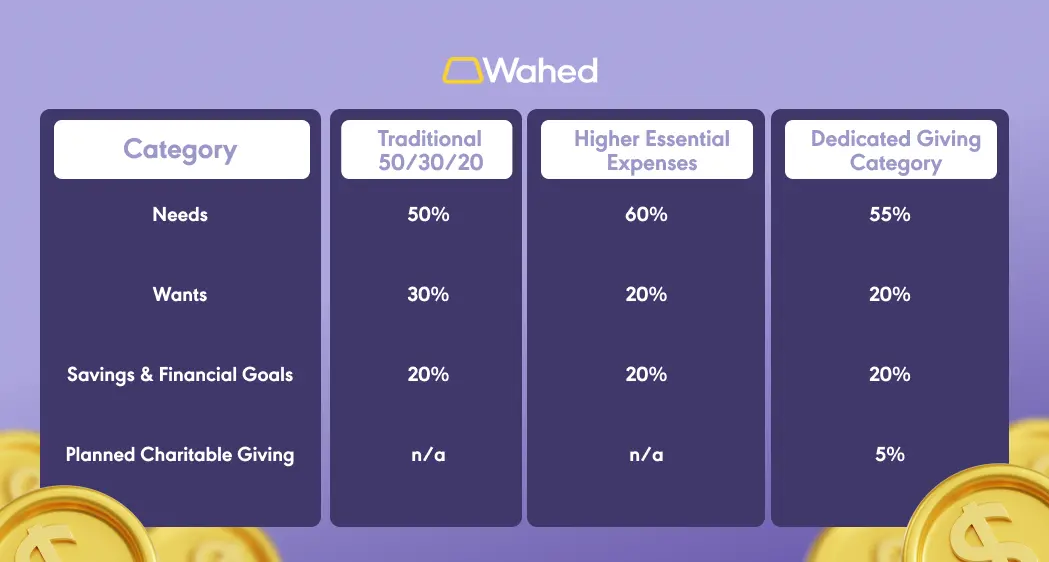
In the third example, the giving allocation is an illustrative budgeting choice and shouldn't be confused with a Zakat calculation.
How to Choose an Appropriate Budget: Consider your essential expenses, household income, dependents, financial obligations, charitable giving, and short- and long-term goals. Your savings allocation should also reflect whether you're saving enough for your goals, rather than simply aiming for a predetermined percentage. Wahed's Goals Calculator can help estimate what reaching a specific goal may require.
How Should Muslim Families Budget for Emergency Savings?
Emergency savings can help families manage unexpected expenses without disrupting long-term financial goals or relying on debt. A commonly referenced starting point is three to six months of essential expenses, although the appropriate amount depends on your household.
Understanding Emergency Fund Needs: Rather than basing your target on income alone, consider the essential expenses your household would need to cover during a financial emergency, such as housing, groceries, utilities, transportation, and healthcare.
How Family Responsibilities Affect Savings: Families with children, higher healthcare or housing costs, dependents to support, or less predictable income may need a larger financial cushion. A single-income household may also approach emergency savings differently than a household with multiple stable income sources.
Where Emergency Savings Fit in the Budget: Emergency savings can be included within the savings and financial goals portion of a 50/30/20 budget. Families building a fund from scratch may choose to prioritize it before directing more of that allocation toward longer-term investments.
Shariah-Compliant Cash Management Considerations: Where you keep emergency savings matters, too. Consider liquidity, risk, and Shariah compliance when evaluating your options. Determining how much cash you should keep before investing can help you balance near-term financial security with longer-term goals. Families considering Wahed's ESA can also compare High Yield Savings vs Everyday Shariah Account to better understand how the two approaches differ.
Wahed's Everyday Shariah Account (ESA) is designed for short-term cash management within an Islamic financial framework. ESA is an investment account rather than a conventional bank deposit, so investments can fluctuate in value and are not FDIC insured.
How Can Muslim Families Budget for Long-Term Investing?
A household budget can create room for long-term investing by treating future financial goals as a recurring priority rather than whatever is left over at the end of the month. Within the 50/30/20 framework, these contributions can generally come from the savings and financial goals allocation.
Retirement Savings: Retirement contributions should reflect factors such as your age, current savings, income, expected expenses, and retirement timeline. There is no universal target, so determining how much you personally wish to save for retirement can help put your current contributions in context.
Children's Education: Parents may also allocate part of their budget toward future education costs. Starting early can provide more time to build funds while reducing the potential need for interest-based borrowing later. When investing for college, consider the time until your child may need the funds, the account options available, and whether the underlying investments align with your values.
Long-Term Wealth Building: A diversified investment portfolio can support goals that may be years or decades away. Your investment strategy and level of risk should reflect your goals, circumstances, and investment timeline.
Balancing Savings and Investments: Short-term cash needs and long-term investments serve different purposes. Money you may need soon generally requires greater liquidity, while longer time horizons may allow for more investment risk.
Exploring Shariah-Compliant Investment Options: Families can explore different approaches to halal investing based on their goals, risk tolerance, and investment timeline. Those who prefer a managed approach can explore Wahed's diversified, Shariah-compliant portfolios through its Robo Advisor.
How Can Muslim Families Track Their Spending?
Muslim families can track their spending by regularly comparing their household's actual cash flow with the budget they've created. Wahed's Expense Tracker can help organize your income and expenses in one place, while the following guidelines can help you build a consistent approach to managing your household finances.
- Review Monthly Income: Start with your household's take-home income so your budget reflects the money actually available to spend, save, and invest.
- Categorize Household Expenses: Organize spending into needs, wants, savings and financial goals, and any additional categories you've created, such as charitable giving.
- Identify Recurring Expenses: Review regular costs such as housing, insurance, childcare, subscriptions, and utilities. Recurring expenses can consume a significant portion of income before discretionary spending begins.
- Review Spending Patterns: Compare your planned budget with what you actually spend each month. This can reveal categories where spending consistently runs higher or lower than expected.
- Adjust the Budget as Family Needs Change: A budget should evolve with your household. Having a child, changing jobs, moving, or taking on education expenses can all affect how your income should be allocated. Similarly, increasing your investments after a raise may make sense if your essential expenses and other financial priorities are already covered.
Common 50/30/20 Budgeting Mistakes
- Treating the 50/30/20 rule as a strict requirement: Use the percentages as a starting point rather than forcing them onto a household where they don't fit.
- Using gross income instead of take-home income: Base your allocations on the income actually available after taxes and other deductions.
- Underestimating housing and childcare costs: Account for your household's actual essential expenses when setting percentages.
- Forgetting irregular annual expenses: Plan for costs such as repairs, annual fees, medical expenses, and other bills that don't occur every month.
- Confusing Zakat with a fixed percentage of monthly income: Zakat is generally calculated based on eligible wealth and applicable Islamic rules.
- Ignoring charitable giving in financial planning: Account for planned giving when deciding how household income will be allocated.
- Failing to build emergency savings: Leave room in your budget for unexpected expenses and financial disruptions.
- Treating all savings as investment money: Keep short-term liquidity needs separate from money intended for long-term investing.
- Setting unrealistic spending limits: Choose allocations your household can reasonably maintain.
- Not reviewing the budget as circumstances change: Revisit your budget when income, expenses, dependents, or financial goals change.
Build a Budget That Reflects Your Family’s Priorities
The 50/30/20 budget rule can give Muslim families a simple framework for organizing household spending, building emergency savings, planning charitable giving, and working toward long-term financial goals. But the right budget isn't necessarily one that follows 50/30/20 exactly. It should reflect your actual expenses, family responsibilities, financial priorities, and Islamic values.
As your income, expenses, and family circumstances change, your budget can change with them. Regularly reviewing your spending and financial goals can help you make intentional decisions today while continuing to plan for your family's future.
Build a Budget Around Your Family's Financial Goals
The 50/30/20 rule can provide a starting point, but your family's financial plan should reflect your actual expenses and priorities. Use Wahed's Expense Tracker to understand your spending and explore tools that support your financial goals.
Frequently asked questions
Yes. It can be a useful starting point, but families may need to adjust the allocations based on childcare, housing, healthcare, and other essential expenses.
The framework generally uses after-tax, or take-home, income rather than gross income.
The percentages can be adjusted to reflect your essential expenses and household circumstances. The 50% allocation is a guideline, not a requirement.
Families may plan for anticipated Zakat within their household budget, but Zakat obligations are calculated according to applicable Islamic rules rather than the 50/30/20 percentages.
There is no universal classification. Voluntary giving can be planned as a separate category or included within a household's discretionary allocation.
The 50/30/20 rule is a budgeting method, not an investment or financing arrangement. Using the framework does not inherently conflict with Islamic financial principles, although individual financial activities should be evaluated separately.
The appropriate amount depends on household income, expenses, financial obligations, and short- and long-term goals. No single savings percentage is appropriate for every family.
Disclaimer:
Wahed Invest LLC (Wahed) is a U.S. Securities and Exchange Commission (SEC) registered investment advisor. Wahed Invest provides brokerage services to its clients through its brokerage partner Apex Clearing Corporation, a member of NYSE - FINRA - SIPC and regulated by the SEC and the Commodity Futures Trading Commission. Registration does not imply a certain level of skill or training. Wahed does not intend to offer or solicit anyone to buy or sell securities in jurisdictions where Wahed is not registered or a region where an investment practice like this would be contrary to the laws or regulations. Any returns generated in the past do not guarantee future returns. All securities involve some risk and may result in loss. Any performance displayed in the advertisements or graphics on this site are for illustrative performances only.