


Key takeaways
Knowing where your money goes is the first step. Tracking your monthly expenses can reveal spending patterns that are easy to miss and help you make more informed financial decisions.
A budget should support your priorities, not simply restrict spending. Separating needs from wants and spending intentionally can help align your money with your short- and long-term goals.
Small, sustainable changes can improve cash flow. Reviewing recurring expenses, automating savings, setting reasonable spending limits, and checking your budget regularly can create more room for your goals.
Better expense tracking can support consistent saving and investing. Understanding your cash flow can help you build emergency savings, prepare for major expenses, and invest toward long-term goals.
Wahed's Expense Tracker can provide greater financial visibility. Organizing your income and spending in one place can help you identify opportunities to save and build a more intentional financial plan.
Picture this: You earn a steady income, pay your bills, and try to save money when you can. Yet for some reason, at the end of the month or pay period you may take a look at your bank account and think, “where did all my money go?” If this sounds familiar, you are not alone. It is a very common dilemma for many people in the United States, especially in this current economy.
That said, this isn’t necessarily an income problem. It’s a visibility problem.
That’s why the fix doesn’t have to mean earning more or cutting costs that may prevent you from doing things you enjoy. Sometimes, simply understanding where your money is going can reveal opportunities to help make better financial decisions. Using an expense tracker can give you that visibility by organizing your monthly expenses and helping you recognize spending patterns that might otherwise fly under your radar. This guide walks you through how to track spending, better understand your financial habits, and how to use Wahed’s Expense Tracker to build a more intentional plan for your money.
Why it Feels Like Your Money Disappears?
When it seems like your hard earned funds just evaporate into thin air at the end of every month, there isn’t always one major expense responsible. Instead, this can more commonly be explained by the accumulation of smaller purchases that feel rather insignificant on their own. Here are some of the more common factors to consider:
Lifestyle inflation: As your income rises, your spending may gradually rise with it, often without a conscious decision. A raise can turn into a nicer apartment, a newer car, or more frequent dining out, leaving less of that additional income available for saving.
Recurring subscriptions: Streaming services, apps, memberships, and automatic renewals can quietly charge month after month. Individually, they may seem insignificant. Together, they can become a meaningful part of your monthly expenses.
Impulse purchases: A quick online order or spontaneous purchase rarely feels significant in the moment. That can make this type of spending particularly easy to underestimate over the course of a month.
Everyday expenses that add up. Coffee, takeout, rideshares, and other convenience purchases may each represent a small expense, but collectively they can account for a much larger portion of your spending. For example, buying the same $6 coffee and $14 lunch every day can add up to about $600 at the end of the month. That adds up significantly over the course of a year.
It is worth noting that this is not meant to come across as a list of bad choices, because it’s not. It's simply meant to portray that without a clear view of where your money is going, it's difficult to decide whether that spending actually reflects your priorities.
Why Tracking Expenses Matters?
Tracking your expenses can tell you way more than how much you spent over a given period. Expense tracking provides a clearer picture about where your income is being used, revealing patterns and habits that otherwise may have been easy to overlook. Understanding those habits is what allows you to make more intentional decisions about your spending and determine what is actually left for savings.
It reveals spending patterns. Seeing a full month, or several months, of spending laid out can surface patterns you didn't know you had.
It improves saving habits. When you understand your actual expenses, saving becomes a deliberate decision rather than a hope that something will be left over. That can also help you determine whether you're saving enough for your goals.
It reduces financial stress. Much of the anxiety around money can come from uncertainty. Having a clearer picture of your finances gives you something concrete to work with, even when there's room for improvement.
It makes your decisions intentional. Once you understand how you're spending your money, you can decide whether those choices reflect what you actually care about and where adjustments may make sense.
Over time, these decisions can create more room for saving, investing, and other long-term priorities. In this way, expense tracking can become an important part of Muslim financial planning, helping you use your income more intentionally in support of the goals that matter to you.
Biggest Spending Categories for Families
Once you start tracking your monthly expenses, it can be helpful to organize them into categories. This makes it easier to see which parts of your budget consume the most income and where you may have better flexibility to make changes. The following five categories can be used as a helpful example for your financial strategy:
Housing. Rent or mortgage payments, utilities, insurance, maintenance, and other housing costs often make up a significant portion of monthly spending.
Transportation. Car payments, insurance, fuel, maintenance, parking, rideshares, and public transportation can collectively become another major expense.
Food. Groceries are only part of the picture. Dining out, delivery, coffee, and other convenience spending can substantially increase what you spend on food each month.
Healthcare and childcare. Insurance premiums, medical costs, prescriptions, daycare, and other family expenses may represent significant recurring obligations.
Entertainment, subscriptions, and shopping. These categories tend to offer more flexibility, but they're also where smaller purchases can accumulate without attracting much attention.
Categorizing your spending isn't about deciding that one category is “too high.” It's about understanding how your money is divided between current needs, discretionary spending, and future priorities. That can also help you decide where to keep money you expect to need within the next 12 months rather than treating every dollar left after expenses the same way.
How Wahed Expense Tracker Works?
Tracking expenses doesn't have to mean building a complicated spreadsheet or manually piecing together your spending each month. Wahed's Expense Tracker brings the key parts of your monthly finances together, functioning as a simple budget calculator that can help you better understand your overall cash flow. You'll start by looking at a few key areas:
- Monthly income: What comes in each month.
- Recurring bills: Regular expenses such as housing, utilities, and subscriptions.
- Discretionary spending: More flexible expenses such as dining out, shopping, and entertainment.
- Savings contributions: What you're setting aside each month.
Bringing these numbers together can give you a clearer picture of how much money is coming in, where it's going, and what's left. From there, you can identify areas where adjustments may be possible and make more informed decisions about saving and spending. As with any planning tool, the usefulness of the results depends on the information you provide. The Expense Tracker is designed to give you greater clarity and a starting point for making those decisions.

Are You Spending in Line with Your Goals?
Understanding where your money goes is only useful if you use that information to decide where you want to allocate it. This is where personal finance budgeting becomes less about restrictive spending and more about alignment with your priorities.
A good first step is to start by separating your expenses into needs and wants. Needs include essential costs such as housing, groceries, transportation, and healthcare. Wants are more flexible, but that doesn't mean they're unnecessary or irresponsible. The goal is to spend intentionally so that enjoying your money today doesn't consistently come at the expense of what you're working toward tomorrow.
Money that isn't needed for current expenses can then be assigned to a specific purpose, such as building an emergency fund, preparing for a major purchase, or working toward a longer-term goal. Depending on that purpose, you may also want to consider whether you can earn halal returns that you hold rather than leaving every dollar in the same place. Ultimately, a budget should help give every part of your income a purpose. Aligning expenses with long-term priorities means balancing what you need today, what you want to enjoy, and what you need to set aside to prepare for the future.
Five Ways to Improve Monthly Cash Flow
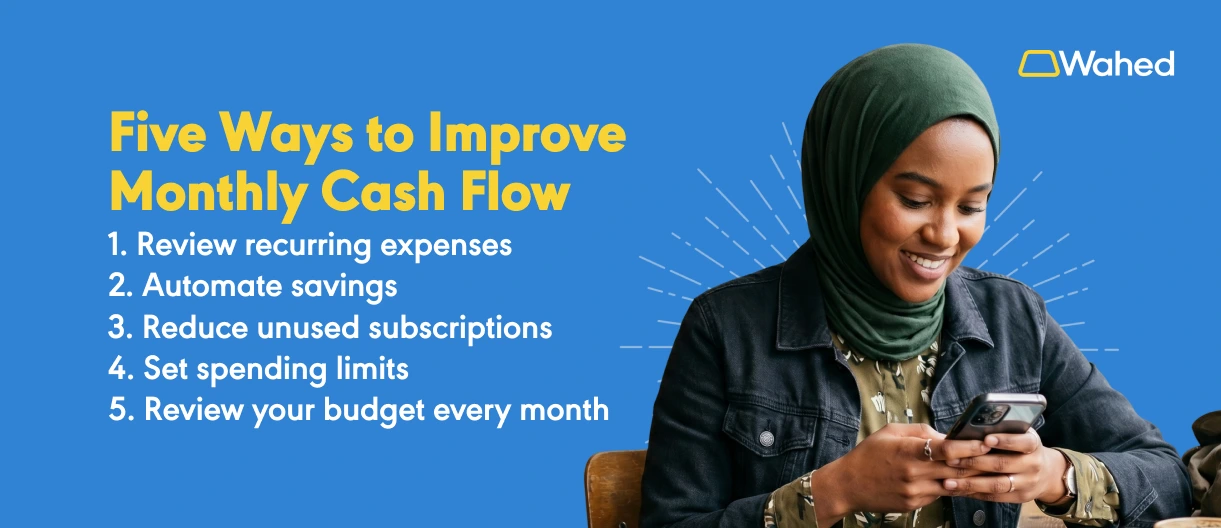
Improving your monthly cash flow doesn't have to mean making drastic cuts, as an effective budget is one that you can actually maintain. A smart approach is to focus on sustainable adjustments that can create more room for your financial goals without making your plan difficult to follow. Here are five practical ways to get started:
1. Review recurring expenses. Go through your fixed bills and recurring charges. Are all of them still worth what you're paying?
2. Automate savings. Setting up an automatic transfer on payday turns saving into a default instead of a decision you have to remake every month. This can be especially useful when building an emergency savings fund.
3. Reduce unused subscriptions. Cancel services you no longer use. This is often one of the simplest ways to free up cash without significantly changing your lifestyle.
4. Set spending limits. Giving flexible categories, such as dining out or shopping, a monthly limit can keep them from quietly growing.
5. Review your budget every month. A quick monthly check-in can keep your plan aligned with your actual expenses and priorities as they change.
How Expense Tracking Supports Investing?
Investing consistently often starts with creating room in your monthly budget. By tracking your expenses, you can identify money that may be redirected toward building an emergency fund, increasing retirement contributions, or investing for other long-term goals. You also don't necessarily need a large amount of money before getting started. Understanding how much money you need to start investing can help you determine what may be realistic based on your current cash flow.
Once you're ready, learning the basics of halal investing for young professionals in the U.S. how investing fits into a broader financial plan that reflects both your goals and values. In this way, expense tracking can serve as the bridge between understanding your spending today and building toward your financial future.
Common Budgeting Mistakes
A few patterns show up often when people try to get a handle on their spending:
- Never reviewing bank statements. If you don't look at where your money went, you can't learn from it.
- Underestimating discretionary spending. Flexible expenses are easy to underestimate, especially when they consist of many smaller purchases.
- Budgeting once and never updating it. A plan that isn't revisited can gradually fall out of line with your actual expenses and priorities.
- Focusing only on cutting expenses. Spending less is most useful when the money you free up is intentionally directed toward savings, investing, or another financial goal.
- Tracking spending inconsistently. Tracking for a short period and then stopping only gives you part of the picture, making it harder to identify longer-term patterns.
Take Control of Your Monthly Finances
Financial awareness is where intentional spending, disciplined saving, and long-term halal wealth building all begin. You don't need to overhaul your life or track every cent forever. You just need a clear picture of where your money goes now and a plan for how you’d like to allocate it instead. Start there, and building the rest of your financial plan becomes much easier.
Frequently asked questions
Your income may be spread across fixed expenses, discretionary purchases, subscriptions, savings, and smaller everyday costs that are easy to overlook. Tracking these categories can help you see where your money is actually going.
There isn't one percentage that works for everyone. How much you can save depends on your income, necessary expenses, financial obligations, and goals. The aim is to find a sustainable balance between covering your needs today and consistently preparing for the future.
Start by recording your income and organizing your spending into categories such as housing, transportation, food, recurring bills, and discretionary expenses. An expense tracker can make it easier to organize and review this information consistently.
A good income doesn't automatically translate into consistent savings. Lifestyle inflation, recurring expenses, discretionary spending, and simply not knowing how much you're spending can all reduce what remains available to save.
Keep the process simple and consistent. Use an expense tracker or similar budgeting tool to organize your spending, review it regularly, and make adjustments when your expenses no longer reflect your priorities.
Risk Disclosure: For U.S. audience. The Everyday Shariah Account is a WRAP investment account managed by Wahed Invest LLC. Wahed Invest LLC is a U.S. Securities and Exchange Commission (SEC) registered investment advisor. This content is for informational purposes only and does not constitute investment advice or a recommendation to buy or sell any securities. All investments have market risk, including loss of principal. Past performance does not guarantee future result and there is no assurance any investment strategy will achieve its objectives or is suitable for all investors. The term halal denotes that permissibility in accordance with Islamic law.
This material is strictly for illustrative, educational or informational purposes only and does not constitute financial, investment, or legal advice. This information should not be relied upon as research, investment advice, or a recommendation regarding any products, strategies, or any security in particular.
Certain content represents an assessment of the market environment at a specific time and is not intended to be a forecast of future events or a guarantee of future results; material is as of the dates noted and is subject to change without notice.