



Key takeaways
We look at the market before we look at the house. The town and the neighborhood decide most of what a property earns over ten years, so we test the area first and the property second.
Every home is bought with cash. No mortgage, no interest, which fits our Shari’ah requirements and means we’re never forced to sell in a down market just to make a loan payment.
We’re underwriting for yield above 8%, and we’re conservative about it. We build in a month of vacancy, a 10% management fee and real maintenance costs before a property makes the cut.
The obvious choices usually aren’t the right ones. Big name cities often yield too little after costs. The highest yield areas usually come with hidden risk. Fast growing towns can get overbuilt fast. Our criteria are built to catch all three.
Raleigh, North Carolina checks every box. Strong job mix, people moving in, low crime, manageable costs, and yields that work. That’s why six of our homes are there and in the towns around it.
Picture two identical homes. Same size, same condition, same price, same rent. One is in a neighborhood where employers are hiring and families keep moving in. The other is in a neighborhood where the largest employer is shrinking, people have been moving out for years, and the tax bill keeps rising. On the day you buy them, they look like the same investment. Ten years later, they almost certainly will not be.
The house is only part of the investment. The rest of it is the area.
That raises the question every property investor has to answer before buying a single home: where? The honest answer is that it depends on what you want the investment to do. If your aim is fast price growth, you might buy in an expensive, booming city and accept that the rent will barely cover the costs. If your aim is the highest possible yield, you might buy cheap homes in a struggling town and accept older properties, higher turnover and flat prices. Each approach leads to a very different kind of place, and sometimes a very different neighborhood within the same city. Detroit is a good example: the city lost more than half of its residents after 1950, yet the wider metro area's population has stayed broadly stable at more than five million, and it remains one of the 15 largest metro economies in the country.
In other words, the right area is not a matter of taste. It follows from the job the investment has been given, and for a fund, that job is set by its mandate. To understand the places we choose, you first have to understand what our fund is built to do.
Built for income
Our real estate fund is designed to serve as an anchor investment within a portfolio: a source of regular rental income, with distributions intended to be paid quarterly, from a diversified portfolio of American homes. Over time, those homes may also grow in value, adding a second source of return on top of the income. The aim is steady income with lower volatility than many growth investments, the kind of holding that can bring stability to the rest of a portfolio.
We invest in single-family real estate (properties of 1-4 units), and we buy every home with cash. The first reason is simple: interest based debt is not Shari’ah-compliant. Owning homes outright also brings real economic benefits. With no loan to repay, we are not forced to sell a home to meet debt payments, which gives us the flexibility to hold through a weak market and continue earning rent while conditions improve. That leaves us free to focus on the income each home produces.
This shapes everything that follows. Because income is at the heart of the fund, the places we choose should be ones where that income is dependable: where tenants have steady jobs, where demand for housing is growing, where running costs are predictable, and where a single storm or a single employer is unlikely to knock the investment off course. Every criterion below is a way of testing for that.

Seven things we look for in a place
1. Jobs, and more than one kind
Jobs are one of the strongest draws for people moving to an area, and tenants in steady work are the foundation of reliable rent. We look for metropolitan areas with strong job activity, and we prefer areas where employment is spread across several industries. A town that depends on one factory or one military base can do very well for years, but if that employer leaves, rents and home values can fall together. We also look at whether the state and local government make it attractive for businesses to relocate and expand, because that tends to support continued job growth.
2. People moving in, at a reasonable pace
We want more people moving into an area than leaving it, because that supports demand for housing over time. What we look for is steady, sustainable growth rather than the fastest-growing city in the country. Very fast growth tends to attract very fast construction, and if too many new homes and apartments are built, rents can stall even while the population rises.
3. Stable neighborhoods with steady incomes
Within a growing area, we look closely at the neighborhood itself: crime levels, the quality of local schools, household incomes and the share of residents in work. These tell us whether an area can attract and keep tenants who pay reliably and look after the home. Lower crime and good schools also make a neighborhood more appealing to families, who tend to stay longer, which tends to mean fewer vacancies and lower turnover costs.
4. Weather and environmental risk
Every region carries some natural hazard risk, so we manage and mitigate it rather than trying to avoid it wholesale. We stay out of FEMA-designated flood plains, check each home's flood risk before we buy, and spread the portfolio across states and regions.
That spread matters for an income fund. When a disaster hits, the cost is not only repairs, which insurance is intended to cover, but also rent lost while a home is repaired, insurance deductibles and higher premiums across the region afterwards. Owning homes in many different places means no single event can affect the income of the whole fund at once.
5. Costs we can predict
Rent is only half of the income picture. The other half is what it costs to own the home, and that can vary widely from one state, and even one county, to the next. Property taxes and insurance are usually the two largest costs, so what we look for is predictability: costs we can estimate accurately before we buy, and that are unlikely to jump unexpectedly afterwards.
We check how a state taxes rental homes, how often counties reassess values, any homeowners association (HOA) fees or rental restrictions, and the local rules for landlords. For every home, we rebuild the tax bill at the rate we will actually pay and obtain a real insurance quote, rather than relying on estimates.
6. Rent that justifies the price
An area can pass every test above and still be too expensive. We look for a gross yield (annual rent divided by purchase price) above 8%, and we test every home against deliberately conservative assumptions: one month of vacancy a year, a 10% property management fee and maintenance of at least 5% of rent. In practice, our costs often come in below these levels, but we underwrite conservatively on purpose. We base rents primarily on comparable homes that have recently been leased nearby, rather than on asking rents or an agent’s estimate. We also want homes that attract standard, long-term tenants such as families and working professionals, rather than homes that rely on student lets or short-term rentals.
7. Homes that are easy to price and easy to sell
We look for areas with plenty of similar homes, so that when we buy and whenever we sell, we can be confident the price reflects the market. We avoid homes with unusual features that make them hard to compare: a two-bedroom cottage on a street of large family homes, a bathroom opening straight onto a living room, or bedrooms with no closets. Homes like these are harder to value and can take longer to sell.
Where the obvious answers fall short?
When we speak with investors, a few questions come up again and again. Each one points to a place that looks like an easy choice, and each answer comes back to the same mandate.
“Why not the big, well-known cities, where real estate is known to do well?”
Homes in the largest, most expensive cities have often risen in value over the long term. The problem for an income fund is the price you pay for that. In cities such as New York or Los Angeles, gross rental yields average around 5% or less, compared with a national average of about 6.7%1, and that is before property taxes, insurance and maintenance. Once those costs are paid, little income is left, and you are relying mostly on prices continuing to rise. These cities also have some of the most extensive rules on rent increases and evictions, and homes cost so much that a fund would own only a handful of them, which is the opposite of the diversification we want.
“I have seen investments offering 10% or 12% yields. Why not buy there?”
We see these opportunities often. Some of the highest rental yields in the country are available in older neighborhoods of cities where home prices are low. The yield looks attractive because the price is low, and a low price often reflects older homes that need more maintenance, weaker local job markets and, in some cases, home prices that have been broadly flat for years. These areas can also carry a higher risk of tenants falling behind on rent or causing significant damage to a home, and that damage is rarely recovered, even through the courts.
A 12% yield on paper can quickly become much less once you account for a month or two of vacancy each year, a new roof or heating system, a single difficult tenancy, and a home that is worth no more in ten years than it is today…
“Why not simply follow where people are moving fastest?”
Population growth matters, but it is only one of our criteria. Some of the fastest-growing areas are also among the most expensive places to own a rental home, because of high insurance or property taxes, and rapid growth can bring a wave of new construction that holds rents down. A market like that can still work, but a home there has to clear a higher bar.
From state to street
In practice, we apply these criteria in layers, starting wide and narrowing down. We have written about the final stage, choosing the individual home, in our acquisition case study of 142 Flintlock Way, Alabama.
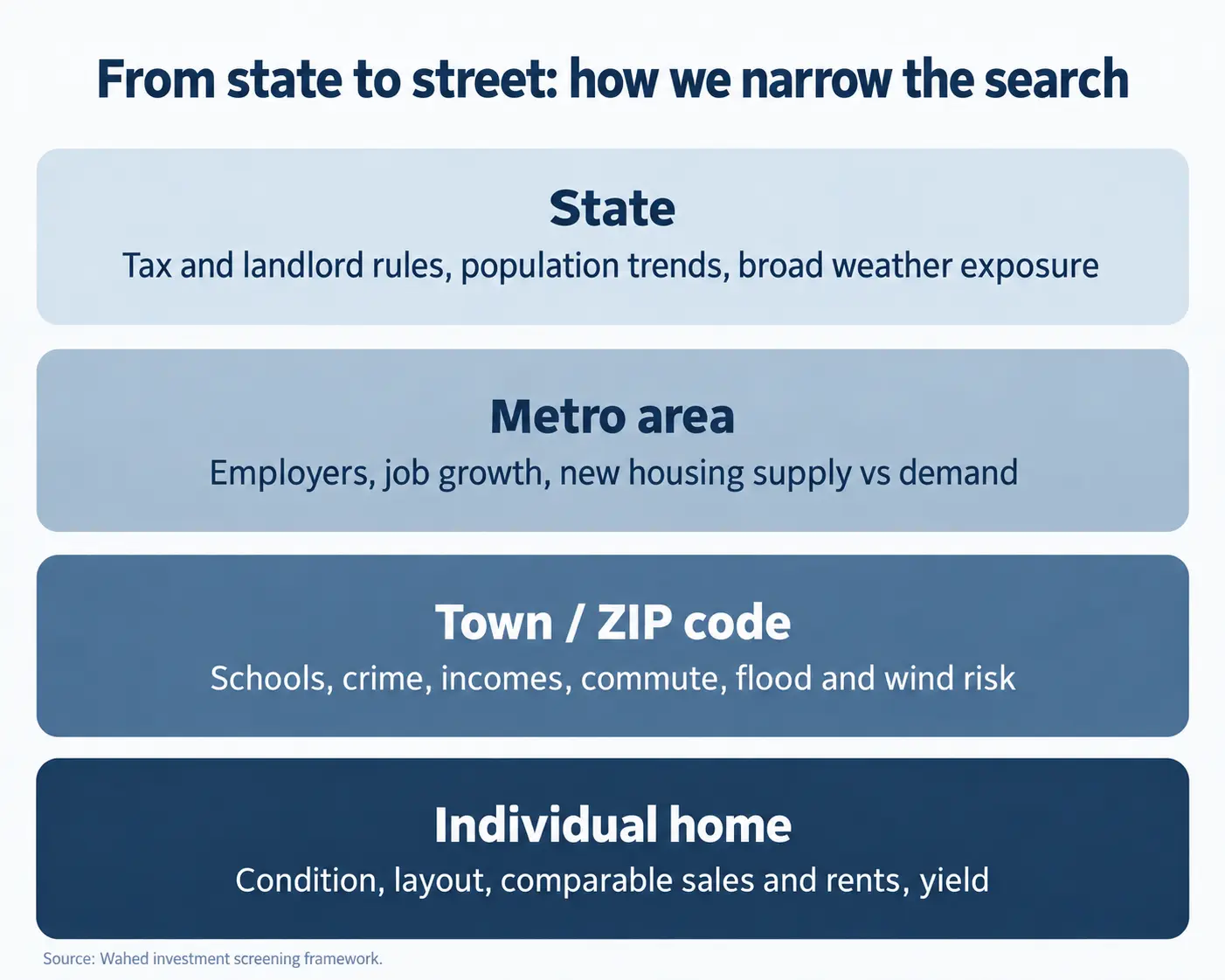
There are hundreds of cities in the United States that pass the first two layers, so there is no shortage of opportunity. The layers that follow are where most of the work, and most of the rejections, happen.
Putting it into practice: Raleigh, North Carolina
The state: people, jobs and a business-friendly backdrop
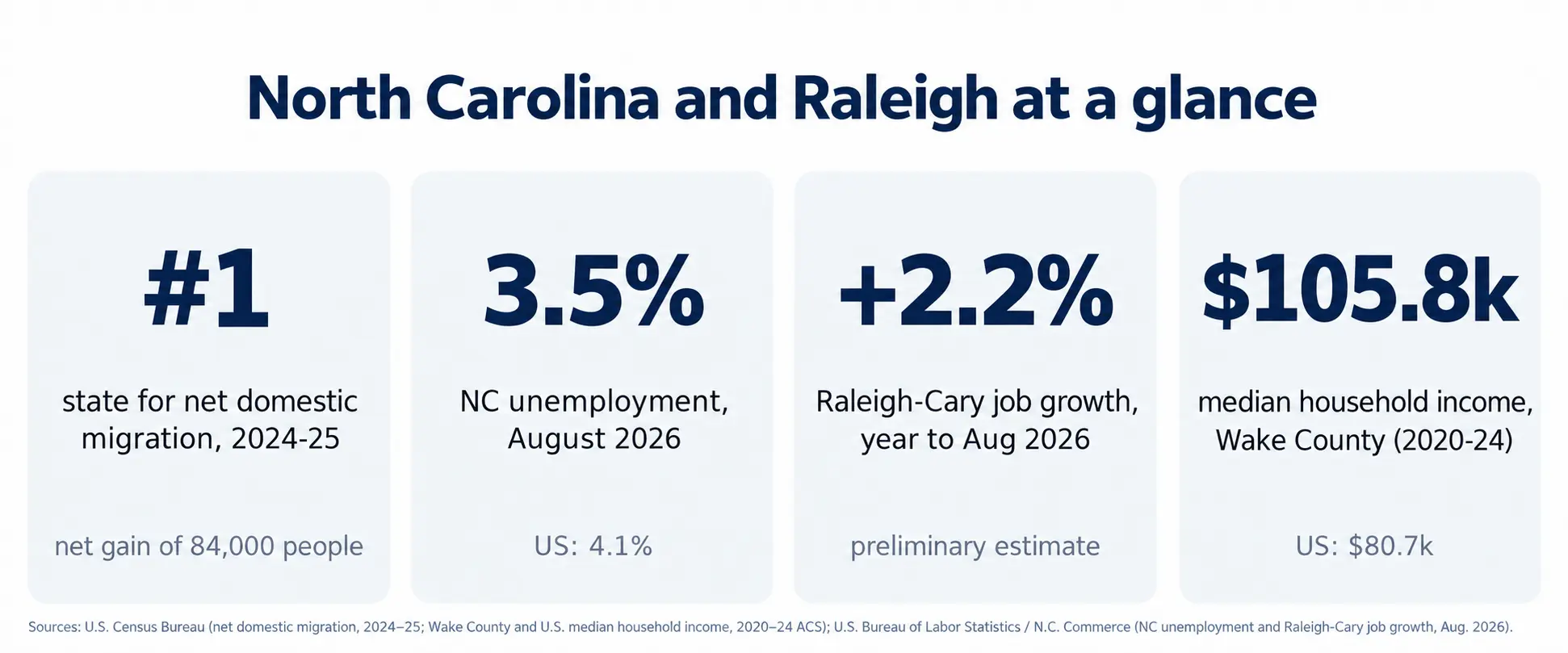
North Carolina passes the first layer comfortably. In the year to July 2025, it had the largest net gain of residents from other states of any state, around 84,0002, and between April 2020 and July 2025 it added about 709,000 people through domestic and international migration3. Many move for work, and newcomers often rent before buying.
The job market has held up well, with unemployment at 3.5% in August 2026 against 4.1% nationally4. The state has also made itself attractive to employers: its corporate income tax rate has fallen to 2% this year and is scheduled to reach zero in 20305.
North Carolina also scores well on the costs and rules we described above. There is no general homestead exemption, so a rental home is generally taxed at the same rate as an owner-occupied home next door6, and state law prevents cities and counties from regulating rent levels on private rental homes7.
The metro: Raleigh and the Research Triangle
Raleigh is the state capital and, together with Durham and Chapel Hill, forms the Research Triangle, anchored by North Carolina State University, Duke University, the University of North Carolina at Chapel Hill and Research Triangle Park, one of the largest research parks in the country.
This gives Raleigh the kind of mixed employment base we look for: state government, universities, technology, research and, increasingly, advanced manufacturing. The Raleigh-Cary metro added more jobs than any other metro in the state in the year to February 20268 and growth has continued since, at about 2.2% in the year to August 2026 (preliminary)9.
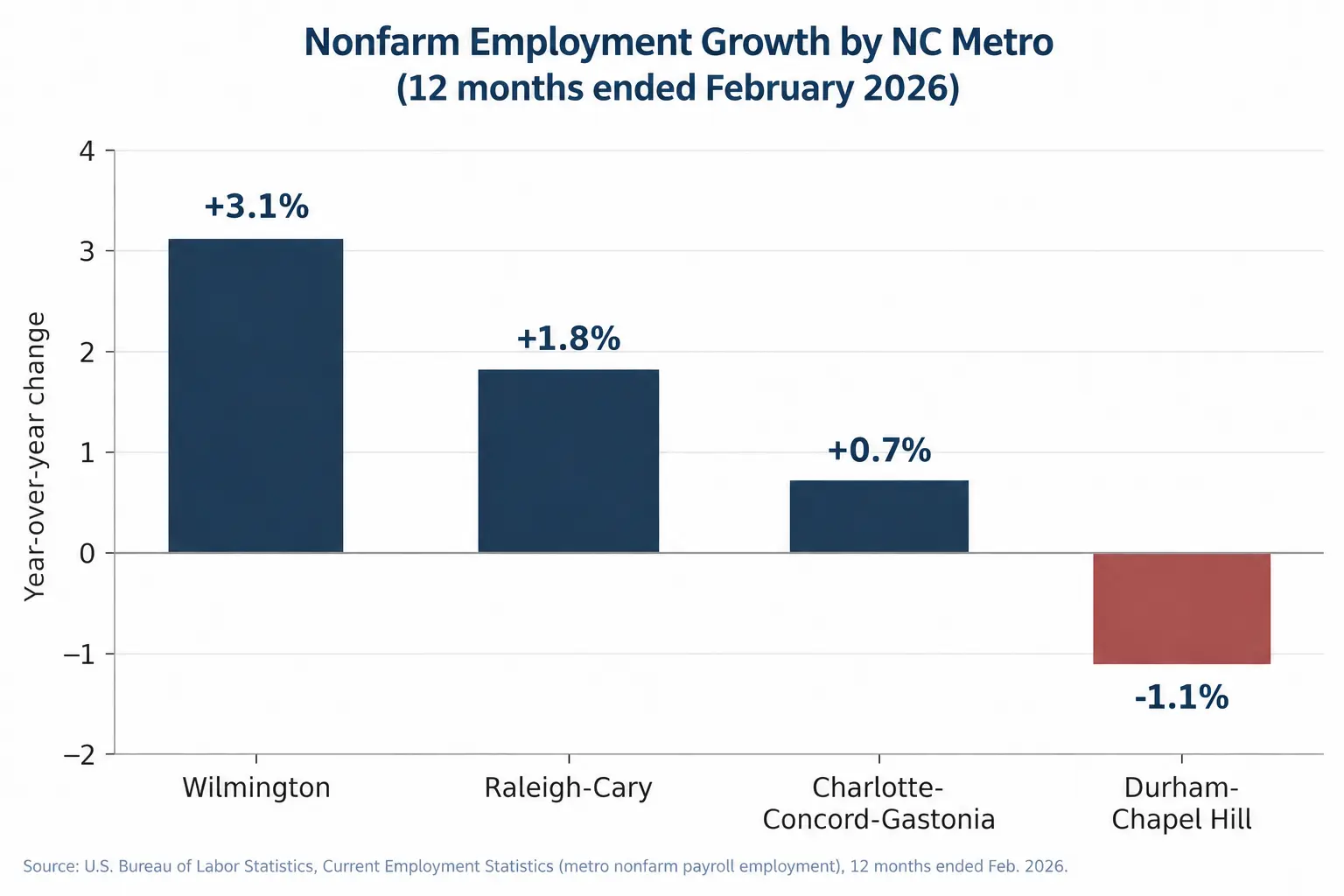
Nonfarm employment growth by North Carolina metro, 12 months ended February 2026. Source: NC Department of Commerce and US Bureau of Labor Statistics data, via WilmingtonBiz.
Growth is not uniform: employment in neighboring Durham-Chapel Hill dipped over the same period, and we keep a close eye on it.
Much of the newest investment is in life sciences manufacturing on the edges of the metro. In Holly Springs, south of Raleigh, Genentech has raised its planned investment to $2 billion, joining existing manufacturing sites run by Amgen and Fujifilm10. These are long-term commitments by large companies, and they bring well-paid jobs within easy reach of several of the towns where we buy.
The weather: one part of a diversified portfolio
Like most of the country, the Raleigh area has some exposure to natural hazards, mainly storms and occasional flooding along creeks. Sitting more than 100 miles inland, it is less exposed to hurricanes than the coast, but it is not risk-free, as Hurricane Fran showed in 1996. As everywhere, we avoid flood plains, check each home's flood risk before we buy, and rely on the portfolio's spread across several states so that no single event affects too much of the fund.
The towns: where the numbers work
Within the metro, the question becomes which towns and neighborhoods meet our yield target. We have found suitable homes in established parts of Raleigh and in the growing towns around it, such as Wake Forest to the north, Wendell to the east and Fuquay-Varina to the south, with neighboring Johnston County one we are also reviewing.
These areas share the qualities our mandate calls for. Tenants are mostly families and working professionals, and Wake County has the highest median household income of any county in North Carolina, about $105,800 against $80,700 nationally11. Raleigh ranks as the safest large city in North Carolina and 15th of 83 large US cities in SmartAsset’s 2026 index, which combines crime, traffic safety and disaster risk12, and violent crime in Fuquay-Varina, Wendell and Wake Forest is well below the national rate13. The commute to Raleigh, Research Triangle Park or the new manufacturing sites is manageable, and the area keeps growing: Wake County is projected to add about 9% more residents between 2025 and 2030, and Johnston County about 12%14.

Where we have bought
Between August 2025 and September 2026, we acquired six homes in North Carolina. Five are in the Raleigh area, two in Raleigh itself and one each in Wake Forest, Wendell and Fuquay-Varina, and one is in High Point, in the Piedmont Triad.
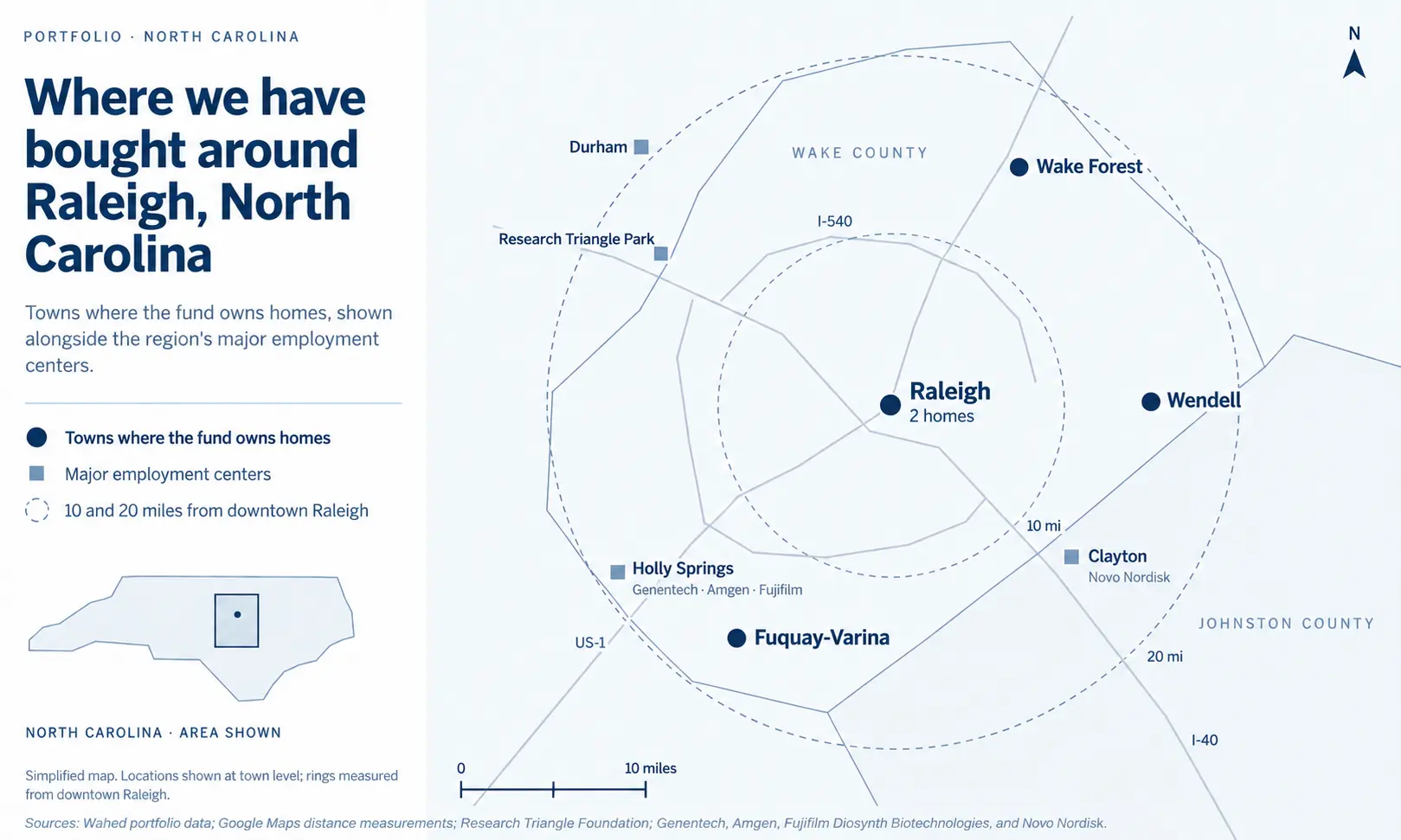
As of September 2026, all six homes are leased and stabilized. Each one, including the home in High Point, was assessed against the same criteria and reflects the process described above: well-kept homes in growing areas, within reach of major employers, and outside flood plains.
Looking ahead
Our approach to growing the fund follows the same logic as our approach to choosing places. First, we build depth where we are already doing well. In markets like Raleigh, we have established strong local partners and a clear understanding of which neighborhoods work. Adding more homes there lets us put that knowledge to work and manage the portfolio more efficiently. Then, as the fund grows, we introduce new markets that pass the same tests, adding diversification across regions, economies and weather patterns.
The wider market is, on balance, helpful to a cash buyer like us. In late September 2026, mortgage rates rose above 7% for the first time since January 202515, which can mean fewer buyers competing for the same homes, and sellers value a buyer who can close quickly without a financing contingency. Home values in Wake County were also down about 2.5% year over year as of January 202616, which can mean better entry prices. And from January 2027, the 21st Century ROAD to Housing Act restricts most purchases of existing single-family homes by investors that, together with their affiliates, control 350 or more such homes17, which may further reduce competition from the largest buyers. Our fund remains well below that threshold.
We are planning for modest rent growth in the near term and for insurance and property tax costs to keep rising, and we are buying with that in mind. The fund is designed to prioritize steady income over double-digit headlines, and we aim to keep doing what it is built to do: generate income from a growing number of homes, with the potential for those homes to grow in value over time.
Final Thoughts
Every home in our portfolio began with a decision about place. Before we ever looked at the kitchen or the roof, we had already asked whether people were moving there, whether they could find work, whether the neighborhood was safe, whether the next storm or tax bill could undo the numbers, and whether the rent justified the price.
Those questions are not unique to us. They are worth asking of any real estate investment, whether it is a fund, a rental property or the home you live in. The yield on a listing tells you what a home earns today. The place has a large say in what it is likely to earn over the next ten years.
That is why we choose carefully, buy with cash, and stay patient, building the portfolio one well-chosen place at a time.
If you’re weighing this fund against other real estate options, our piece on 8 Questions Muslim Investors Should Ask Before Investing in Any Real Estate Fund walks through what to check first.
References:
1. Global Property Guide. (2026, Q2). United States rental yields.
2. North Carolina Office of State Budget and Management. (2026, January 28). North Carolina top destination for domestic migrants [Blog post]. https://www.osbm.nc.gov/blog/2026/01/28/north-carolina-top-destination-domestic-migrants
3. North Carolina Office of the Governor. (2026, January 30). North Carolina ranked top state for domestic migration, remains third-fastest growing state in the nation [Press release]. https://governor.nc.gov/news/press-releases/2026/01/30/north-carolina-ranked-top-state-domestic-migration-remains-third-fastest-growing-state-nation
4. North Carolina Department of Commerce. (2026, September 18). August 2026 employment release.
5. North Carolina Department of Revenue. (n.d.). Corporate income tax rates; PwC. (n.d.). North Carolina enacts corporate income tax phase-out. https://www.pwc.com/us/en/services/tax/library/north-carolina-enacts-corporate-income-tax-phaseout.html
6. North Carolina Department of Revenue. (n.d.). Tax Administration Manual, Section 21: Exemptions, exclusions and applications.
7. N.C. Gen. Stat. § 42-14.1.
8. WilmingtonBiz. (2026, April 30). [Exact headline needed from source team].
9. U.S. Bureau of Labor Statistics. (2026, August). Raleigh-Cary, NC employment situation [Preliminary]. https://www.bls.gov/regions/southeast/nc_raleigh_msa.htm
10. Genentech. (2026, January 20). Genentech more than doubled investment in Holly Springs, North Carolina manufacturing facility [Press release]. https://www.gene.com/media/press-releases/15096/2026-01-20
11. U.S. Census Bureau. (2024). American Community Survey 2020-2024, 5-year estimates [QuickFacts]; county ranking via USAFacts.
12. SmartAsset. (2026). America’s safest big cities, 2026 study. https://smartasset.com/data-studies/americas-safest-big-cities-2026-study
13. Federal Bureau of Investigation. (2024). Uniform Crime Reporting data [via OpenCrime].
14. North Carolina Office of State Budget and Management. (2025). County population projections, Vintage 2025.
15. Freddie Mac. (2026, September 24). Primary Mortgage Market Survey. https://www.freddiemac.com/pmms
16. Zillow. (2026, January). Zillow Home Value Index, Wake County, NC. https://www.zillow.com/research/data/
17. Latham & Watkins. (2026). 21st Century ROAD to Housing Act becomes law.
Frequently asked questions
Seven things, mainly. Jobs and how varied they are. Whether people are moving in at a steady pace, not too fast and not too slow. How stable the neighborhood is, things like crime, schools, and household income. Weather and flood risk. Whether costs like taxes and insurance are predictable. A rental yield above 8%. And whether homes in the area are easy to price and easy to sell when the time comes.
In most big, expensive cities, rental yields run around 5% or less before you’ve even paid taxes, insurance and upkeep. That doesn’t leave much income, and the high prices mean we could only afford a handful of homes there, which goes against spreading the risk.
Nothing, on paper. In practice, a 12% yield often comes from an older home in a weaker job market, and that gap gets eaten up fast. One bad tenant, one new roof, a couple of months of vacancy, and the yield that looked great in a spreadsheet stops looking so great.
North Carolina had the biggest net gain of people moving in from other states in the year to July 2025. Its corporate tax rate keeps falling, and state law stops cities from capping rent on private homes. Raleigh adds a job base that isn’t tied to one industry, which is exactly what we want. Government, universities, tech, and life sciences all play a part there.
No. Every property is bought with cash. Part of that is Shariah compliance, since debt isn’t allowed in Islam. The other part is practical. Without a loan to service, we’re never forced to sell during a weak market. We can just hold the property and keep collecting rent until things improve.
Over time, yes. The plan is to go deeper in markets we already understand well, then branch out into new ones once they pass the same seven tests. That builds in more diversification as the fund grows, without chasing growth for its own sake.
This article is for educational and informational purposes only. It does not constitute financial, investment, legal, or religious advice. Wahed Financial, LLC (“Wahed”), as a manager of Wahed Real Estate Fund I LLC; Wahed Real Estate Series I, LLC (the “Wahed Issuer”), operates the wahed.com/real-estate website (the “Site”) and is not a broker-dealer or investment advisor. All securities related activity is conducted through Dalmore Group LLC, a registered broker-dealer and member of FINRA/SIPC, located at 525 Green Place, Woodmere, NY 11598.
This investment is speculative, illiquid and involves substantial risk, including the possible loss of your entire investment. Securities are offered through Dalmore Group LLC, Member FINRA/SIPC. Wahed and Dalmore are not affiliates. Investors will be clients of Wahed. An offering statement has been filed with the SEC. SEC qualification does not imply approval or endorsement of the offering’s merits. Please review the full offering circular for complete terms and risks.
Investors are purchasing shares of a Fund and not the underlying asset(s) of the Fund. There is no assurance any Fund will achieve its objectives, is not listed on an exchange and may not be suitable for all investors. Distributions are subject to and are not guaranteed.
%20Open%20a%20Shariah-Compliant%20Retirement%20Portfolio%20with%20Wahed.webp)
