



Key takeaways
Investment risk includes more than short-term market volatility and can include concentration, liquidity, inflation, and investment-specific risks.
The appropriate level of risk depends on your risk tolerance, financial capacity, goals, and investment timeline.
Taking too much risk can expose you to losses your finances may not be able to absorb, while taking too little may make long-term goals harder to achieve.
Diversification can help manage concentration risk, but it cannot eliminate investment losses.
Shariah compliance does not automatically make an investment less risky.
Your risk preferences and capacity can change as your finances, responsibilities, and goals evolve, making periodic portfolio reviews important.
Managed investment services can provide a structured approach to portfolio construction, diversification, monitoring, and Shariah-compliant investment selection.
Imagine two investors working toward the same goal: building enough wealth for retirement. One invests almost everything in a handful of individual stocks. The other keeps most of their long-term savings in cash because they're worried about losing money. Both face risk. The first may be overly exposed to concentration and market losses, while the second faces inflation risk and the possibility that their savings won't grow enough to support their goals.
That being said, how much investment risk should you take? The appropriate amount depends on your financial goals, investment timeline, ability to absorb losses, and comfort with market fluctuations. Taking too much risk can expose you to losses you can't afford, while taking too little can make long-term goals harder to achieve.The goal isn't to eliminate risk, but to understand and manage it. This guide will help you assess whether the level of risk in your portfolio still fits your financial circumstances and long-term goals.
What Does Investment Risk Actually Mean?
Investment risk is the uncertainty surrounding an investment's outcome, including the possibility of losing money or falling short of your financial goals. That risk can take several forms:
- Market risk: The possibility that investments decline in value because of broader market or economic conditions.
- Concentration risk: The risk of having too much of your portfolio exposed to a single company, industry, or asset class.
- Liquidity risk: The possibility that you can't sell an investment quickly without accepting a significantly lower price.
- Inflation risk: The risk that your money loses purchasing power over time, particularly when its growth doesn't keep pace with inflation.
- Investment-specific risk: Risks tied to an individual company, fund, real estate investment, or other asset class rather than the broader market.
Avoiding one type of risk can increase your exposure to another. Holding more cash, for example, may reduce exposure to market volatility while increasing inflation risk over longer periods. That's one reason the decision to keep cash or invest it should depend on the purpose of the money and when you expect to need it.

How Much Investment Risk Should You Take?
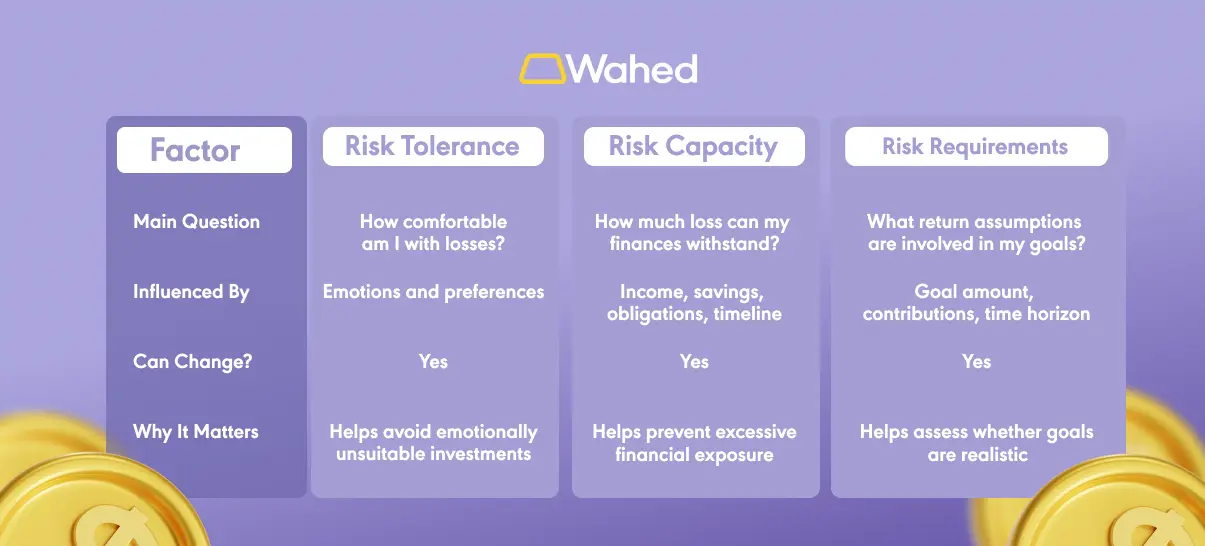
There is no universal risk level. Three separate concepts, risk tolerance, risk capacity, and risk requirements, can help you determine what's appropriate for your circumstances.
Risk Tolerance: How Much Volatility Can You Emotionally Handle?
Risk tolerance reflects your comfort with uncertainty and potential losses. Consider how you've responded to previous market downturns and whether significant fluctuations could lead you to abandon your investment strategy.
Risk Capacity: How Much Financial Risk Can You Afford?
Risk capacity is your financial ability to absorb losses. Income stability, emergency savings, financial obligations, dependents, and how soon you'll need the money can all affect your capacity for risk.
Risk Requirements: How Much Risk Might Your Goals Involve?
Your goals, contributions, and investment timeline can influence the level of investment risk needed to pursue your financial goals. If you're not saving enough for your goals, taking more risk isn't necessarily the answer. You may need to reconsider your contributions, timeline, or expectations instead.
5 Signs You May Be Taking Too Much Investment Risk
Your portfolio may be too risky when potential losses don't align with your financial capacity, goals, or ability to tolerate volatility. These five signs may indicate that your current level of risk deserves another look:
- Your portfolio is concentrated in a few investments: Holding a large share of your wealth in one company, sector, or asset class can magnify the impact of a downturn affecting that investment or part of the market.
- You may need the money soon: Money intended for near-term expenses has less time to recover from a market decline, while illiquid investments may be difficult to sell when you need the funds.
- A significant loss would disrupt your financial obligations: This is a risk capacity issue. If a substantial decline could interfere with essential expenses or other financial commitments, your exposure may be more than your finances can comfortably absorb.
- You don't understand the investments you own: You should understand the underlying assets, fees, liquidity, and potential losses associated with an investment before deciding whether its risks are appropriate for you.
- Your portfolio no longer matches your original risk preferences: Market movements or changes in your income, responsibilities, or financial goals can shift your risk exposure over time.
5 Signs You May Be Taking Too Little Investment Risk
A conservative strategy can be appropriate, but taking too little risk may create challenges if your investments don't support your long-term goals. Watch for these signs:
- Most of your long-term investments are held in cash: Cash can provide liquidity and stability, but over long periods, inflation can reduce its purchasing power and make it harder to build wealth.
- Your financial goals depend on growth your current strategy may not support: If your expected returns don't align with your goals, risk tolerance, contributions, and timeline, it may be worth reassessing your financial plan.
- You're avoiding investments because of short-term market headlines: Making long-term decisions in response to temporary volatility can lead you away from a strategy that otherwise fits your circumstances.
- You have a long investment horizon but haven't reviewed your allocation: A longer timeline may provide more time to experience and potentially recover from market downturns, making your time horizon an important part of assessing risk.
- Your portfolio hasn't changed despite major changes in your financial circumstances: Changes in income, responsibilities, goals, or investment timelines can affect how much risk is appropriate for you.
Conservative vs Moderate vs Aggressive Investing: What's the Difference?
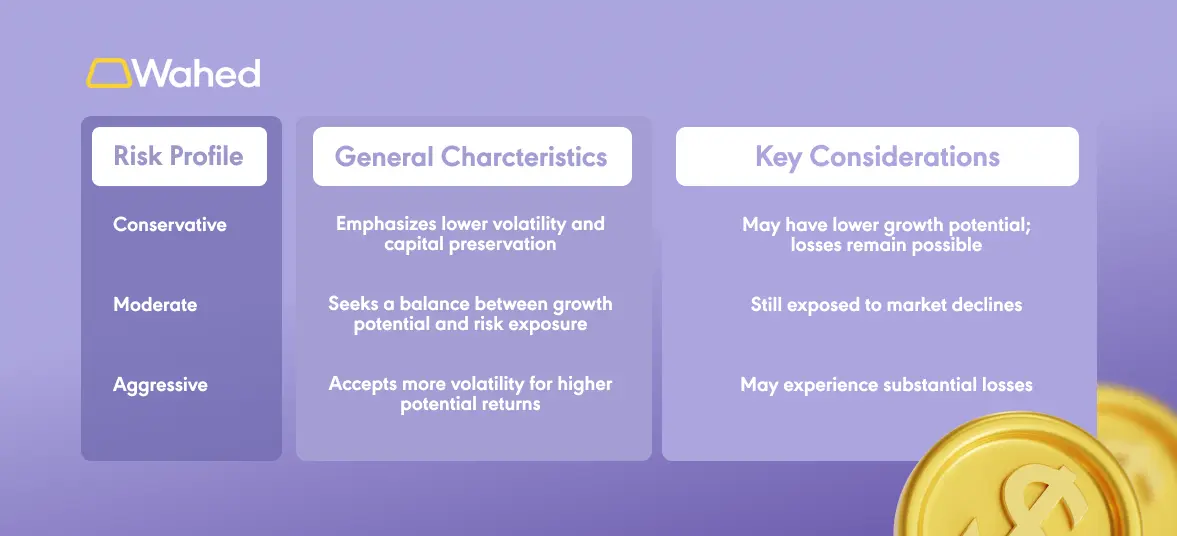
Conservative, moderate, and aggressive are common labels that describe how much volatility a portfolio is designed to accept in pursuit of growth. None guarantees a particular outcome, and the right appropriate approach depends on your individual circumstances.
Does age determine your risk profile? Not by itself. Age can influence your investment horizon, but your financial goals, income, obligations, savings, and risk capacity also matter.
Can two investors of the same age have different risk profiles? Yes. One may have substantial emergency savings and decades before needing invested funds, while another may have greater financial obligations or a shorter investment timeline.
Should your risk profile change over time? It can. Major changes in your goals, finances, responsibilities, or investment timeline may be reasons to reassess whether your current level of risk still fits your circumstances.
How Does Your Investment Timeline Affect Risk?
The more time you have before you need the money, the more room you may have to ride out market declines, though recovery is never guaranteed.
- Short-term goals (emergency savings, upcoming major expenses) generally prioritize liquidity and capital preservation.
- Medium-term goals call for balancing investment risk against expected withdrawal needs.
- Long-term goals give investments more time to experience and potentially recover from downturns, without any guarantee.
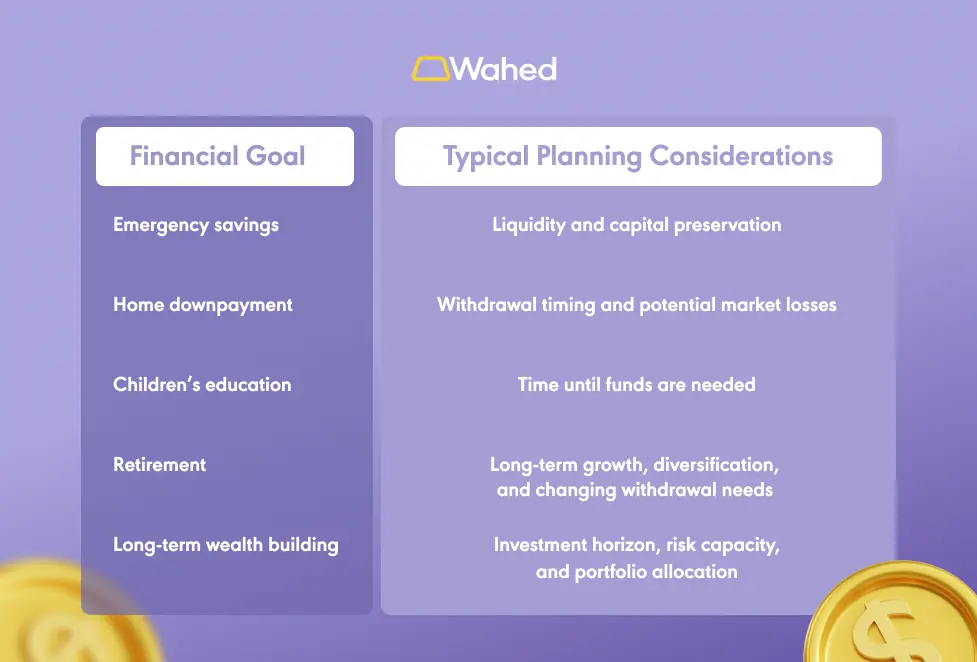
For retirement in particular, periodically reassessing how much you should save for retirement can help you account for changes in your income, savings, timeline, and expected expenses. Wahed's Retirement Calculator can also help you explore how different assumptions may affect your long-term plan.
How Can Diversification Help Manage Investment Risk?
Diversification can reduce your dependence on any single investment or source of risk, although it cannot eliminate the possibility of losses.
Across companies: Holding multiple companies can reduce the impact that problems at a single business have on your overall portfolio.
Across sectors: Investing across eligible industries can help reduce exposure to a downturn concentrated in one part of the economy.
Across asset classes: Different eligible asset classes may respond differently to changing market conditions, helping spread risk across your portfolio.
Across investment accounts: Choosing to use multiple investment accounts, doesn't automatically make you diversified. A 401(k), IRA, and brokerage account could still hold many of the same investments or create similar exposures when viewed together.
For example, owning five technology stocks may look diversified because you hold five companies, but your portfolio could still be heavily exposed to the technology sector. A broader halal portfolio diversification strategy considers how your investments are spread across eligible holdings, sectors, and asset classes.
Does Shariah-Compliant Investing Carry Different Risks?
Yes. Shariah screening can affect which investments are eligible, but a compliant portfolio can still carry meaningful financial risk.
How Does Shariah Screening Affect Investment Selection? Shariah-compliant investing generally considers a company's business activities and financial ratios, while excluding certain prohibited industries. Because company activities and finances can change, compliance may also require ongoing monitoring.
Can Shariah Screening Affect Diversification? Screening criteria can reduce the eligible investment universe and influence exposure to certain sectors, investment factors, or types of companies. This makes diversification an important consideration when constructing a Shariah-compliant investment portfolio.
Are Halal Investments Less Risky? No. Meeting applicable Islamic investment criteria doesn't guarantee lower volatility, positive returns, or protection from losses.
How Can Muslim Investors Evaluate Risk? Consider portfolio diversification, investment objectives, liquidity, costs, underlying holdings, and the Shariah screening methodology being used. For ETFs specifically, understanding what makes an ETF halal can help you evaluate how Shariah screening affects investment selection.
How Can You Assess Your Own Investment Risk?
You don't need to assign yourself a risk score to start evaluating your portfolio. Instead, consider the factors that influence how much investment risk may be appropriate for your circumstances:
- When will you need the money you're investing? Consider whether you'll need it within 1-3 years, 3-10 years, or more than 10 years from now.
- How would a substantial portfolio decline affect your finances? Would it disrupt essential obligations, require changes to your financial plans, or could other resources cover your near-term needs?
- How comfortable are you with investment values fluctuating? Consider whether significant market declines would make you uncomfortable enough to change your strategy.
- How diversified are your current investments? Look at whether your portfolio is concentrated in a few holdings or spread across eligible companies, sectors, and asset classes.
- How recently have you reviewed your financial goals? If your goals, income, responsibilities, or timeline have changed, your current investment strategy may deserve another look.
These questions aren't designed to prescribe an asset allocation. They're a starting point for identifying where your portfolio and financial circumstances may need further review. Wahed's Goals Calculator can also help you review your financial milestones and the time available to work toward them.
What Should You Do If Your Portfolio Doesn't Match Your Risk Preferences?
Realizing that your portfolio may no longer reflect your risk preferences doesn't mean you should immediately buy or sell investments. Any changes should follow a broader review rather than a reaction to short-term market conditions. A year-end portfolio review is a natural time to work through these steps:
- Review your financial goals. Determine whether your objectives, timeline, or financial circumstances have changed.
- Evaluate your overall asset allocation. Look at your holdings across all investment accounts.
- Understand the sources of risk. Identify concentration, volatility, liquidity, and investment-specific risks.
- Consider whether rebalancing is appropriate. Restoring a target allocation can involve benefits and trade-offs.
- Review costs and tax consequences. Portfolio changes may involve transaction expenses or tax implications.
- Seek qualified guidance when necessary. Complex investment decisions may warrant professional support.
Can a Robo Advisor Help Manage Investment Risk?
A robo advisor may help manage investment risk by building and monitoring a portfolio around an investor's goals and financial circumstances. However, managed investing doesn't eliminate the possibility of losses or guarantee suitability or performance, so investors should review current product disclosures. Managed services may incorporate:
- Investor objectives: Financial goals and circumstances may inform portfolio selection.
- Portfolio construction: Investments may be allocated across eligible assets according to a managed strategy.
- Diversification: Spreading investments can help manage concentration risk.
- Monitoring and rebalancing: Portfolio allocations may be reviewed and adjusted over time.
- Shariah-compliant selection: Islamic screening can be integrated into the investment process.
Wahed's Robo Advisor is one example of a managed Shariah-compliant investment solution. Investors deciding between a managed approach and DIY halal investing should consider how much responsibility they want to take for portfolio construction, monitoring, and rebalancing.
Common Investment Risk Mistakes to Avoid
- Assuming higher risk always produces higher returns. Greater risk creates the potential for greater losses, not guaranteed returns.
- Believing conservative investments can't lose value. Lower-risk investments can still decline or expose you to inflation and other risks.
- Confusing Shariah compliance with financial safety. Shariah-compliant investments can still fluctuate and lose value.
- Concentrating too much wealth in one investment. Choosing between a diversified halal portfolio and individual stocks involves different levels of concentration and portfolio-management responsibility.
- Ignoring liquidity needs. Consider when you may need access to invested funds.
- Taking more risk to recover previous losses. Trying to quickly recoup losses can expose your portfolio to even greater losses.
- Changing investments based only on market headlines. Short-term news shouldn't automatically determine a long-term strategy.
- Overlooking risk across multiple accounts. Evaluate your overall portfolio rather than each account separately.
- Assuming diversification eliminates all risk. Diversification can help manage certain risks, but it can't prevent losses.
- Failing to reassess risk after major life changes. Your financial circumstances and investment needs can change over time.
Build an Investment Portfolio That Reflects Your Goals
The goal of investing isn't to take the most risk or avoid it altogether. It's to understand which risks you're exposed to and whether they align with your goals, timeline, and ability to withstand losses. Appropriate diversification, Shariah-compliant selection, and periodic reviews all support that. Understanding your investment risk is an important part of building a long-term financial strategy. Explore Wahed's Shariah-compliant managed portfolios and financial planning tools to evaluate your investment options.
Frequently asked questions
Your portfolio may be too risky if potential losses could disrupt your financial obligations, you need the money soon, your investments are highly concentrated, or significant market fluctuations could cause you to abandon your strategy.
Yes. An overly conservative approach may expose long-term savings to inflation risk or provide insufficient growth to support your financial goals.
Risk tolerance describes how comfortable you are with investment losses and volatility. Risk capacity describes how much financial loss you can actually afford to absorb.
Not necessarily. Younger investors often have longer investment horizons, but age alone doesn't determine an appropriate risk level. Financial goals, income, obligations, savings, and risk capacity also matter.
No. Shariah screening determines whether investments meet applicable Islamic criteria, not whether they are protected from volatility or losses.
Diversification can help reduce concentration risk by spreading investments across eligible holdings, sectors, or asset classes, but it cannot eliminate market risk or guarantee against losses.
Consider reviewing your portfolio periodically and after significant changes to your income, financial obligations, goals, or investment timeline.
Wahed Invest LLC (Wahed) is a U.S. Securities and Exchange Commission (SEC) registered investment advisor. Wahed Invest provides brokerage services to its clients through its brokerage partner Apex Clearing Corporation, a member of NYSE - FINRA - SIPC and regulated by the SEC and the Commodity Futures Trading Commission. Registration does not imply a certain level of skill or training. Wahed does not intend to offer or solicit anyone to buy or sell securities in jurisdictions where Wahed is not registered or a region where an investment practice like this would be contrary to the laws or regulations. Any returns generated in the past do not guarantee future returns. All securities involve some risk and may result in loss. Any performance displayed in the advertisements or graphics on this site are for illustrative performances only.

