
Key takeaways
There is no universally better choice between individual halal stocks and a managed halal portfolio. The right approach depends on your goals, experience, available time, and desired level of control.
Picking individual Shariah-compliant stocks gives you greater control but also makes you responsible for research, diversification, ongoing monitoring, and Shariah screening.
Managed halal portfolios offer a more structured approach to diversification, portfolio management, and Shariah screening with less day-to-day involvement.
Both approaches involve investment risk, and neither diversification nor professional management guarantees better returns or prevents losses.
You can also combine both approaches by using a managed halal portfolio as a diversified core while holding selected individual stocks alongside it.
When building wealth through halal investing, an early decision you’ll encounter is whether to personally select individual stocks or use a professionally managed portfolio. Both approaches work, but offer different levels of time commitment, control, and ongoing management. Individually picking Shariah-compliant stocks offers greater control, but places the responsibility of research, portfolio construction, and Shariah-compliance screening in your hands. Conversely, a managed halal investment portfolio can simplify those responsibilities by providing a more structured approach to diversification and portfolio management.
Deciding which approach makes sense for you means looking beyond convenience alone. This guide compares a halal portfolio vs individual stocks across factors like diversification, Shariah-compliance, cost, risks, and time commitment. The goal is to help you determine which approach better fits financial goals and investing preferences.
Should You Build Your Own Portfolio or Let Someone Else Manage it?
The short answer is that both approaches can be valid. The better fit depends on how much control you want, how much time you can commit, and comfortability with monitoring and researching investments yourself. Investors who enjoy researching companies and making their own investment decisions may prefer building their own portfolio as it offers more control over these aspects. Alternatively, a managed portfolio may be better suited for investors who value convenience, have limited time to manage their investments, or aren't sure which investments to select on their own.
For Muslim investors, the decision also involves Shariah compliance. Building your own portfolio means taking responsibility for determining whether your investments meet Islamic investment principles and continuing to monitor their compliance over time. With a managed halal portfolio, some of that responsibility can instead be incorporated into the portfolio's investment and screening process. Understanding the broader differences between direct investing vs investing through a partner can also help you determine how much control and ongoing responsibility you want to maintain.
What does picking individual halal stocks involve?
Picking individual halal stocks requires a more hands-on approach as you're responsible for both the investment decisions and the Shariah considerations behind each holding. Unlike using a managed portfolio, those responsibilities continue for as long as you own the investments. Conducting halal stock investing on your own generally involves four ongoing responsibilities:
- Researching individual companies: Understanding each company's business model, financial performance, valuation, and potential risks.
- Evaluating Shariah compliance: Reviewing factors such as a company's primary business activities and applicable financial screening criteria to determine whether it meets the Shariah standards you follow.
- Building a portfolio: Selecting and allocating investments in a way that helps manage concentration risk across your holdings.
- Monitoring investments: Tracking company performance and watching for changes that could affect an investment's Shariah compliance.
The common thread here is ongoing involvement. As the number of individual stocks in your portfolio grows, so does the amount of information you may need to keep track of across different companies, industries, and Shariah screening considerations. This makes building a diversified portfolio yourself possible, but also increasingly complex as you add more holdings.
What is a managed halal investment portfolio?
A managed halal investment portfolio is a set of Shariah-compliant investments that is built, monitored, and maintained according to a defined investment strategy. Instead of selecting each holding yourself, you invest in a portfolio structured around an overall approach:
- Asset allocation: Capital is distributed across different types of investments based on the portfolio's objectives and investment stretegy.
- Diversification: Investments can be spread across eligible companies, sectors, or asset types to help manage concentration risk.
- Ongoing monitoring: The portfolio is reviewed over time to help maintain its intended investment strategy.
- Shariah screening and oversight: Investments are selected and monitored according to defined Islamic investment principles.
This is also where a halal robo advisor can be useful. Robo advisors use automated investment management to help build and maintain portfolios without requiring investors to select every holding themselves. Wahed's Robo Advisor, applies this managed approach within a Shariah-compliant investment framework.
Halal portfolio vs individual stocks: Side-by-side comparison
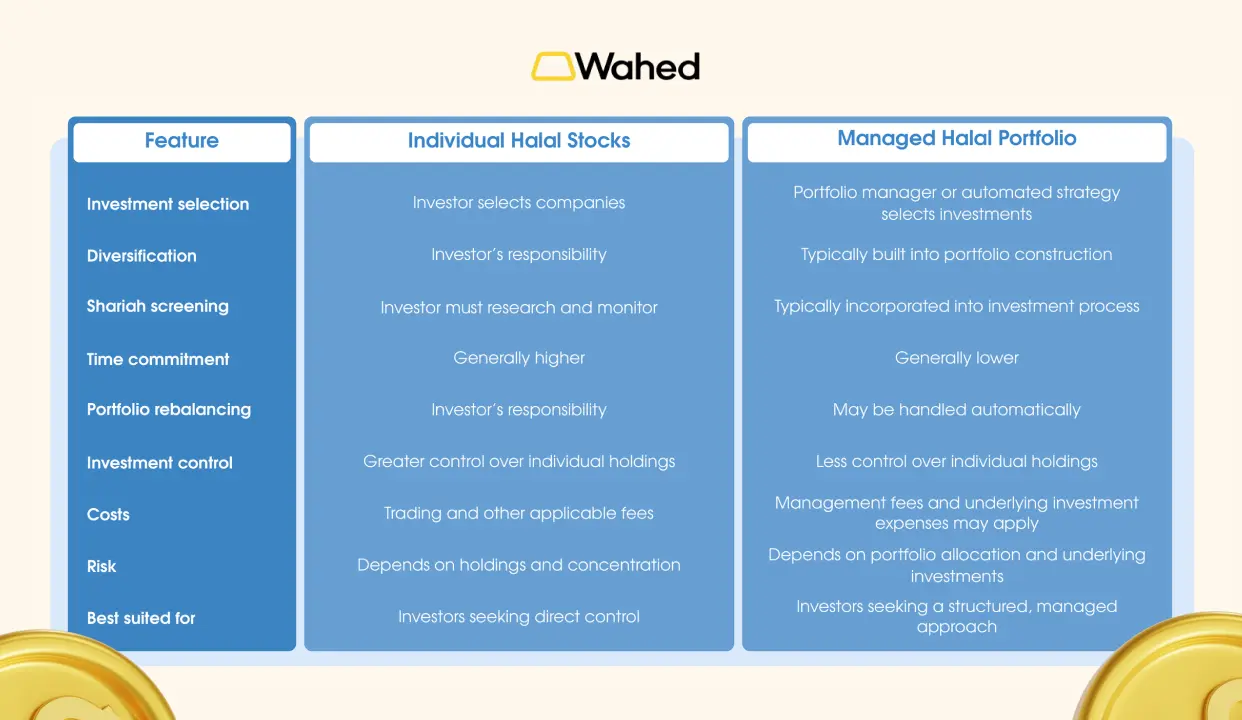
Here’s how the two approaches compare across some of the factors that may influence your decision:
Is Picking Individual Stocks Riskier?
Individual stock portfolios can carry greater concentration and company-specific risk, particularly when only a few companies are held. However, the level of risk ultimately depends on which investments you own and how your portfolio is constructed. Four risks are worth understanding:
- Concentration risk: When an investor holds only a few companies, each one can have an outsized effect on the overall portfolio.
- Market volatility: Individual stocks can experience substantial price swings, sometimes within a short period.
- Company-specific risk: A company's performance or business challenges can affect its stock regardless of what the broader market is doing.
- Emotional decision-making: Market news and short-term price movements can push investors toward reactive decisions, and direct control can make it easier to act on those impulses.
A managed portfolio still carries investment risk and can lose value. The distinction is that diversification and portfolio construction can help distribute risk across a broader set of investments rather than concentrating it in only a few holdings.
Why diversification matters for Muslim investors?
Diversification spreads your investments across companies, industries, and asset types so that your portfolio isn't overly dependent on the performance of a single holding. This can include asset allocation, which distributes capital across different types of investments to help manage concentration risk.
For Muslim investors, diversification can require additional attention because Shariah screening narrows the pool of eligible investments. Excluding certain companies and industries can potentially create unintended concentrations in other areas of a portfolio if it isn't constructed carefully.
Building out your halal portfolio diversification strategy requires considering not only how many investments you own, but how those investments work together. Additionally, because asset allocation can extend beyond the stock market, understanding real estate vs stocks for Muslim investors can help evaluate how different asset types may fit within your broader investment strategy.

When you pick stocks yourself, you take responsibility for screening and monitoring each company. With a managed halal portfolio, that work is typically incorporated into the investment process, although you should still understand the methodology being used. For individual stock investing you may need to evaluate:
- Business activities: whether the company's core business is permissible.
- Financial screening criteria: whether the company meets the applicable financial standards used by your chosen Shariah methodology.
- Non-permissible income: whether revenue is generated from impermissible sources.
- Changes in compliance status: whether developments at the company affect its continued eligibility.
- Purification, where applicable: whether any non-permissible income associated with the investment needs to be purified.
Managed halal portfolios can incorporate defined Shariah screening methodologies, periodic reviews, and ongoing monitoring into the investment process, reducing the amount of compliance research an investor needs to conduct independently.
That said, because a company's operations and financial characteristics change over time, this can potentially affect whether it continues to meet the Shariah-compliant screening standards you follow. However, investors should still understand how their investments are screened and recognize that methodologies can differ. This becomes particularly important when investing through funds. Understanding what makes an ETF halal or whether Muslims can invest in index funds can help you evaluate Shariah compliance beyond individual stocks.
What about investment fees?
When comparing costs, the lowest fee doesn't necessarily mean the best value. A more useful comparison considers both the total cost of investing and how much of the portfolio management you're responsible for handling yourself.
- Individual stocks: Potential costs include trading fees, bid-ask spreads, research tools, and your own time, which isn't a line item on an account statement but can still be a meaningful consideration.
- Managed portfolios: Potential costs include management fees, underlying investment expenses, and other disclosed account or transaction costs.
It’s important to note that neither approach is automatically cheaper or more cost-effective. Whatever method you choose, review the applicable fees and disclosures so you understand what you're paying for and what services are included.
Can picking individual stocks outperform a managed portfolio?
It's possible, but neither approach guarantees better returns, and consistently choosing winning stocks is difficult. Individual stocks have the potential to outperform, and a well-chosen holding can beat a diversified portfolio over some periods. However, the same concentration that creates the potential for greater returns can also increase the impact of underperformance.
It's also important to consider risk-adjusted performance, rather than focusing on returns alone. An investment that generates higher returns while exposing you to substantially more risk isn't necessarily the better strategy. Diversification involves its own trade-off as it may limit the impact of one standout investment while reducing your dependence on the performance of any single company. Ultimately, long-term discipline, diversification, and the amount of risk you're comfortable taking may be more useful considerations than trying to predict which approach will produce the highest return.
Which approach is better for different types of investors?
Neither approach is universally better. The right fit depends largely on your experience, available time, financial goals, and how involved you want to be in managing your investments.
- First-time investors may prefer a structured, diversified approach that requires less ongoing research. Understanding how much money you need to start investing can help you determine a practical starting point. Halal investing for young professionals in the US offers additional guidance for those beginning to build a long-term investment strategy.
- Experienced investors may value direct control over individual company selection.
- Busy professionals may prefer managed portfolios that reduce the time spent researching and monitoring investments.
- Long-term retirement investors may prioritize diversification, consistency, and ongoing portfolio management.
- Investors who enjoy research may prefer picking individual stocks while maintaining appropriate diversification.
Can you combine a halal portfolio with individual stocks?
Yes. You don't necessarily have to choose one approach exclusively. Some investors use a diversified, professionally managed halal portfolio as the foundation of their strategy while holding individual Shariah-compliant stocks alongside it.
This is sometimes called a core-and-satellite approach. It is a strategy that allows the managed portfolio to serve as the diversified “core,” while individual stocks provide greater control over selected investments. There is no universal allocation between the two, and any combination should reflect your goals and risk tolerance.
If you combine both approaches, consider your portfolio as a whole. Individual stocks may overlap with holdings already included in your managed portfolio, potentially creating more exposure to certain companies or sectors than you intended.
Common mistakes Muslim investors should avoid
- Assuming a popular stock is automatically halal. Shariah compliance should be evaluated rather than assumed.
- Holding too few companies. A small number of holdings can create unnecessary concentration risk.
- Ignoring changes in Shariah compliance. A company that qualifies under a screening methodology today may not always continue to qualify.
- Chasing recent performance. Strong past returns don't guarantee that an investment will continue performing well.
- Overlooking fees. Understand the total costs associated with whichever approach you choose.
- Assuming managed portfolios can't lose money. Professional management and diversification don't eliminate investment risk.
- Failing to review diversification. Periodically consider whether your overall portfolio has become overly concentrated in certain companies, sectors, or asset types.
Build a halal investment portfolio that works for you
There's no single right choice between picking individual stocks and using a managed halal portfolio. The better approach depends on your goals, experience, desired level of control, and the time you're willing to commit. Whichever path you choose, the fundamentals of long-term discipline, thoughtful diversification, Shariah-compliant investing, and consistent portfolio management remain the same. For investors who prefer a more structured approach, a managed halal portfolio can simplify investment selection, diversification, and ongoing monitoring without promising better returns.
Frequently asked questions
Neither is universally better. Individual stocks offer more control but require more research and monitoring, while a managed portfolio offers a structured, diversified approach with less involvement.
Yes, as long as the stocks meet Shariah criteria. That means evaluating business activities, applicable financial screening criteria, and non-permissible income, and monitoring compliance over time.
A halal robo advisor is designed to operate within Shariah-compliant guidelines, but methodologies can differ between providers, so it's worth understanding the screening approach and oversight behind any you consider.
No. They're subject to market risk and can lose value. They're designed to offer diversification and structure, not guaranteed performance.
There's no single number for everyone. What matters is how your investments are distributed across different companies and sectors so that your portfolio isn't overly dependent on any single holding.
Yes. Some investors hold a managed portfolio as their core and add a smaller allocation of individual Shariah-compliant stocks, watching for overlap.
A halal ETF is a single fund holding a basket of Shariah-compliant investments. A managed halal portfolio is typically a broader strategy that may combine multiple investments, allocated and monitored according to an overall plan.
Wahed Invest LLC (Wahed) is a U.S. Securities and Exchange Commission (SEC) registered investment advisor. Wahed Invest provides brokerage services to its clients through its brokerage partner Apex Clearing Corporation, a member of NYSE - FINRA - SIPC and regulated by the SEC and the Commodity Futures Trading Commission. Registration does not imply a certain level of skill or training. Wahed does not intend to offer or solicit anyone to buy or sell securities in jurisdictions where Wahed is not registered or a region where an investment practice like this would be contrary to the laws or regulations. Any returns generated in the past do not guarantee future returns. All securities involve some risk and may result in loss. Any performance displayed in the advertisements or graphics on this site are for illustrative performances only. Diversification does not guarantee a profit nor protect against loss.