
Key takeaways
Wahed and DIY halal investing can both support Shariah-conscious investment strategies, but they differ in how much responsibility the investor takes on.
DIY investing offers greater control and flexibility, while requiring you to handle investment research, Shariah screening, diversification, rebalancing, and ongoing portfolio decisions.
Wahed's Robo Advisor provides a more structured, managed approach, allowing investors to delegate more of the day-to-day portfolio management process.
Cost comparisons should consider more than management fees. Fund expenses, brokerage costs, and the services included can all affect the total cost of investing.
Neither approach guarantees better returns or eliminates investment risk. Diversification, asset allocation, market conditions, costs, and investor behavior can all influence results.
The better fit depends on your goals, experience, available time, and desired level of control. Some investors may also choose to combine managed and self-directed investing.
You've decided to invest according to Islamic principles. The next step is determining how involved you want to be in managing your investments. You can open a brokerage account, research Shariah-compliant stocks and ETFs, and build and manage your portfolio yourself. Another option is to use Wahed's Robo Advisor, which provides a managed approach to building and maintaining a Shariah-compliant investment portfolio.
Both approaches offer a way to participate in financial markets, but differ in cost, time commitment, diversification, investment control, and ongoing management. DIY halal investing gives you greater control over individual investment decisions, while Wahed's Robo Advisor provides a more structured approach with less day-to-day portfolio management. This guide compares Robo Advisor by Wahed vs DIY halal investing across those differences to help you determine which approach better fits your goals, experience, and desired level of involvement.
What is DIY Halal Investing?
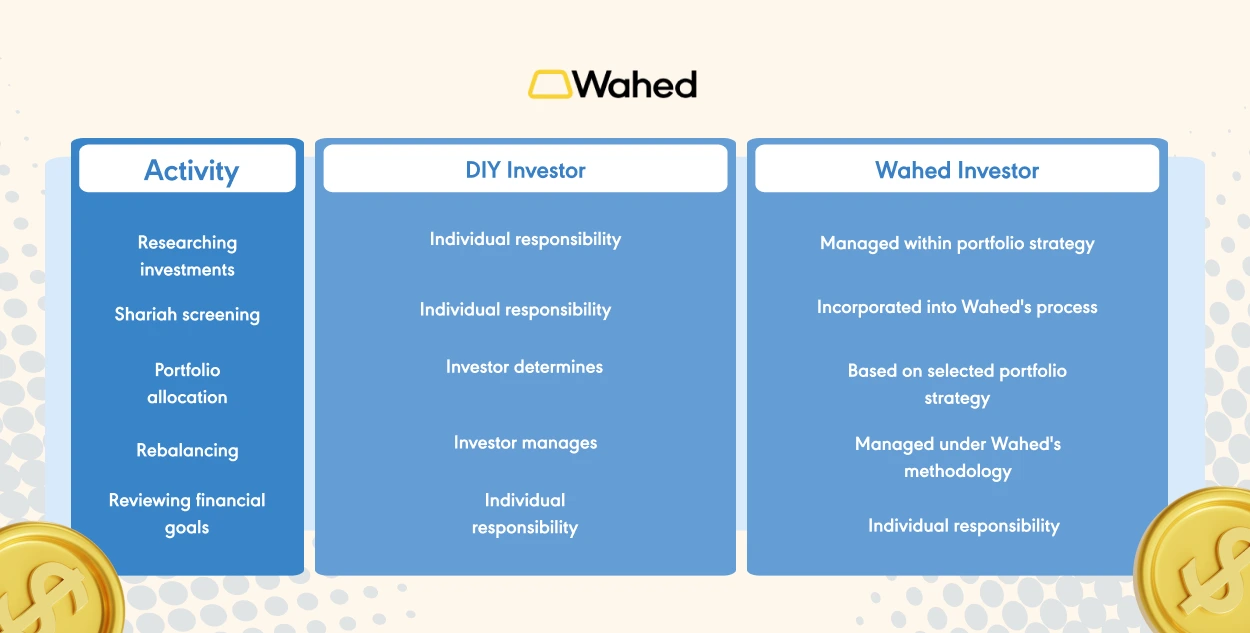
DIY halal investing means opening a brokerage account and building and managing your own Shariah-compliant portfolio. Unlike conventional investing, the investments you choose must also satisfy the Shariah standards you follow. DIY investors typically research Shariah-compliant stocks or ETFs, select investments, determine their asset allocation, monitor performance, rebalance their portfolios, and continue reviewing whether their holdings remain compliant.
What Are the Advantages of DIY Investing?
- Greater control over individual investments
- The ability to choose the companies or ETFs you prefer
- Flexibility to customize your portfolio allocation
- Potentially lower direct management fees
- Opportunities to build your investment knowledge
What Are the Challenges?
- Time-consuming research when selecting and monitoring investments
- Ongoing Shariah screening to ensure holdings continue meeting the standards you follow
- Portfolio concentration if investments aren't sufficiently diversified
- Rebalancing responsibilities as portfolio allocations change over time
- Behavioral mistakes, such as reacting to short-term market movements
- Difficulty staying consistent with an investment strategy over many years
None of this means DIY investors can't build well-diversified, Shariah-compliant portfolios. Many can. The distinction is that the research, portfolio decisions, and ongoing management remain your responsibility. If you're preparing to build your first portfolio, determining how much money you need to start investing can help you plan your next steps.
What is Wahed’s Robo Advisor?
Wahed's Robo Advisor, offers a managed approach to halal investing for those who would rather not select and manage every investment themselves. Instead of building a portfolio independently, investors use a structured investment process designed around factors such as their financial goals, time horizon, and risk tolerance. The broader purpose of a robo advisor is to simplify some of the responsibilities that come with managing a portfolio yourself. These can include:
- Portfolio construction: Building a portfolio around a defined investment strategy and asset allocation.
- Diversification: Spreading investments across eligible holdings to help manage concentration risk.
- Shariah-conscious investing: Incorporating Islamic investment principles into investment selection and portfolio management.
- Ongoing management: Monitoring the portfolio over time rather than requiring the investor to manage every investment decision independently.

How We Build and Manage Your Portfolio
Investor Assessment
Every Wahed client completes a risk assessment when they open an account. The questionnaire looks at your goals, time horizon, and comfort with market ups and downs. Based on your answers, we recommend the portfolio that best fits your profile.
Portfolio Options
Wahed offers three ways to invest:
- Investment Portfolios. These are six professionally constructed portfolios, each built for a different level of your investment objective and risk tolerance:
- Very Conservative
- Moderately Conservative
- Moderate
- Moderately Aggressive
- Aggressive
- Very Aggressive
- Custom Portfolios. Clients who want more control can build their own portfolio and choose how much to put in each fund available on our platform.
- Thematic Portfolio. Our Gold Portfolio is invested entirely in gold asset class, for clients who want dedicated exposure to this asset.
We also offer the Everyday Shariah Account, a Shariah-compliant investment alternative to a conventional high-yield savings account.
Available Asset Classes
Our portfolios are viewable on our investing page.
Shariah Screening and Oversight
Every investment on our platform goes through several layers of Shariah review:
- Screened indexes. The funds we use follow Shariah-screened indexes.
- Business activity screening. Companies involved in activities that conflict with Shariah principles are excluded. These include interest-based financial services (riba), weapons, gambling, alcohol, and adult entertainment.
- Financial ratio screening. Companies must also meet set Shariah financial ratio thresholds to be considered compliant.
- Internal Shariah Review Board. Wahed has its own Shariah board that oversees our products.
- External consultation. We also consult with outside Shariah bodies in Islamic finance.
Ongoing Portfolio Management
We rebalance portfolios quarterly. This brings each portfolio back to its target allocation so it stays in line with the risk level you chose.
The key distinction from DIY investing is responsibility. A managed approach shifts more of the day-to-day portfolio management away from the investor, trading some direct control for greater convenience and a more structured investment process.
Wahed Robo Advisor vs DIY Halal Investing: Side-by-Side Comparison
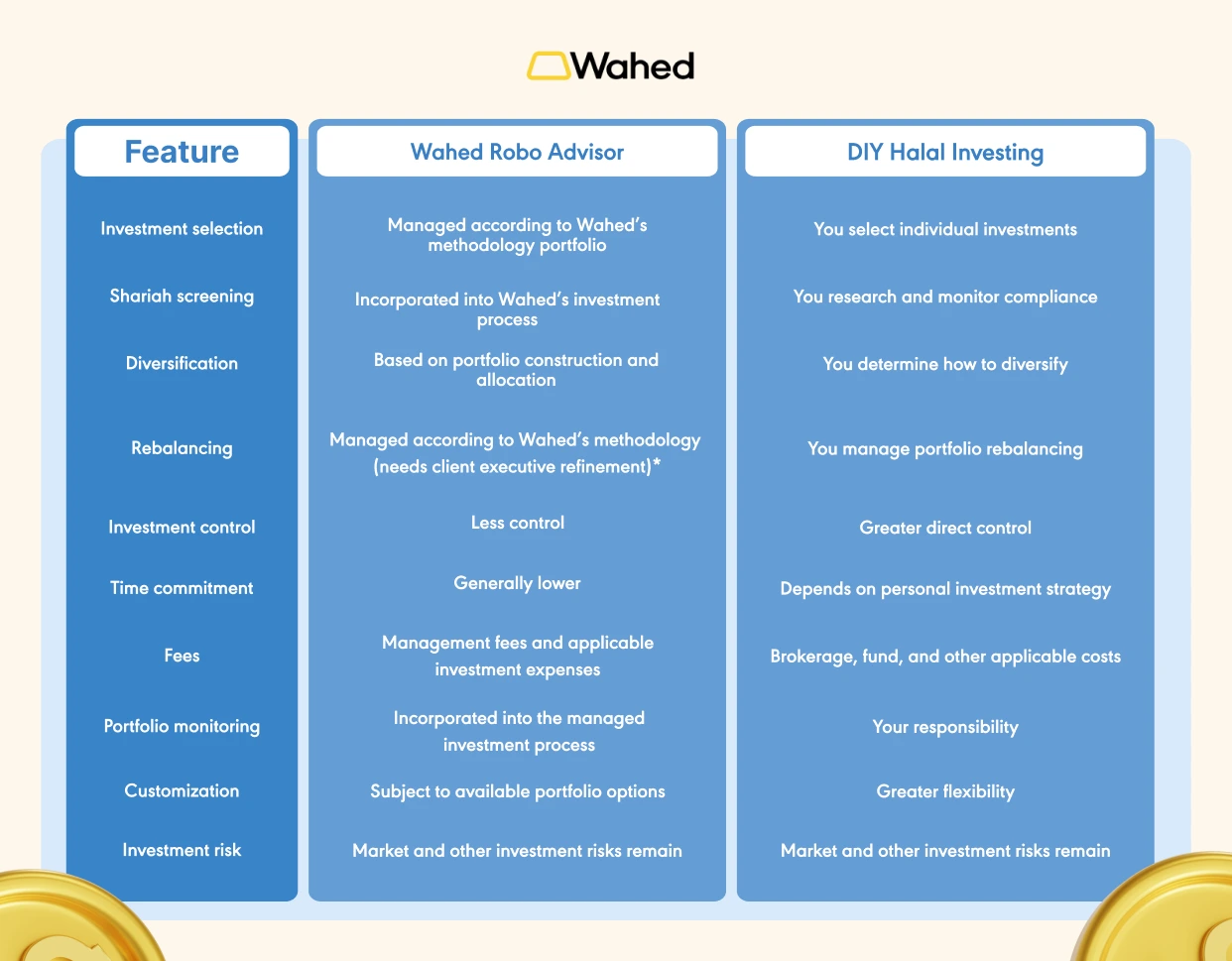
Here’s how the two approaches compare across some of the factors that may influence your decision:
Investment Selection
Every Wahed client starts with a risk assessment questionnaire. It covers your investment goals, time horizon, liquidity needs and comfort with market swings. Based on your answers, we recommend the portfolio that best fits your profile. Our portfolios are built using financial algorithms based on Modern Portfolio Theory. The goal is the highest potential return for your level of risk. Every investment on the platform is screened for Shariah compliance before it can be included.
Diversification
Clients are invested in diversified portfolios built from Shariah-screened funds across several asset classes:
Details around these asset classes can be found on our investing page.
Portfolio Options and Customization
- Investment Portfolios: six professionally managed portfolios matched to different risk levels:
- Very Conservative
- Moderately Conservative
- Moderate
- Moderately Aggressive
- Aggressive
- Very Aggressive
- Custom Portfolios: clients can build their own portfolio and choose how much to put in each fund on the platform.
- Thematic Portfolio: our Gold Portfolio is invested entirely in gold asset class.
- Everyday Shariah Account: a Shariah-compliant investment account designed for short-term goals.
Clients can retake the risk assessment or change their portfolio at any time in the Wahed app.
Rebalancing
Portfolios are rebalanced quarterly to bring them back to their target allocations. Rebalancing may also happen when your risk profile changes, when you add or withdraw funds, or when market conditions shift significantly. Rebalancing comes at no additional cost.
Portfolio Monitoring
Wahed monitors client portfolios on an ongoing basis. Clients can track performance daily in the Wahed app, see their current holdings, and download monthly statements summarizing holdings and performance.
Applicable Costs
Wahed charges one simple annual wrap fee. It is based on your combined assets across all Wahed portfolios:
We never double-dip. The 0.49% fee applies only to the part of your portfolio invested in non-Wahed funds. The part invested in Wahed’s own funds is not charged the wrap fee.
The wrap fee covers management, custody and transaction costs, and is billed monthly. Each underlying fund also has its own expense ratio, which is built into the fund’s price. There are no fees for ACH deposits or withdrawals, and no fee on a $0 balance. Your bank may charge its own transfer fees.
All investing involves risk, including possible loss of principal. Past performance does not guarantee future results. For full fee details, please refer to Wahed’s Form ADV Part 2A Wrap Fee Brochure.
Example: A client has $50,000 across their Wahed portfolios, with $20,000 of it in non-Wahed funds.
- Wrap fee: $20,000 × 0.49% = $98
- Fixed fee: $60
- Total: $158 per year (about $13 per month)
Account and Transfer Costs
- No fees for ACH deposits or withdrawals
- No fee on accounts with a $0 balance
- No account-opening fees for IRAs
- Your bank may charge its own wire or transfer fees
- Other custodian fees, such as for wires or IRA-related services, may apply
Fees are subject to change. For complete fee details, see Wahed’s Form ADV Part 2A Wrap Fee Brochure and each fund’s prospectus. All investing involves risk, including possible loss of principal.
Is Wahed More Expensive Than DIY Investing?
Understanding DIY Investing Costs
DIY investors don't pay a robo advisor management fee, but other costs may still apply, including:
- ETF expense ratios
- Brokerage or transaction fees, where applicable
- Bid-ask spreads
- Research tools or services
- Other investment-related costs
Comparing Total Investment Costs
Consider a hypothetical investment service charging a 0.50% annual management fee. On a $10,000 balance, that would equal $50 per year before any additional investment expenses or other applicable costs.
This example is for illustrative purposes only and does not represent Wahed's actual fee.
The lowest fee isn't automatically the best value. When comparing Wahed investment fees with DIY investing costs, consider both the total amount you're paying and the services included, such as portfolio construction, ongoing management, and Shariah screening.
How Does Shariah Screening Compare
Shariah Screening for DIY Investors
DIY investors are responsible for researching and monitoring Shariah compliance themselves. This can involve evaluating:
- Business activities: Whether a company's core business is permissible
- Financial ratios: Such as debt levels and other financial metrics used in Shariah screening
- Non-permissible income: Revenue from impermissible sources
- Changes in financial statements: A company's financial ratios can change between reporting periods
- Ongoing compliance: An investment that qualifies today may not qualify later
- Purification considerations: Whether any non-permissible income associated with an investment requires purification
These criteria also distinguish Shariah screening from other values-based approaches. While there can be some overlap between halal investing and ESG investing, the two approaches use different standards when evaluating investments.
Shariah Screening With Wahed
With Wahed, Shariah screening is incorporated into the managed investment process rather than handled independently by the investor.
Shariah Compliance at Wahed
Shariah compliance is the foundation of everything we offer. Every investment on the Wahed platform goes through several layers of screening and oversight before it can be included in a client portfolio. It continues to be monitored after that.
Shariah Screening Methodology
Our funds follow Shariah-screened indexes, and every company goes through two screens.
1. Business Activity Screening. We exclude companies whose core business involves activities that are impermissible under Shariah, including:
- Interest-based financial services (riba), such as conventional banking and insurance
- Alcohol and tobacco
- Gambling
- Weapons and defense
- Adult entertainment
- Pork-related products
- Any other activity our Shariah board has not approved
2. Financial Ratio Screening. A company with a permissible core business must also meet financial thresholds to make sure it doesn’t rely too heavily on interest. These ratios cover:
- Interest-bearing debt
- Cash and interest-bearing investments
- Income from non-compliant sources
Companies that exceed these limits are excluded.
Investment Eligibility Criteria
An investment is eligible for Wahed portfolios only if:
- Its underlying holdings pass both the business-activity and financial-ratio screens.
- The fund’s methodology has been reviewed and approved by our Shariah Supervisory Board.
- It holds no conventional fixed income or other interest-bearing instruments. Our income-focused holdings use Shariah-compliant structures instead, such as sukuk.
Shariah Oversight
Wahed’s compliance is overseen at several levels:
- Index-level screening: each fund’s index is screened by Shariah scholars and specialists.
- Wahed Shariah Supervisory Board: our board reviews and approves our screening standards, funds and products.
- External consultation: we also consult with outside Shariah bodies in Islamic finance.
Ongoing Review
Compliance is checked continuously, not once:
- Fund indexes are re-screened on a regular schedule. Companies that no longer meet the criteria are removed.
- Our Shariah board conducts periodic reviews and audits of our products and holdings.
- New products and funds must be approved by the board before they reach clients.
Purification
Screened companies can still earn a small amount of incidental non-compliant income, such as interest on cash balances. Purification removes that portion by giving it to charity.
- Wahed’s own funds: Wahed calculates and publishes purification amounts for its funds.
- Annual reporting: clients receive annual purification reporting showing the amount that should be given to charity.
- Third-party funds: other funds in our portfolios may purify at the fund level, according to each manager’s process.
Wahed also offers a built-in Zakat calculator to help clients meet their zakat obligations.
Does Using a Halal ETF Eliminate the Need for Research?
No. A halal ETF can simplify the process of selecting individually screened investments, but you should still be aware of what you're investing in. Shariah-screened ETFs can differ in their screening methodology, portfolio composition, fees, geographic exposure, sector concentration, and purification practices. What makes an ETF halal, can therefore vary depending on the screening standards and methodology being applied.
What Approach Offers Better Diversification?
Neither approach automatically offers better diversification. What matters is how effectively a portfolio spreads risk across different investments rather than whether it is DIY or professionally managed.
DIY Portfolio Diversification
DIY investors can diversify across multiple companies, industries, geographic markets, ETFs, and other eligible asset classes. Passive investments such as index funds can also make broad diversification easier to achieve, though whether Muslims can invest in index funds depends on the underlying investments and Shariah screening methodology.
Diversification in a Managed Portfolio
Managed portfolios typically incorporate diversification into their portfolio construction and asset allocation process rather than requiring the investor to assemble and maintain it independently.
Portfolio Allocation and Diversification
Our Approach
Wahed builds portfolios using Modern Portfolio Theory. We combine investments that behave differently from one another, aiming for the highest potential return at each level of risk. A client’s risk assessment decides which of our six recommended portfolios fits their goals, time horizon and comfort with market swings.
Allocations are approximate and may change. Current allocations are shown on our investing page.
Keeping Portfolios on Target
Market movements cause portfolios to drift from their targets over time. Wahed rebalances quarterly, and also when your risk profile changes, when you add or withdraw funds, or when market conditions shift significantly. This keeps your portfolio in line with the risk level you chose.
Custom and Thematic Options
Clients who want more control can build a Custom Portfolio, choosing their own mix of the funds above. Clients who want dedicated gold exposure can choose our Gold Portfolio, which is invested entirely in gold.
Diversification does not guarantee a profit or protect against loss.
Why Diversification Doesn't Eliminate Risk
Diversification can help reduce concentration risk, but it cannot prevent investment losses or guarantee returns. Market downturns can affect multiple investments or asset classes at the same time, and your asset allocation can influence how much your portfolio fluctuates. Building a halal portfolio diversification strategy therefore involves more than simply owning a large number of investments. It requires considering how those investments work together within your broader portfolio.
How Much Time Does DIY Halal Investing Require?
There is no fixed time commitment for DIY halal investing. The amount of work depends on your strategy and portfolio, but managing investments yourself generally requires more ongoing involvement than using a managed approach. DIY investors may need to research companies and funds, review Shariah compliance, monitor portfolio allocations, evaluate costs, rebalance holdings, and maintain discipline during periods of market volatility. A simpler strategy may require less attention, while actively selecting and monitoring individual investments can require considerably more.
Can DIY Investing Deliver Better Returns than Wahed?
It can, but it can also deliver worse returns. Neither approach guarantees better results. Individual stocks can outperform diversified portfolios, but they can also significantly underperform. Returns depend on factors such as asset allocation, individual holdings, costs, and market conditions. Managed portfolios aren't guaranteed to outperform self-directed investments, and comparing the two requires considering risk and time horizon, not just returns. Rather than asking which approach will produce the highest returns, a more useful question is which one you can manage consistently over time.
Wahed vs DIY Investing: Which is Better for Different Investors?
The right choice depends on your experience, available time, financial goals, and preferences. The considerations below should serve as a general framework and not be interpreted as personalized investment recommendations.
Beginner investors: Wahed may appeal to investors seeking a structured starting point. Halal investing for young professionals often starts with establishing clear financial goals and building a long-term strategy early in your career.
Busy professionals: Managed investing may appeal to those who prefer delegating routine portfolio decisions.
Experienced investors: DIY investing may appeal to people comfortable researching investments and managing their own allocations.
Long-term retirement investors: Both approaches may be appropriate depending on your goals, time horizon, fees, and risk tolerance.
Investors who want maximum control: DIY investing generally provides more control over individual holdings and portfolio decisions.
Investors who prioritize convenience: Wahed may appeal to those who prefer managed portfolio construction and ongoing investment oversight.
Can You Use Wahed and DIY Investing Together?
Yes. Some investors combine a managed core portfolio with a smaller set of self-directed holdings. In a core-and-satellite investment strategy, a diversified managed portfolio can support long-term objectives and structured asset allocation, while individually selected halal stocks allow investors to pursue specific interests or conduct their own research.
If you combine the two, consider portfolio overlap, concentration risk, total investment costs, and whether your overall asset allocation remains consistent with your financial goals. There is no universal percentage that should be allocated to either approach, and the tradeoffs between a halal portfolio vs picking individual stocks should factor into how you structure the two.
Common Mistakes When Comparing Wahed and DIY Investing
- Comparing management fees alone: Consider total investment costs and the services included rather than focusing on a single fee.
- Assuming DIY investing produces better returns: Greater control doesn't guarantee stronger performance.
- Believing managed investing eliminates risk: Managed and diversified portfolios can still lose value.
- Ignoring ongoing Shariah screening: Compliance can change over time as a company's finances or business activities evolve.
- Choosing based on recent performance: Short-term returns may not reflect how an investment strategy will perform over your time horizon.
- Overlooking diversification: Owning several investments doesn't necessarily mean your portfolio is well diversified.
- Underestimating the time commitment: DIY investing requires ongoing research, monitoring, and portfolio decisions.
- Assuming all halal investments use the same standards: Shariah screening methodologies and investment criteria can differ between products.
Simplify Your Halal Investment Journey with Wahed
Investing according to Islamic principles requires long-term discipline, thoughtful diversification, and consistent portfolio management. Whether you oversee your investments yourself or prefer a managed approach, the better choice is one that fits your goals, experience, available time, and desired level of involvement while supporting a strategy you can maintain over the long term.
Frequently asked questions
Neither approach is universally better. Wahed offers managed investing, while DIY investing provides greater direct control. The better fit depends on factors such as costs, experience, available time, and investment preferences.
That depends on how you value the services provided relative to their total cost. Consider portfolio management, Shariah screening, investment expenses, and the responsibilities you would otherwise handle yourself.
Yes. Investors can independently purchase ETFs that meet their chosen Shariah screening standards, subject to brokerage availability. However, screening methodologies, holdings, costs, and diversification can differ between funds.
No. Investing involves risk, including the potential loss of principal, and neither managed nor DIY investing guarantees returns.
Yes. Investors may hold self-directed investments alongside a managed account, but should consider their overall asset allocation, diversification, and potential portfolio overlap.
Yes. Wahed monitors client portfolios and rebalances them automatically, at no additional cost. You don’t need to do anything.
When rebalancing happens
- Quarterly: portfolios are rebalanced each quarter to bring them back to their target allocations.
- When your risk profile changes: if you retake the risk assessment or switch portfolios, your holdings are adjusted to the new allocation.
- When you add or withdraw money: deposits and withdrawals are used to move your portfolio back toward its targets.
- During significant market moves: Wahed may also rebalance when market volatility changes significantly.
Conditions and limitations
- Portfolios drift between rebalances. Market movements can pull your allocation away from its targets until the next rebalance.
- Changes aren’t instant. When you change your portfolio, positions are typically adjusted within 1–3 business days for funded accounts.
- Possible tax impact. In taxable (non-retirement) accounts, rebalancing can mean selling investments that have gained value, which may create capital gains. Rebalancing inside IRAs and Roth IRAs does not create a current tax bill. Wahed does not provide tax advice, so please consult a tax professional.
- No guarantee. Rebalancing helps keep your portfolio aligned with your chosen risk level, but it does not guarantee returns or protect against loss.
It can have lower direct management fees, but that doesn't necessarily mean lower total costs. The overall cost depends on the investments, funds, brokerage services, and other tools or services used.
Wahed Invest LLC (Wahed) is a U.S. Securities and Exchange Commission (SEC) registered investment advisor. Wahed Invest provides brokerage services to its clients through its brokerage partner Apex Clearing Corporation, a member of NYSE - FINRA - SIPC and regulated by the SEC and the Commodity Futures Trading Commission. Registration does not imply a certain level of skill or training. Wahed does not intend to offer or solicit anyone to buy or sell securities in jurisdictions where Wahed is not registered or a region where an investment practice like this would be contrary to the laws or regulations. Any returns generated in the past do not guarantee future returns. All securities involve some risk and may result in loss. Any performance displayed in the advertisements or graphics on this site are for illustrative performances only.